$HSLV.TO - Highlander Silver
There it is!
(“Highlander Silver” or the “Company”) is pleased to announce that it has executed a mandate letter with Natixis Corporate & Investment Banking (“Natixis CIB”) to lead a fully underwritten 7-year senior secured structured project finance facility of $330 million (the “Facility”) to fund the development and construction of the Corani Silver Project in Peru. The financing will be supported by a cost overrun facility of up to $100 million to be established prior to first draw and provided by the Company; final facility amounts will be subject to due diligence. As of June 30, the Company reported a cash balance of approximately $100 million and no debt.
I will buy HSLV, but not yet. You will want exposure to this company years ahead. The Corani project is a project not to ignore.
Ping @realTimHack bring up your toiletpaper and your right hand
Friday Recap
Current (Last Week) -- (% from ATH | ATH)
AU: $4,380 ($4,344) -- 22% from ATH ($5,608)
AG: $66 ($64) -- 45% from ATH ($121)
HUI: 802 (813) -- 18% from ATH (986)
DXY: 99 (99)
S&P 500: 7,643 (7,656) -- 2.2% from ATH (7816)
10-Year: 5.0% (4.9%)
This was Fed week. The Fed raised rates by 25 bps with a unanimous vote. The stock market had priced it in and was flat for the week. Gold and silver are not supposed to like rate hikes, but they both rose. The miners (HUI) didn’t like the hike and were down a smidge to 802. The 10-year bond remains elevated at 5%, putting pressure on the stock market. The battle to watch is between the ATH on the S&P 500 at 7800 and the 100 DMA at 7500. If we get below 7500, it gets interesting.
Warsh said the economy was strong, which was clearly Bravo Sierra. Yes, pockets of the economy are strong, such as technology, data center construction, and related AI-impacted industries. But if you remove the AI-impact, the economy is limping along. The low and middle portion of consumer spending is clearly weak. Without a K-shaped economy, whereby the top 20% are spending aggressively, the economy would be a train wreck. Wage growth is flat. Replacing a professional job is difficult. Private credit is wobbling. The NFP (non-farm payroll) reports for the past year are anemic. Housing is dead and getting worse. The low quits rate implies weakness in the employment market. And did I mention high gasoline and diesel prices?
Many analysts are saying that Warsh cares more about inflation than the economy, and is willing to let the economy weaken. That is highly unlikely, which we will soon learn. My contention is that the Fed doesn’t really care about inflation, at least not as a top priority. Yes, they raised rates this week, but that was because they had no choice with the 90% expectation. Markets would have freaked out if they didn’t raise, and the one thing the Fed cannot lose is credibility. The Fed’s top priority is to prevent a financial meltdown, and if that means inflation runs hot, then so be it.
The Fed will wait for a stock market sell-off, and then they will begin QE and economic stimulus. From that point forward, inflation will take a back seat until it breaks the bond market. The path forward is easy to see for those who are paying attention. The Fed can’t stop the coming recession, and once the recession begins, they won’t be able to fix it. I like to call this the Humpty-Dumpty crash, because there will be no putting it back together again. It could be weeks, or perhaps months, before it begins. But it shall begin. Got Gold?
I still expect to see $4200 gold before $5000, and silver will fall more than gold. We don’t know the next cycle bottom for gold, but the probabilities are high for sub $4200, low for sub $4000, and extremely low for sub $3800. Once we get to sub $4200, it will be a good time to buy gold/silver miners to the bottom. I expect this before the end of November, but it could slip to 2027. The longer it takes, the more gold/silver mining shares we get to accumulate.
Western Star Resources has defined two tungsten-in-soil anomalies at its Rowland Tungsten Property in Nevada, including a high of 4,240 ppm tungsten (0.53% tungsten trioxide) on previously untested ground.
Continue reading: https://t.co/mU2n0Uo2Oz
$WSR #WSRIF
Wanna be ahead of the crowd? Don Durrett & John Feneck just dropped a monster interview with Stillwater Critical Minerals (uploaded on YouTube 58 min ago)..
This will lead to capital inflow.
And rising metals will lead to rising shareprice.
And Beaver Creek next week will lead to capital inflow.
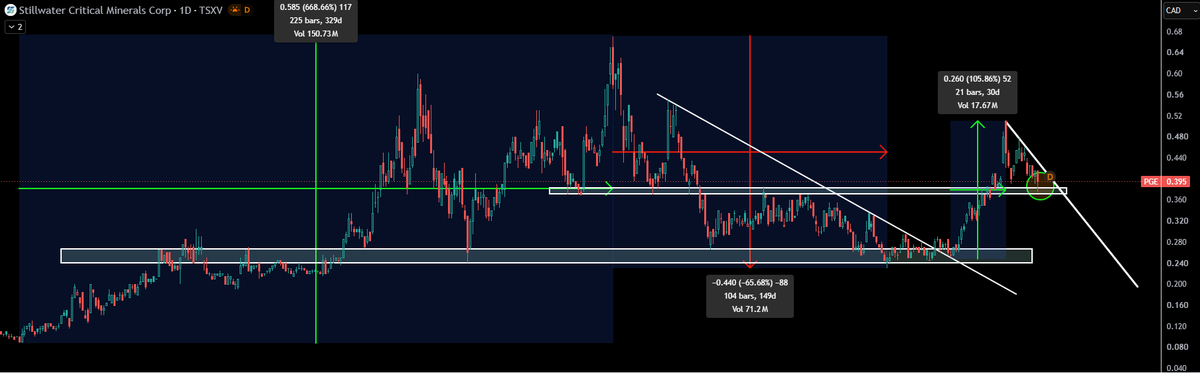
PGE will be poppy near term I guess.
$PGE.v - Stillwater Critical Minerals
Former support, that turned resistance is now again support.
Buyers stepped in hard around the close yesterday to show us that.
Stillwater Critical Minerals heads to Beaver Creek next week after basically tripling its inferred resource and establishing a maiden indicated resource. Perfect timing to market the newly massive MRE directly to institutional investors, senior miners and potential strategic partners.
You better want a seat leading into that combined with metals starting a new leg up. I bought the dip yday and the position is now full for another upleg.
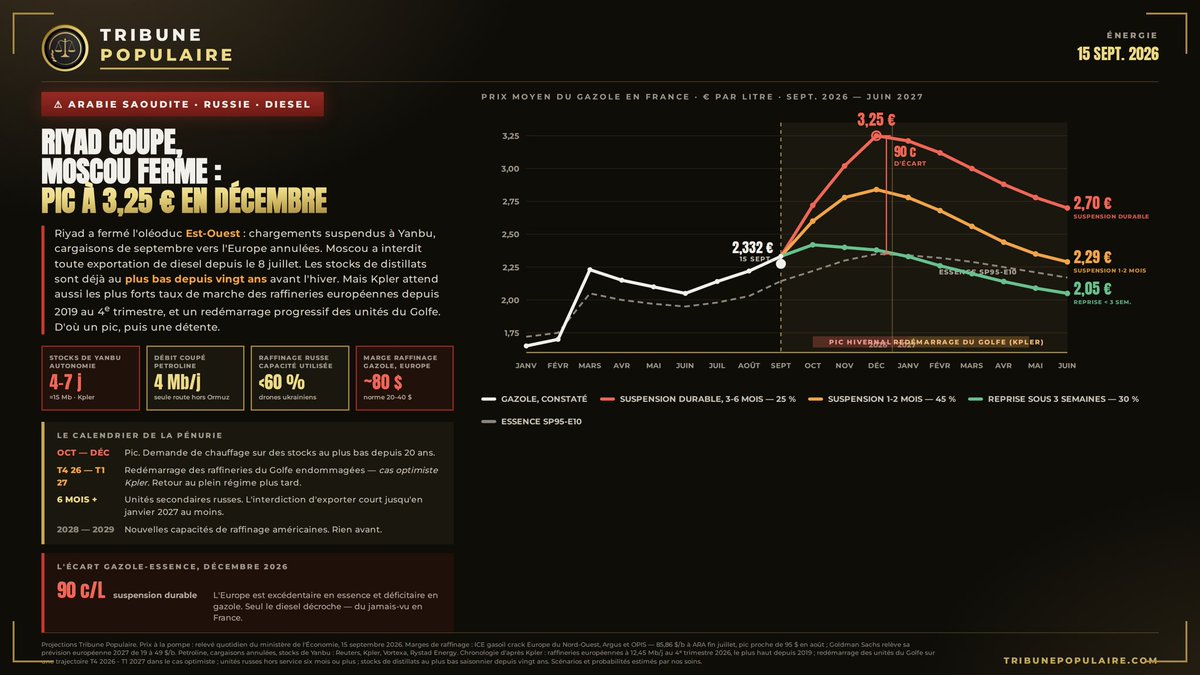
⛽🇫🇷ANALYSE — D’après mes projections à travers 3 hypothèses (détail plus bas), le gazole pourrait atteindre 3,25 € le litre dès décembre !
L’Arabie saoudite a fermé vendredi l’oléoduc Est-Ouest après des frappes de drones. Les chargements à Yanbu sont suspendus, plusieurs cargaisons de septembre vers l’Europe sont annulées.
Le tube acheminait 4 millions de barils par jour : c’est la seule route qui contourne le détroit d’Ormuz. Les stocks du port tiennent 4 à 7 jours.
Au même moment, Moscou a interdit toute exportation de diesel depuis le 8 juillet, et jusqu’en janvier 2027 au moins. Le raffinage russe tourne sous 60 % de sa capacité sous les drones ukrainiens.
Les deux premiers fournisseurs de gazole de l’Europe sont à terre en même temps.
Les réserves stratégiques de l’AIE contiennent du pétrole brut, pas du gazole. L’Europe a fermé une trentaine de raffineries entre 2009 et 2024. Les unités secondaires russes ont besoin de six mois ou plus. Les nouvelles capacités américaines n’arrivent pas avant 2028.
Aujourd’hui, le gazole est à 2,332 € le litre et l’essence à 2,143 €. Tout dépend de la durée de la coupure saoudienne.
Reprise sous 3 semaines — 30 % → pic à 2,42 € en octobre, puis 2,05 € en juin.
Suspension 1 à 2 mois — 45 % → pic à 2,84 € en décembre, puis 2,29 €.
Suspension durable, 3 à 6 mois — 25 % → pic à 3,25 € en décembre. Il faut attendre l’été 2027 pour repasser sous 2,75 €.
Pourquoi décembre ? La demande de chauffage culmine sur des stocks de distillats déjà au plus bas depuis vingt ans, et avant que les raffineries du Golfe endommagées ne redémarrent, Kpler les situe entre le quatrième trimestre 2026 et le premier trimestre 2027, dans son scénario optimiste.
Méthode 👇
Personne ne publie de probabilités sur cette coupure. Je les ai donc estimées moi-même, comme une météo.
45 % pour la suspension d’un à deux mois. C’est l’hypothèse la plus probable parce que trois analystes différents — Rystad, Kpler et les sources de Reuters — arrivent tous à peu près au même résultat.
30 % pour une reprise rapide. En 2019, le même oléoduc avait déjà été attaqué et réparé vite. Mais cette fois les dégâts sont plus importants.
25 % pour une coupure longue.
Ensuite, j’ai ajusté la forme des courbes, pas les niveaux. Kpler annonce des raffineries européennes qui tourneront à plein cet hiver, et celles du Golfe qui redémarreront début 2027. C’est pour ça que le prix monte jusqu’en décembre, puis redescend au lieu de rester bloqué en haut.
Ces chiffres sont un jugement, ils servent à classer les scénarios, pas à prédire l’avenir.
I believe the precious metals #bullmarket, especially the rise in #Gold, will continue deep into the 2030s.
We have a large window to make an extraordinary amount of money.
This will not happen in a straight line. There will be violent corrections, false breakdowns and periods when people declare the bull market dead. A secular bull market is defined by increasingly higher cycle highs and lows, not by the absence of major drawdowns.
WHY:
THE FISCAL MATHEMATICS ARE BROKEN
The United States is running enormous deficits despite not being in a major recession.
#US public debt is already around 101% of GDP and is projected to reach approximately 120% by 2036. Interest costs are compounding and consuming an increasingly large share of government revenue.
#Europe, #Japan, #China and many emerging economies also face ageing populations, growing entitlement costs, military spending and heavy debt burdens.
Debt does not guarantee immediate money printing, but it gradually removes every politically acceptable alternative.
Eventually governments must choose between austerity, higher taxes, restructuring, inflation or financial repression.
History suggests they will choose currency debasement, negative real rates and periodic central-bank intervention.
#GOLD IS BEING REMONETISED
Central banks have accumulated approximately 1,000 tonnes of gold annually during the past four years, twice the average of the previous decade.
In the latest survey:
89% of central banks expect global gold reserves to increase.
45% expect to increase their own holdings.
74% expect the dollar’s share of global reserves to decline during the next five years.
Gold has no counterparty risk, cannot be printed, cannot default and, when stored domestically, cannot easily be frozen or sanctioned by another country.
Central banks are not preparing for the #dollar to disappear tomorrow. They are protecting themselves against excessive dependence on it.
DE-DOLLARISATION IS SLOW, BUT REAL
The dollar’s share of global foreign-exchange reserves has fallen from approximately 72% in 2001 to around 57% today.
This is diversification, not abandonment.
#BRICS represents more than a quarter of global trade and a much larger share of global population, commodity production and economic growth. Its members are gradually increasing local-currency settlement and developing payment infrastructure that reduces dependence on Western-controlled systems.
A common #BRICS #currency is unlikely anytime soon. It is also unnecessary.
Every transaction settled outside the #dollar, every bilateral payment connection and every additional tonne of #gold held instead of government debt weakens dollar concentration at the margin.
A complete replacement is not required to move gold substantially higher.
THE RESERVE-CURRENCY PARADOX
Global reserve demand structurally supports the dollar, makes #American imports cheaper and helps the United States finance persistent deficits.
But that same strength makes American manufacturing and exports less competitive.
If the United States seriously wants to reshore strategic production, rebuild its industrial base and reduce its trade deficit, it benefits from a weaker real exchange rate. (It is in their interest to see the dollar weaken.)
#America effectively wants the dollar to remain the centre of the financial system while becoming less expensive.
That is an extremely difficult balance to maintain.
The likely outcome is not the sudden death of the dollar. It is gradual erosion of its purchasing power while its financial network remains dominant.
WEAPONISING THE FINANCIAL SYSTEM HAS CONSEQUENCES
Freezing national reserves, expanding #sanctions, threatening #tariffs and using access to the dollar system as a geopolitical weapon give other countries a rational reason to create alternatives.
#Trump’s aggressive and transactional approach has accelerated that incentive, including among traditional American allies.
Tariffs, higher rates and global fear can strengthen the dollar temporarily. However, repeated coercion encourages countries to diversify their reserves and payment systems over the longer term.
You can force countries to use your system for a period of time. You cannot force them to trust it forever.
THE WORLD IS BECOMING MORE #MULTIPOLAR
Cheap drones, ballistic missiles, electronic warfare and precision weapons allow weaker countries to inflict enormous damage at a fraction of the historical cost.
This makes invasions, occupations and large troop concentrations considerably more dangerous and expensive.
Military superiority still matters, but the cost of enforcing geopolitical dominance is rising rapidly.
The United States will find it increasingly difficult to maintain the global order through coercion alone. It must compete through trade, alliances, investment and mutually beneficial agreements.
This military shift is not the main reason for gold’s rise, but it reinforces the transition towards a more fragmented and multipolar world.
#DEGLOBALISATION IS #INFLATIONARY
The previous global system prioritised efficiency and the lowest possible production cost.
The new system prioritises security.
Countries are reshoring factories, duplicating supply chains, stockpiling strategic materials, rebuilding #militaries and investing in #energy independence.
At the same time, the world needs enormous investment in electrical grids, data centres, #AI infrastructure, defence, #nuclear energy, renewable power and transportation.
These projects require vast quantities of metals, energy, labour and capital.
A less efficient and more fragmented world is structurally more inflationary, which is favourable for scarce real assets.
GOLD SUPPLY CANNOT RESPOND QUICKLY
New mines often require more than a decade to move from discovery into production.
The industry faces declining grades, permitting delays, political risk, environmental restrictions, higher construction costs and shortages of skilled labour.
Even dramatically higher gold prices cannot create new production overnight.
Investment and central-bank demand can change within months. Mine supply takes many years.
That imbalance is extremely powerful in a sustained bull market.
#SILVER PROVIDES ADDITIONAL LEVERAGE
Silver is both a monetary metal and an essential industrial material.
The market is expected to record its sixth consecutive annual supply deficit in 2026. Only approximately 28% of mine production comes from primary silver mines, meaning supply cannot respond freely to higher silver prices. Much of it depends on the economics of #copper, #lead, #zinc and #gold mines.
AI infrastructure, data centres, vehicles, electrical grids, electronics and energy investment all require silver.
Thrifting, substitution and recycling will limit demand at extremely high prices, but they do not remove silver’s strategic importance.
Because the investable silver market is relatively small, even a modest shift in financial demand can create explosive price movements.
GOLD DOES NOT NEED ANOTHER FIAT CURRENCY TO REPLACE THE DOLLAR
The #euro, #yen, #yuan and other #currencies have their own debt, demographic, political and structural problems.
That makes gold the neutral alternative.
The dollar can remain the world’s leading reserve currency, strengthen against the euro or SEK during crises and still lose substantial purchasing power against gold over a full decade.
These outcomes are not contradictory.
The cleanest long-term trade is not necessarily shorting the dollar against another fiat currency. It is measuring every fiat currency against scarce real assets.
THE #PETRODOLLAR WILL ERODE AT THE MARGINS
The dollar system is supported by far more than #oil. It rests on #Treasury collateral, global capital markets, dollar-denominated #debt, trade #finance, legal infrastructure and powerful network effects.
However, more energy and #commodity trade being settled in local currencies gradually reduces automatic dollar demand.
The #petrodollar does not need to collapse for this to benefit gold. Marginal erosion is enough when combined with growing debt and reserve diversification.
SECULAR BULL MARKETS LAST LONGER THAN PEOPLE EXPECT
The 1970s precious-metals bull market lasted roughly a decade and included an enormous mid-cycle correction.
The 2001–2011 bull market also lasted approximately ten years and survived the 2008 financial crisis.
The current move should not be viewed as one reaction to a single inflation report, war or Federal Reserve meeting.
It reflects a structural change in the global monetary, fiscal and geopolitical system.
MY BASE CASE:
The dollar remains the world’s number-one currency, but gradually loses reserve share and purchasing power.
Central banks continue accumulating gold in record speed.
Parallel payment systems and local-currency trade continue expanding.
Debt and interest expenses force increasingly aggressive financial intervention.
#Deglobalisation, #rearmament, reshoring, #AI, #electrification and #energy security keep demand for #commodities elevated.
Gold remains the monetary anchor.
Silver becomes the higher-beta monetary and industrial expression.
#Mining equities provide operating leverage to both, although they will experience much larger corrections, dilution risks and volatility.
The bull market will include several brutal corrections. Those corrections will convince people that the cycle has ended (Think #Zeberg and other clowns) when they may simply be resets inside a much larger secular move.
The thesis does not require hyperinflation, a common BRICS currency or the disappearance of the dollar.
It only requires persistent fiscal deterioration, gradual reserve diversification, declining trust at the margin and more capital competing for a limited supply of neutral monetary assets.
All four are already happening.
That is why I believe Gold, Silver and carefully selected mining equities can continue creating extraordinary opportunities deep into the 2030s.
Be prepared to build substantial wealth in the years ahead.
Oh and yeah - Repost!
Cheers,
Ape
Strong tungsten drilling results support potential resource growth at Pilot Mountain, with DFS, engineering and permitting advancing in parallel.
#gmtl#gmet is working to make Pilot Mountain the first new tungsten mine on 🇺🇸soil in over 10 years.
https://t.co/twvJIyROgS
The leaders of Scotland, Wales and Northern Ireland will gather on Monday to sign a deal designed to kick-start the break-up of the United Kingdom, The Telegraph can disclose.
🔗: https://t.co/VeumqCHVkT
🚨🌋 “The system remains open in all directions and at depth.” 🌋🚨
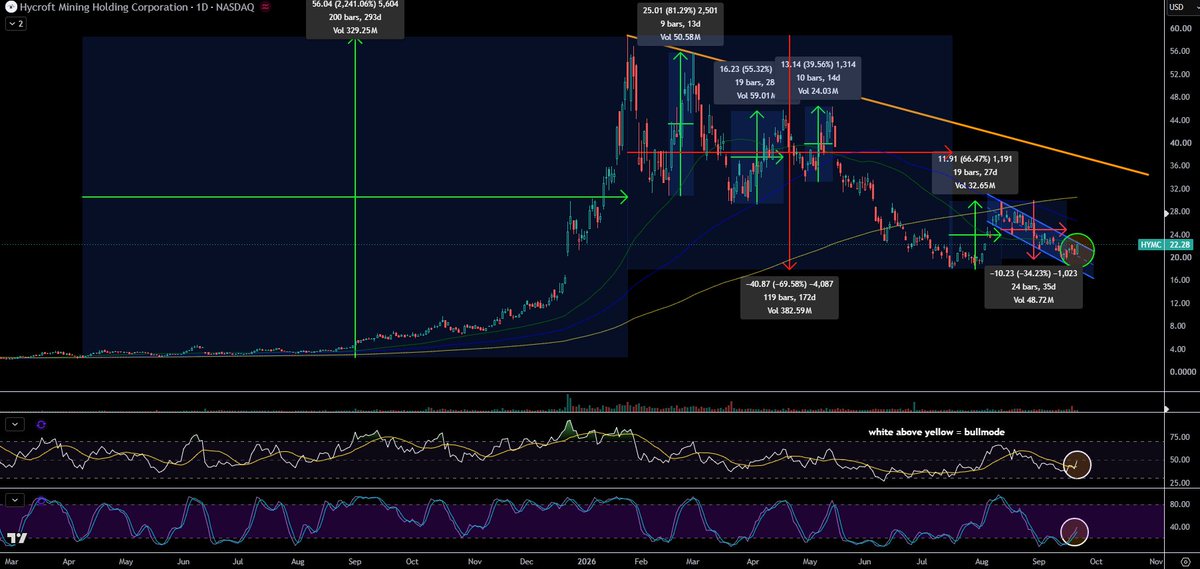
Think about what that means for $HYMC. 👀🥈🔥
They keep drilling…
➡️ More high-grade silver
➡️ More high-grade gold
➡️ Thick intercepts
➡️ Strong continuity
➡️ Vortex expanding
➡️ Brimstone expanding
…and they STILL haven’t found the edges. 😳
This is happening inside an already MASSIVE Nevada gold & silver deposit.
Now imagine adding a growing high-grade underground opportunity on top of that enormous resource. 💥⛏️🥈
That’s where this gets VERY interesting.
Every new hole could reveal another piece of something much bigger hiding beneath Hycroft. 👀
💰 Strong cash
✅ No debt
🇺🇸 Nevada
🌋 Massive resource
🔥 High-grade discoveries
⛏️ Underground potential
🚀 Exploration still wide open
The ground keeps talking…
and $HYMC keeps finding more. 🌋🥈🔥
How big does this system actually get? 👀
🚀🚀🚀🚀🚀
$HYMC