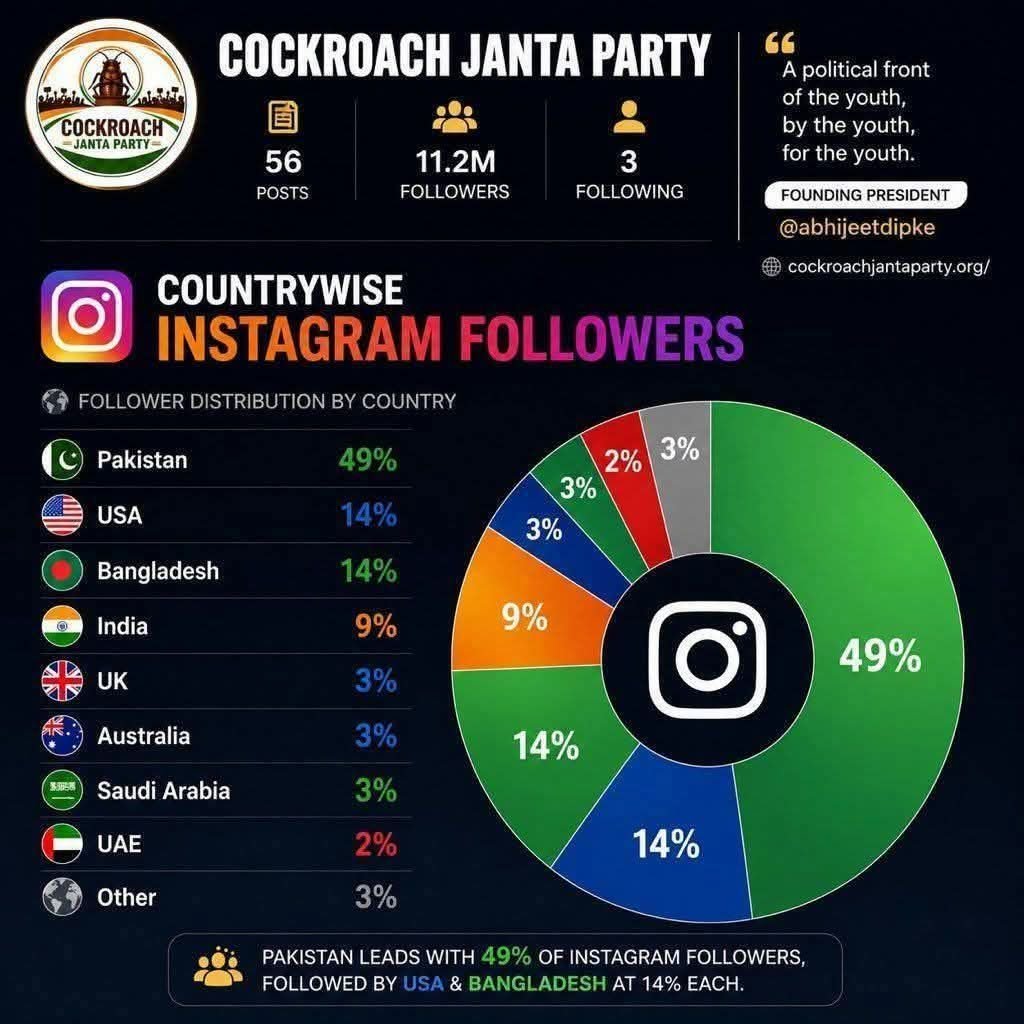
Since Gen Z things are again in trend, I remembered this extraordinary clip of @CharuPragya.
Nowadays, people, especially youngsters, have the habit of making allegations and asking questions without knowing the facts. This is how you deal with them.
-They're also students.
-They're also hurt by irregularities in exams.
-They're also protesting against the government.
But they're not getting attention. Why?
-Because they're protesting in an INDI alliance-ruled state, Jharkhand? -Because they're not being abusive?
The poster says
1) No religious, casteism and religious speech allowed
2) Focus on the main subject of the protest
3) No personal allegations
4) Absolutely no abusive language allowed
This is from the students protest site of Jharkhand.
No wonder they're not getting attention..
> some teachers leaked the exam
> some students bought it
> to make the NEET fairer he announced the retest
> made it happen without any leaks & declared result in a month
> introduced CBT for fairness from next year
> yet he had to resign to please the protestor
that's how democracy punish an innocent family for serving the country
Meet NEET aspirant Harsh Dubey, who expressed his frustration during an interview, pointing out that nobody speaks about reservation, yet many protest over a fair education policy.
Will CJP & Dipke address such issues?
🚨 EXPOSED! FCRA Amendment hits.
— One lady. One foundation. Multiple protests within 72 Hours🤯
Govt announces Doon-Rishikesh road expansion.
Manavi Anusha of "Aumana Foundation" begins IG campaign.
Shaves her head BALD on camera, floods Instagram with CRYING reels, emotional blackmail galore → project STOPS 🤯
48 hours later? Back in Delhi, same victim script. This time at CJP Protest😳
Meanwhile, This “Spiritual guru” was hurling the FILTHIEST slurs involving women, abusing everyone in reels & DMs like a street goon!
Leads a “spiritual society” but calls for street Anarchy on cops & PM, then plays bald victim.
These FCRA-hit NGOs are professional drama terrorists!
India’s development won’t be held hostage by bald hypocrisy anymore.
Jantar Mantar protests are no longer just about NEET.
Some want restoration of article 370,
Bas naam rahega Allah ka,
Sita ka pati,
Defeat Hindutva,
slogans like brahmanvad murdabad !
#AntiIndiaCJP
S. Janaki Ji refused the Padma Bhushan in 2013 and said she deserved the Bharat Ratna instead. A lot of people found that arrogant at the time.
Most of North India does not know her name. Almost all of India has heard her voice. If you have ever heard an old South Indian film song playing in a shop, a bus, a wedding, it was probably her.
So let me tell you who she was.
Her full name was Sistla Sreeramamurthy Janaki. Born 23 April 1938 in Pallapatla, a village in Guntur district.
Her father was an Ayurvedic doctor and a teacher. She spent most of her childhood in Sircilla. She sang on a stage for the first time at the age of nine.
In her twenties, an uncle told her to go to Chennai and try working with a composer named R. Sudarsanam at AVM Studios. She went.
She got her first film song in 1957. A Tamil film called Vidhiyin Vilayattu. She was 19.
In that very first year, she recorded songs in six different languages.
Six. In year one.
Across her career she recorded around 48,000 songs. In roughly 20 languages. Kannada the most, then Malayalam, then Tamil, Telugu, Hindi, Odia, Tulu, Urdu, Punjabi, Bengali, Konkani, Sanskrit.
She also sang in English, Japanese, German and Sinhala.
Yes, 48,000.
Her career ran about 60 years. That works out to more than two songs a day, every day, for six decades.
Including the days she was sick, travelling, grieving, tired.
While her mother tongue was Telugu, but she could speak and write Tamil, Kannada, Malayalam and Hindi. Malayalis claim her as theirs. Kannadigas claim her as theirs. Tamils claim her as theirs.
All of them are correct. :)
They called her the queen of expression and modulation. Meaning she could change how a song felt with tiny things.
A slight break in a word. A softer breath. She could sound like a village girl in one song and a heartbroken woman in the next and a child in the one after that.
That is why composers fought to book her.
Infact, Ilaiyaraaja Ji had heard her voice while assisting the composer G. K. Venkatesh. When he got his own first film, Annakkili in 1976, he asked her to sing three songs. All three became huge.
That started something. For the next two decades, Ilaiyaraaja and Janaki produced hit after hit. He knew exactly what her voice could do and kept stretching it.
She became the first choice for anything with a village setting, anything that needed rawness.
Ilaiyaraaja sang around 200 duets with her himself.
Three of her four National Awards came from his compositions.
And eventually she became the only singer to have won state awards under all three of the giants. M. S. Viswanathan. Ilaiyaraaja. A. R. Rahman.
Imagine, three generations of music.
Three completely different styles.
She worked across all of them and was excellent in all of them. A 40 year span of staying relevant while the entire sound of Indian cinema changed twice.
Her first National Award came in 1981 for a Malayalam song, Ettumanoorambalathil, from a film called Oppol.
She won four National Awards in all, and 33 State Film Awards. Thirty three.
She also had a Hindi chapter that almost nobody remembers. Bappi Lahiri heard her singing a Hindi song for a Tamil film at Prasad Studio and was floored.
He brought her to Bombay. She ended up singing duets with Kishore Kumar.
Now, her personal life was much harder than the discography.
She married V. Ramprasad in 1959. He backed her career fully and used to travel with her to recordings. He died in 1997 of a cardiac arrest.
Her son Murali Krishna died this January, just six months ago.
She is survived by her granddaughter, Apsara Vydyula, who announced her death on Instagram.
She wrote that to the world Janaki was an iconic voice, and to them she was a grandmother whose warmth and humility they will carry forever.
She ended her singing career in 2017 with a concert in Mysuru. The last song she chose was a Malayalam lullaby, Amma Poovinum.
She picked a lullaby to close out 48,000 songs. :)
Now back to the Padma Bhushan.
In 2013 the government offered it to her. It is India's third highest civilian honour. She said no.
She said it had come far too late. And she said if the country actually wanted to recognise her work, it should have been the Bharat Ratna.
At the time, plenty of people called that ego.
But look at what she was sitting on when she said it. 48,000 songs. Twenty languages. Four Nationals. Thirty three state awards. Six decades. Work with every major composer across three generations. A voice that raised entire regions.
Lata Ji got the Bharat Ratna in 2001. Bhimsen Joshi got it in 2008. M. S. Subbulakshmi got it in 1998.
Janaki was 75 when they offered her the third best one.
She had every right to feel that the country had taken her for granted. And she said so out loud, without an agent or a PR team softening it.
But honestly, what bothers me is that she is being introduced to half the country today, in a condolence tweet, at 88, after she is gone.
She was not obscure. She was not niche. Her voice was in millions of homes for sixty years. She was just South Indian in a country where national fame is still mostly decided in Hindi.
If you have never heard her, do not scroll past this.
Go put on Thumbi Vaa Thumbakudathil. Or Vasantha Panchami Naalil. Or Singara Velane Deva. You do not need to understand the words. You will understand the voice in about ten seconds.
That is the whole point of her. She never needed you to know the language.