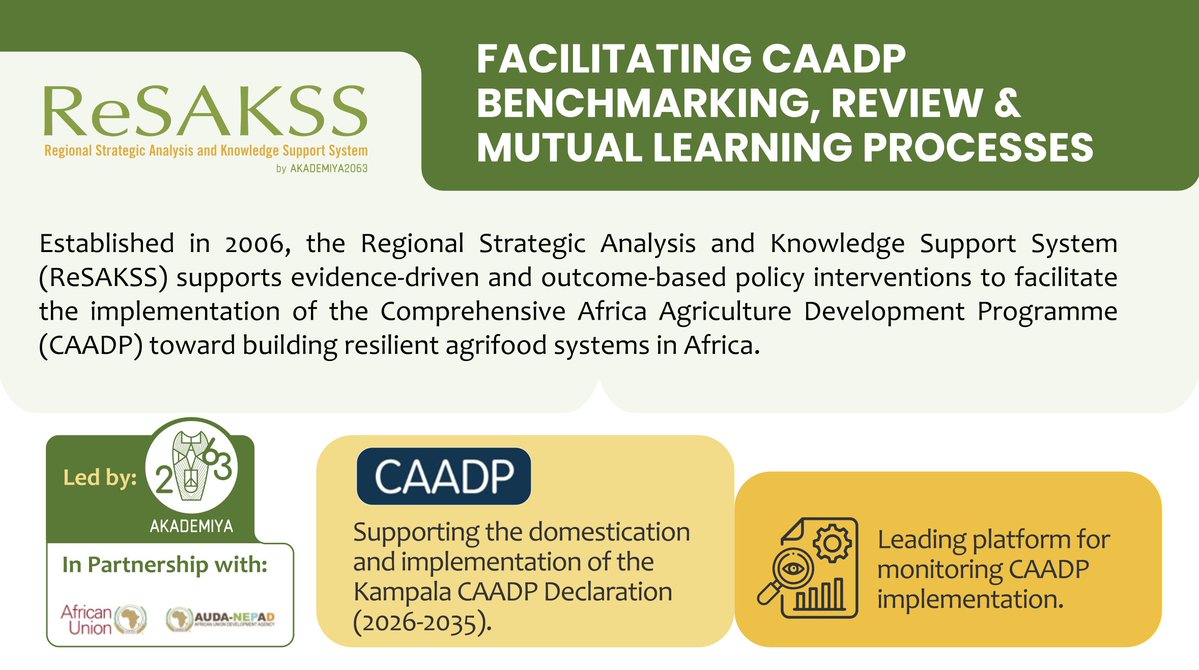
@ReSAKSS @AKADEMIYA2063 serves as a knowledge hub driving evidence-based interventions to advance @AUC_CAADP targets & agrifood system transformation in Africa.
Integrating Emerging Irrigation Technologies to Advance Agricultural Production and Resilience
in Africa
Recent technological advancements, such as sensor-based irrigation, solar-powered pumps, and digital water monitoring systems, are reshaping and enabling improvements in yield and achieving environmental sustainability. These emerging technologies include digital agriculture, which utilizes next-generation technologies such as machine learning, artificial intelligence (AI), the Internet of Things (IoT), big data analytics, and remote sensing.
Often associated with concepts such as “Agriculture 4.0” and “Smart Agriculture Transformation” (SAT), these technologies enable real-time optimization of water resources, reduce energy expenditure, and connect farmers to weather data, market prices, and advisory services via mobile platforms.
#ATOR (Chap. 8): https://t.co/gmhn5aZ5X4
What will it take for agricultural innovation to deliver greater impact across Africa? Beyond developing new technologies, the challenge is to create the conditions that enable their adoption and widespread use.
Business A.M. draws on findings from the 17th ATOR to examine the factors shaping the adoption and scaling of agricultural innovation. The article highlights the importance of supportive institutions, coherent regulatory frameworks, sustainable financing, and stronger accountability.
The piece reinforces a central message of the report: advancing Africa’s agrifood systems requires connecting technological advances with the policies and institutions needed to scale their use.
More insights from @fkokutse: https://t.co/t1n5yqaLJ8
Africa’s agrifood transformation will depend not only on the technologies available, but also on the conditions that enable them to deliver results.
The 17th ATOR examines why technological progress must go hand-in-hand with stronger institutions, effective governance, coherent policies, and sustained investment. It highlights how these factors influence the adoption of innovations and their contribution to agricultural productivity, resilience, and poverty reduction.
As African countries advance the @_AfricanUnion Kampala CAADP Declaration and the CAADP Strategy and Action Plan (2026–2035), the report provides evidence to inform policies that connect technological innovation with more inclusive and sustainable agrifood systems.
ATOR insights: https://t.co/RZBQbMt78j
The 2026 Agricultural Innovations and Technologies Marketplace (MITA) will take place in Freetown, Sierra Leone (Oct 19–21), bringing together researchers, innovators, public and private sector stakeholders, and end users to promote access to agricultural technologies for animal production and integrated crop–livestock–aquaculture systems.
These priorities align with the 17th ATOR which examines how technologies such as AI, geospatial tools, digital agriculture, biotechnology, mechanization, and improved processing can support agrifood systems transformation.
The report also emphasizes that technology alone is not enough. Scaling innovation requires supportive institutions, effective governance, coherent policies, and investment strategies that enable technologies to be adopted and deliver broad-based benefits across Africa’s agrifood systems.
ATOR insights: https://t.co/i4q1O5eopW
@CORAFNews
As African countries work toward stronger regional integration and the implementation of continental development agendas, modernizing national statistical systems is critical to ensuring that decisions are grounded in robust evidence.
The 10th Session of the Statistical Commission for Africa, will focus on “Unleashing the value of data in Africa: making official statistics a true mirror of the continent.” The session provides an opportunity to discuss how statistical systems can better support evidence-based decision-making and Africa’s development priorities.
Through ReSAKSS, @AKADEMIYA2063 supports the implementation of the Comprehensive Africa Agriculture Development Programme (CAADP) by monitoring progress, strengthening evidence-based policy analysis, and informing policy dialogue and mutual accountability. This work includes tracking progress toward continental agrifood systems commitments through the CAADP Biennial Review process.
Learn more: https://t.co/oJ2Zg0qP0p
Visit https://t.co/oZ6mv7TrOj
Biotechnology presents a transformative opportunity for Africa to address pressing challenges in food and nutrition security, climate resilience, and sustainable agricultural productivity.
In South Africa, the introduction of GM maize, soybean, and cotton helped raise farmers’ incomes by more than US$1 billion, increasing annual crop yields by 32%. Nigeria’s farmers now grow GM maize and cowpea varieties that have been improved to resist infestation and destruction by insect pests, therefore requiring fewer or even no pesticide applications.
ATOR insights: https://t.co/iGhMwfJo0J
@_AfricanUnion #KampalaDeclaration
The adoption of the Kampala Declaration and the CAADP Strategy and Action Plan (2026–2035) marks a renewed and ambitious commitment to accelerate productivity growth, strengthen resilience, expand value addition and trade, and harness science, technology, and innovation as drivers of transformation.
The Annual Trends & Outlook Report advances a systems perspective on innovation, emphasizing that the true technology frontier lies at the intersection of digital, biological, engineering, and ecological innovations with institutional reform, political learning, and accountable governance.
ATOR insights: https://t.co/UNlGAsaBnM
Africa’s agrifood transformation will require more than a single technological breakthrough.
The 17th ATOR shows that ending hunger and reducing poverty depends on coordinated technical, institutional, and socio-political innovations, supported by effective governance and stronger coordination.
The opportunities span AI, geospatial intelligence, improved seeds, precision irrigation, biotechnology, and digital advisory services. The priority now is to create the enabling environments, incentives, and partnerships needed to scale these innovations and adapt them to African realities.
ATOR insights: https://t.co/DrBdV57UCr
Advancing Mechanization in African Agrifood Systems
Africa still faces a significant mechanization gap. More than 60% of agricultural land is cultivated manually, while tractors and other motorized equipment provide only about 10% of agricultural power. For smallholder farmers, fragmented landholdings, limited finance, weak rural infrastructure, underdeveloped machinery service markets, and skills gaps continue to limit access.
Emerging models are creating new opportunities, including tractor-hire schemes, local innovation around two-wheel tractors and small-scale machinery, and public-private partnerships tailored to different agroecological zones.
ATOR insights: https://t.co/3cSCeuAtht
How can AI help Africa address food insecurity while building more productive, resilient, and financeable agrifood systems?
In this article, @AKADEMIYA2063’s @dr_racinely, examines how AI, geospatial technologies, and digital tools can help transform Africa’s agrifood systems.
Drawing on the latest Annual Trends and Outlook Report (ATOR), “Moving the Technology Frontiers in African Agrifood Systems,” the article highlights practical applications ranging from drought forecasting and pest detection to digital advisory services, agricultural finance, and climate-risk management.
Read more @panagrimedia: https://t.co/ltpMzIzJV3
Insect Farming Innovations: A Pathway to Self-Reliance in Agrifood Systems in Africa!
Insect farming emerged as a transformative and sustainable approach to addressing the interconnected challenges of food insecurity, environmental degradation, and economic vulnerability in Africa’s agrifood systems.
By converting organic waste into high-value products (protein-rich feed, frass fertilizers, and bioactive compounds), insect farming offers an efficient circular economy solution that bridges nutrition, livelihoods, and ecological resilience.
Almost all of an insect’s body is edible, a trait that maximizes nutrient output while minimizing waste. This trait distinguishes insect farming from conventional livestock systems and underscores its potential to combat malnutrition and improve food security.
ATOR (Chap. 10): https://t.co/tpt0Zh0c8M
Brachiaria Grass Seed Innovation in Mali
Did you know Brachiaria (palisade grass) cultivation has shown significant benefits for livestock productivity?
The main results are related to a 15% to 40% increase in milk yield and weight gains of up to 50%. Its higher biomass yield and nutritional quality compared to traditional grasses, like Napier and Rhodes, make it a preferred forage for farmers, extension workers, and researchers.
#ATOR insights: https://t.co/i4q1O5eopW
Integrating Emerging Irrigation Technologies to Advance Agricultural Production and Resilience
in Africa
Recent technological advancements, such as sensor-based irrigation, solar-powered pumps, and digital water monitoring systems, are reshaping and enabling improvements in yield and achieving environmental sustainability. These emerging technologies include digital agriculture, which utilizes next-generation technologies such as machine learning, artificial intelligence (AI), the Internet of Things (IoT), big data analytics, and remote sensing.
Often associated with concepts such as “Agriculture 4.0” and “Smart Agriculture Transformation” (SAT), these technologies enable real-time optimization of water resources, reduce energy expenditure, and connect farmers to weather data, market prices, and advisory services via mobile platforms.
#ATOR (Chap. 8): https://t.co/gmhn5aZ5X4
Empowering Women and Youth in Africa’s Agrifood Sector!
Women and youth are increasingly becoming key drivers of transformation in Africa’s agrifood systems. Across countries like #Zimbabwe, #Ethiopia, #Kenya, and #Tanzania, women account for 43–67% of agrifood processing activities, highlighting their critical role in adding value to local agricultural products.
Access to finance, training, networking opportunities, and market information enables these groups to scale their businesses and create sustainable livelihoods. For example, in Tanzania, local government authorities actively encourage women and youth to form groups to access business loans and establish agrifood processing initiatives. In 2023 alone, the Tanzanian local government authorities (LGAs) allocated 44 billion shillings (about US$18 million) to over 23,000 women and youth, providing a strong boost to entrepreneurship and economic participation.
Check out @ReSAKSS #ATOR, Chapter 7: Processing and Value Addition Technologies in African Agrifood Systems: https://t.co/lOzYgpmQId
Strengthening Africa’s seed systems is key to transforming the continent’s agrifood systems
The Africa Seed Summit (October 5–7) will bring together African leaders and to mobilize political commitment, investment, and partnerships for stronger seed systems, while launching the Seed Sector Performance Index (SSPI) 2025 Status Report.
The Summit’s priorities closely align with Chapter 13 of the latest Annual Trends and Outlook Report (ATOR), which examines seed policies and regulatory frameworks across Sub-Saharan Africa. The chapter highlights the importance of inclusive seed systems, stronger public–private–producer partnerships, improved access to quality seeds, and harmonized policies and regulations to support seed production, marketing, and regional trade.
The chapter also points to emerging opportunities, including digital platforms and blockchain technologies for seed traceability, as well as hybrid approaches that can help reach farmers and communities underserved by commercial seed markets.
ATOR (Chap. 13): https://t.co/FAzbzxDCbc
@_AfricanUnion
#AATM
“Africa’s food security challenges are increasingly intertwined with the structure of its trade, as demonstrated in this year’s AATM,” said @DrOBadiane, Executive Chairperson at @AKADEMIYA2063.
“Growing import dependence, concentrated suppliers, and exposure to global shocks mean that the continent must strengthen both domestic production and regional markets.
Learn more: https://t.co/M6nWO04Lo1
#AATM
Chapter #4 of the 8th Africa Agriculture Trade Monitor (AATM) – The Role of Fertilizer Trade in Enhancing Food Security in Africa – analyzes the role of fertilizer trade in enhancing food security in Africa. This timely, specialized topic is embedded in the broader question of trade and food security, which constitutes the common thread of this report. The complex links between fertilizer trade and food security are examined in the context of increased global crises, shifting regional dynamics, and climate change.
The latter is of utmost importance as Africa is highly subject to rising temperatures, extreme weather events, plant diseases, and rainfall variability, all of which seriously threaten agricultural production, requiring more and better use of fertilizers.
AATM insights: https://t.co/ROmOcb5uaT
#ATOR
Women make up around 50% of Africa’s agricultural labor force, yet often face barriers to finance, land, skills and access to machinery. At the same time, Africa’s young population presents an opportunity to make agriculture more attractive through new roles as machinery operators, service providers and entrepreneurs.
Inclusive mechanization requires practical action:
• Expand access to affordable and appropriate machinery
• Support women-led mechanization services and cooperative models
• Provide targeted technical and vocational training
• Improve access to finance and equipment ownership
• Create pathways for youth as operators, technicians and entrepreneurs
• Invest in rural infrastructure that enables mechanization services
ATOR insights: https://t.co/RZBQbMt78j
#ATOR
Key Lessons on What Works in Digital Agriculture in Africa
Digitalization can transform Africa's agrifood systems, but only if constraints are addressed through coordinated, equity-focused, and evidence-based interventions.
Key recommendations from the 17th ATOR:
-Advancing bundled and integrated solutions: Scale multi-service platforms combining market access, advisory services, finance, and e-learning. These offer higher impact, lower user-acquisition costs, and greater sustainability.
-Aligning digitalization with agroecological and SDG goals: Fund innovations that track sustainability, contribute to equity, and enable agroecological transitions. Evaluate impact beyond productivity—on nutrition, food security, welfare, and climate resilience.
ATOR insights: https://t.co/RZBQbMt78j
Sept. 28–30 | @LesothoPR, in partnership with @ECA_OFFICIAL, @UNDPLesotho and the @UNLesotho, will host a workshop in Maseru to strengthen MSMEs’ capacity to leverage regional trade agreements and the @AfCFTA.
The 8th Africa Agriculture Trade Monitor (AATM) focuses on the trade-food security nexus, examining the continent’s high dependency on world markets for key staples, as well as the potential of regional trade and the related bottlenecks.
Given the debate over trade integration in Africa, the report examines whether existing regional trade agreements support or hinder deeper continental integration and what can be expected from @AfCFTA.
AATM insights: https://t.co/gB3oqh9ipr