@ReadReadj@pash22@timwand@DuthieAlyne@DrAnnieHickox@jill_d35@samhall404@GeorgeKirov1 I see you are being asked by Annie Hickox if you want to set up services to help the injured? I notice this with psychiatry. Everyone else is expected to deal with the harm they cause. Patients; families, GPs, other professionals. What are psychiatrists doing about it?
A Story of Bad Science: How Defenders of Antidepressant Efficacy Make Their Case
By Peter C. Gøtzsche, MD
"In my view, some of the psychiatric leaders should be in jail because they knowingly spread falsehoods about psychiatric drugs that kill people."
https://t.co/eFyoW7mJuc
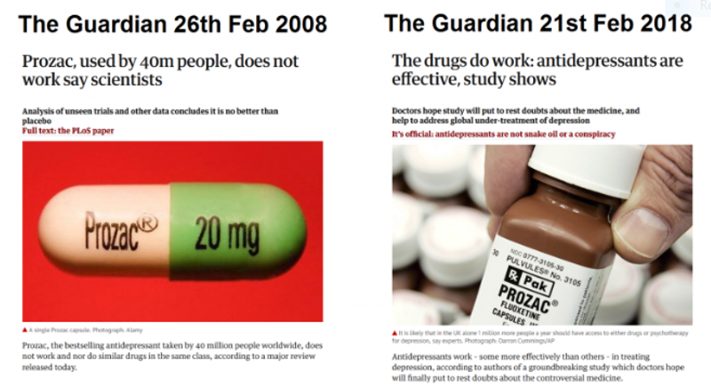
A story of bad science: How defenders of antidepressant efficacy make their case. The drugs don’t work, which patients confirm in placebo-controlled trials, but psychiatric leaders say they are highly effective. I describe in my paper the main tricks they use: fraud, bias, lies, willful ignorance, illegitimate statistics, and wishful thinking. https://t.co/8vP8x8eOvp.
On the difficulty of psychiatric drug withdrawal and of finding a doctor who can support this. Plus a plea to doctors to reduce prescribing of these drugs and to patients to be more wary of taking them. https://t.co/G5HhpjeJo5
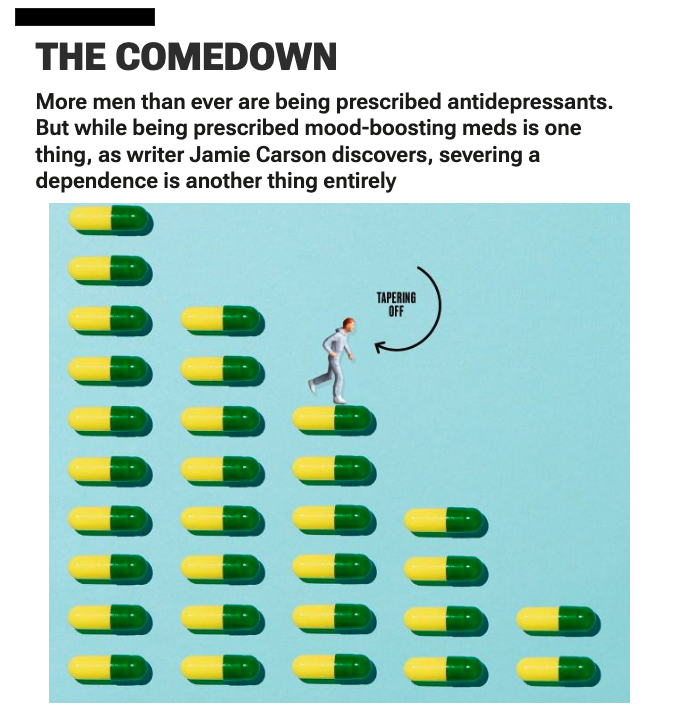
"...being prescribed mood-boosting meds is one thing, as writer Jamie Carson discovers, severing a dependence is another thing entirely"
Good to see physical dependence to antidepressants covered in Men's Health (paywall)
https://t.co/OT2kZnv35K
It actually isn't an explanation either, but a description. A key weakness of the ND paradigm is that it reifies psychiatric diagnoses uncritically.
Terms such as ADHD & autism identify clusters of experiences and behaviours; they do not explain why those experiences and behaviours occur.
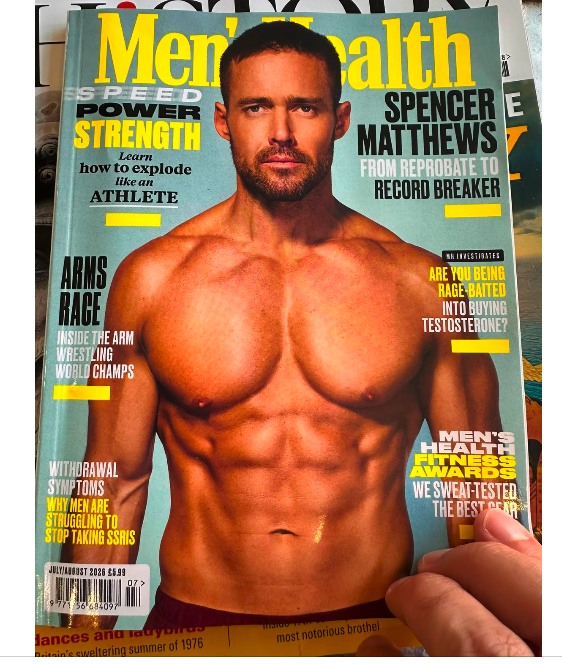
After years of hard work I am pleased to say I have finally been featured on the cover of Men's Health...
...
...in the story in the bottom left about the difficulties of stopping antidepressants
I have had a few people confirm what is in pharmaceutical guides - that holding an antidepressant in the mouth causes numbing of the tongue and mucosa. Along with evidence that they cause some genital numbing and emotional numbing (see latest systematic review below) I think the quest to find how antidepressants work is over.
https://t.co/mDnz8Bm7Dj
This is heart-warming to hear. I wonder how many people are walking around not realising that their 'treatment resistant' conditions or declining health is due to the medications they are taking or the lingering withdrawal effects of drugs they have switched or stopped in the past....this must account for a significant proportion of spending in the mental health system and more widely in disability support.
Early coverage of the next paper from our ECT survey, on memory loss. @mind ‘echoes concerns raised by this research’ and calls for ‘a rethink about whether and when it is offered’
@PsychRecovery@LisaTMSA@MITUKteam@JDaviesPhD
https://t.co/kmx13EcHDR
🧵 Unlike the diagnosis of a broken bone or a diseased organ, psychiatric diagnoses do not identify a specific, observable problem in the brain—despite the mental health industry’s decades-long claims about targeting abnormal brain chemistry in order to correct it.
Instead, psychiatric diagnoses implicate everything that makes a person unique. From your sense of humor to your fears, your relationships and how they play out, how you perceive and respond to the world, and your belief in your own potential.
It's understandable, then, why the very act of receiving such a diagnosis can profoundly change how someone sees themselves. And for a young person still figuring out who they are, that diagnosis can redefine their entire sense of identity, limit their belief in their own agency, and steer the course of their development as they move into adulthood.
In other words, a single diagnosis—often issued in a matter of minutes in primary care—can set off a cascade that reshapes a person's life for decades, or their entire lifetime.
Our founder, Laura Delano, touches on this subject here as part of a new episode from the Low Carb MD Podcast, where she is joined by physicians Tro Kalayjian (@DoctorTro) and Brian Lenzkes (@BrianLenzkes). 1/2
"Big Pharma has been treating human suffering like an endless subscription service." An astute viewer's response to my interview with Dr Mark Hyman. https://t.co/8nHfhV1RHz
My appearance on the Dr Hyman show has gone live. Among other things, we discuss the harms of presenting depression as a biological condition and other, more hopeful ways to understand it. @drmarkhyman@flint_books. https://t.co/8nHfhV1RHz
A huge thank you to @KatinkaNewman for sharing your story with our NHS National Psychiatric Deprescribing Support Group yesterday. Your honesty, warmth and hope meant a great deal to everyone who attended. We appreciated you taking the time to be with us.
SSRIs have been on the market 40 years. How many millions of patients have consumed them? How many left injured? Imagine if HGV drivers were allowed on the road on a regular basis having been poorly trained to drive safely. How many accidents would it take?
Just back from the UK launch of The Madness Pill. It was an honor to be introduced by Sir Norman Lamb, former UK mental health minister, and joined by roughly 20 journalists and mental health advocates. Encouraging to see the book resonating on both sides of the ocean.