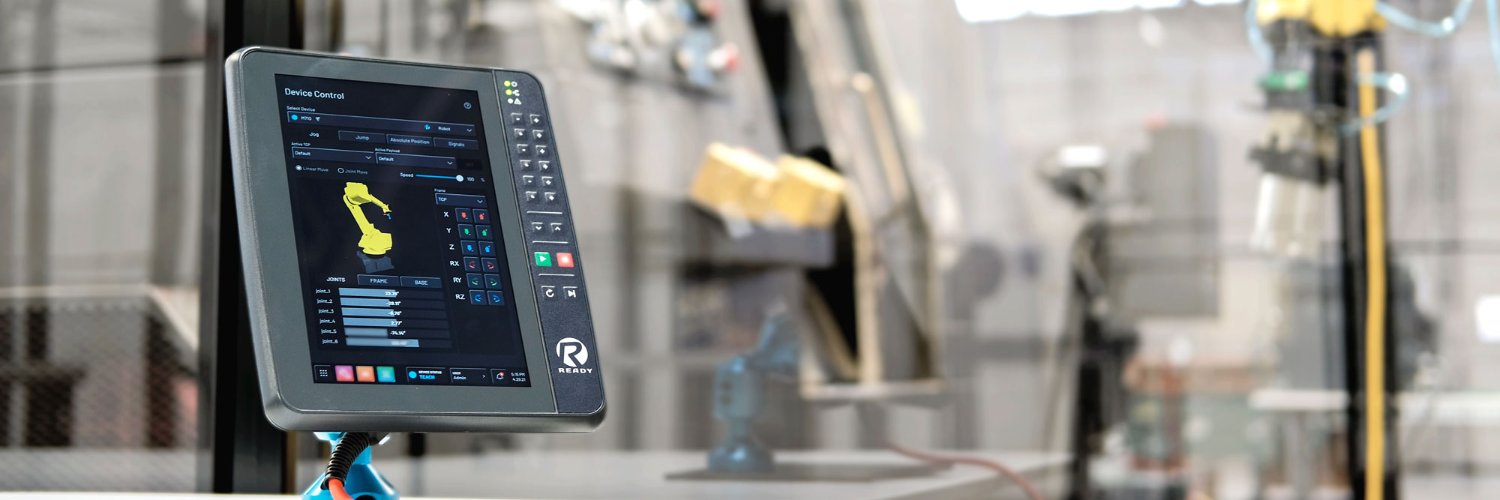
We built a foundational software platform that enables AI to scale across any robot or industrial automation system in a way previously not possible.
You can read about it here first on @X ...
What did we build?
Yesterday, we announced a project with @nvidia and @ToyotaMotorCorp that combines the high-fidelity simulation capabilities of @nvidiaomniverse with ForgeOS, the highly-extensible industrial OS for robotics and automation built by our company @ReadyRobotics.
This is the first ever truly hardware-agnostic implementation of a sim-to-real-to-sim feedback loop that enables physical robots and industrial automation equipment, as well as their digital twins, to be controlled using the same REST APIs.
Toyota will be using this powerful, combined software architecture of ForgeOS and Omniverse to automate its aluminum hot forging production lines.
Traditionally, programming robotic systems for forging involves working with hot metal parts, posing significant safety challenges. The ForgeOS + Omniverse integration enables seamless programming in a simulated environment, eliminating risks associated with hot parts.
In the article from @deantak on @VentureBeat that announced this project, Kazuhiro Suzuki, group manager of Toyota’s raw materials development division, had this say: “The unique architecture of ForgeOS allows for the sim-to-real workflow we need for this production line because it bridges Nvidia Isaac Sim’s simulation capabilities with the control of our physical system. This means we can program in simulation, transfer that program, and then use ForgeOS to capture live production data and iteratively improve our processes.”
Where does AI fit into this?
We built a software platform that provides AI agents and models with a bridge to interact with and control robots from almost any major brand, as well as thousands upon thousands of industrial automation components.
I have long believed that the biggest bottleneck in massively scaling robotics (and more broadly, industrial automation) is the fact that all this very powerful hardware, very sophisticated hardware lacks a modern software layer. ROS tried to be this. I love the vision of ROS, but ROS is really just a collection of middleware services.
What is truly needed is an integrated platform built from the ground up with a modern software architecture.
So that's what we built with ForgeOS.
ForgeOS runs on the edge, using an off-the-shelf industrial PC, connecting to and controlling physical automation hardware in manufacturing facilities.
ForgeOS also runs in the cloud, connecting to and controlling virtual automation hardware with high-fidelity physics simulated in NVIDIA Omniverse.
As the physical hardware executes an automation program, ForgeOS feeds all the data of the system back into the digital twin in real-time.
AI uses that data to learn about the characteristics and performance of the physical system.
AI can then write new automation programs to optimize performance, test them in the Omniverse simulation, and then before push that exact program to the real-world system via the ForgeOS APIs. No need to deal with antiquated software stacks from legacy robot and automation OEMs (who make amazing hardware by the way!)
We've been working on ForgeOS for a long time, and its deployed in manufacturing facilities around the world. We know it works in the real-world.
Now thanks to the ongoing collaboration with NVIDIA that started in 2022, ForgeOS can now control high-fidelity simulated systems as well.
We'll be sharing more details and examples of how this combined software architecture works in the coming days and weeks, so please stay tuned!
Discover how @ReadyRobotics and @ToyotaMotorCorp are coming together to bring a new approach to how robotic automation is programmed and deployed using #simulation and low-code tools, increasing efficiency, usability, and safety. #NVIDIARobotics
We're thrilled to share that we're collaborating with NVIDIA and Toyotoa Motor Corporation on a project set to transform industrial automation. https://t.co/jyBW59LJ7o
Once you create standardization at one level of your technology stack, those standard components become the building blocks of the next wave of innovations.
This is why we've built standardized interfaces for robots and industrial automation with ForgeOS at @ReadyRobotics. It makes scaling your solutions much easier and faster!
From the Edge Impulse Imagine conference in 2022.
https://t.co/R4DM0Pa2mJ
Attending the Rockwell Automation Fair? Find your way to the Rockwell Automation Innovation Booth #1176 and be part of a paradigm shift with READY Robotics! We're not just making robots better; we're transforming the global perception of automation. How exactly? Come ask us.
Can’t help but stare and share any time @NVIDIAEmbedded’s Jetson AGX modules show up on the timeline. Like a @Lamborghini Revuelto or @LockheedMartin F-35, they’re a work of art and marvel of engineering before they’re even powered on.
"At READY you are a part of the great shift, enabling the world to move away from dangerous, dirty and dull manufacturing operations toward automation, making way for better, safer and higher skill jobs." — Jerid Hayward, Director of Program Management
#weareready#readyrobotics
"What's exciting about my job is being able to solve new challenges every day and incrementally make Forge a better product. It's extremely rewarding being able to see robots from all different manufacturers behave as if they were exactly the same." — Josh Davis, VP of Robotics
@nvidia CEO, Jensen Huang, shared a look at the future of robot programming during his keynote at SIGGRAPH yesterday. It's an honor to see READY Robotics recognized as a driving force in the advancement of generative AI for robot programming. @nvidiaomniverse
@nvidia CEO, Jensen Huang, shared a look at the future of robot programming during his keynote at SIGGRAPH yesterday. It's an honor to see READY Robotics recognized as a driving force in the advancement of generative AI for robot programming. @nvidiaomniverse