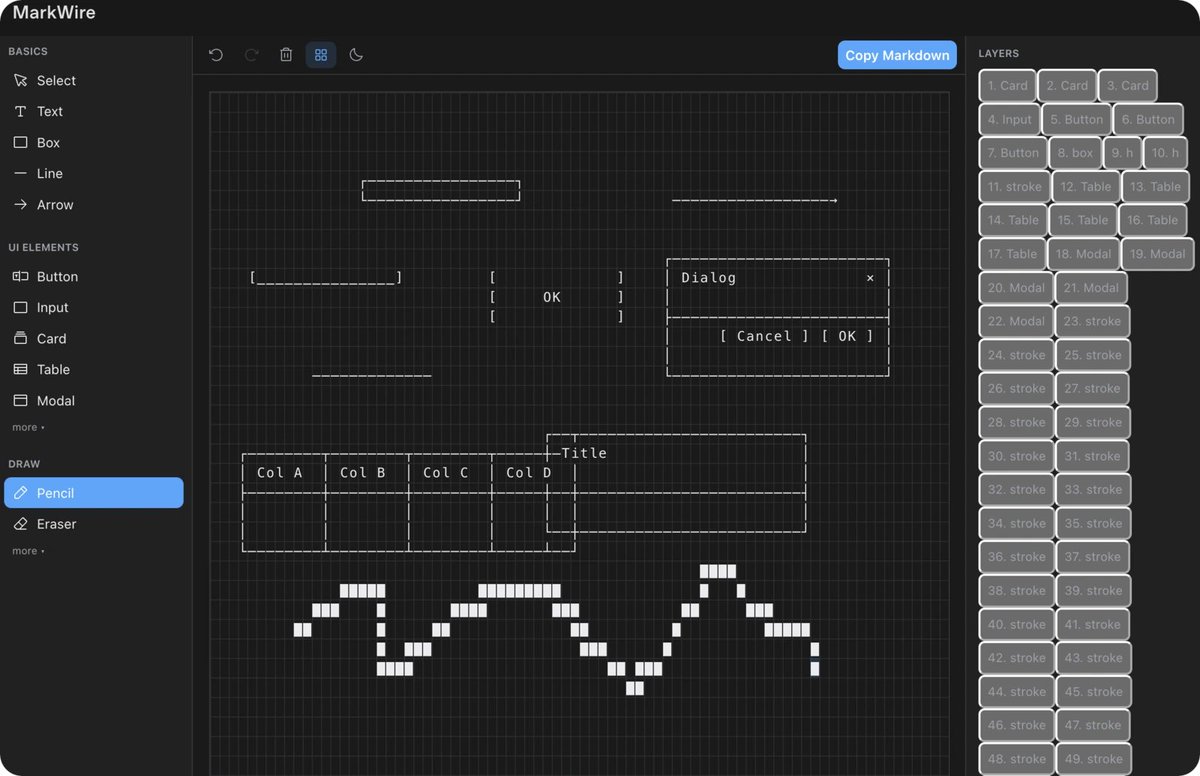
Built a local ASCII wireframe editor that opens as its own panel inside Codex.
Sketch layouts, copy Markdown, stay in the agent loop — no remote service.
Codex Agent Plugin: markwire
Your agent is not slow. Your sandbox is far.
Same prompt. 238ms cold start vs 865ms. The tax is region + vendor, not model IQ.
Where does your tool call actually land?
Two agents. One file. No lock.
Claude Code sessions race the same path; the second overwrites the first mid-edit.
Write ownership isn't polish -- it's merge vs silent corruption.
Who owns the file when both agents think they do?
Claude Code just fixed the ugly MCP trap: HTTP tool calls dual-fired when the socket died mid-call.
Only read-only / idempotent tools get retried now.
How many of your MCP tools are actually safe to fire twice?
Your coding agent isn't slow. You are.
One Claude Code log dump: 56% of session time waiting on the next human message. Model 31%. Tools 13%.
Still tuning tool latency while the cursor blinks on you?
An "agent swarm" with no lead is one invoice wearing three name tags.
Pick an explicit lead. Workers execute. Lead routes. No lead = cosplay teamwork.
Still fanning out subagents with nobody owning the next step?
Zero deny rules is not a flex.
It's a deferred incident. Block rm, force-push, and .env reads before the agent invents a reason.
Still running open-permissions "to see what happens"?
Shipping "an agent" in 2026 is cosplay.
The product moved to the harness: sandbox, policy, session, recovery.
BYO the subscription. Own the wrapper.
Still pitching model choice as your moat?
Claude + Codex in one repo still sync by paste-md.
Coordinators exist. Most teams export chat, drop a .md, and hope both harnesses see the same world.
The handoff file is the protocol. Who owns shared state across tools?
What do you actually use for cross-harness context?
If tool responses land in your gateway logs, so do the tokens inside them.
Sandbox the agent all you want — the log still holds the secret.
Where do YOUR agent responses get written?
If your agent's eval score jumped after you tuned the harness, read the traces it newly passes.
Sometimes it got better at the task.
Sometimes it got better at the grader.
Which one did you ship?
Context compaction isn't forgetting.
It's forgetting while still treating your hours-old message as the live turn.
Does your agent check timestamps before it "answers" again?
Claude Code now emits an OTel event every time a hook, permission rule, or sandbox stops a tool call.
Safety stopped being a vibe check. It's a counter.
How many deny-events does your agent rack up in a day?
"One skill, every harness" is the pitch.
Reality: Claude Code, Cursor, and Codex each own a different folder for the same skill.md.
When they drift, which tree is source of truth?
The scariest harness feature isn't more tools.
It's an agent that can rewrite its own guardrails mid-run.
If self-edit is on by default, who signs the diff?
Teams keep adding agent skills. Almost nobody prunes them.
A skill that helped once becomes permanent context tax — and an unreviewed trust surface.
When did you last delete a skill on purpose?
Shared memory as a flat log still collides with itself.
The missing unit is a graph (or a branch): what links, what forks, what can be forgotten.
Is your agent memory a timeline or a topology?
No confirm in the chat is not autonomy.
It's a missing ask-gate: terraform destroy, kill, spend - same failure class.
What do you refuse closed when the operator is offline?
CI green is not agent success.
Exit code 0 can mean the tests were deleted, the assertion never ran, or the harness grepped the wrong log.
What do you score besides the return code?
Agents narrate confidence. That is not a routing signal.
If the model says "done" and the house is still the wrong height, you routed on a self-grade.
What do you trust instead of the agent's own story?
Crash recovery is not a free replay button.
If the write may already have landed, "resume" without a receipt is how you double-bill the world.
Where's your durable log?