Biotech press releases, read against the filing. Topline claim vs. 8-K vs. registered endpoint. Usually they match…sometimes the PR is optimistic.
AI does the first pass. A physician checks it.
Make it your go-to, or your second read of the data.
✓ MD in the loop · Signal, not spin · Sources: PR · 8-K · NCT#
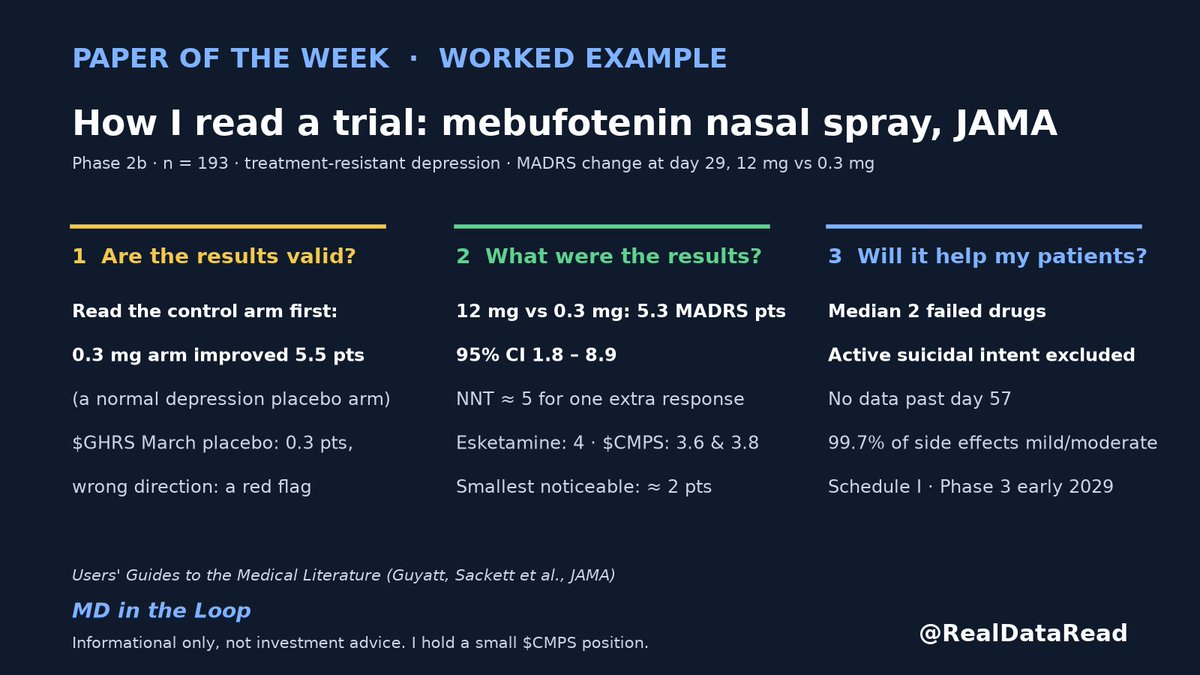
Paper of the Week: how I read a trial about a new therapy, using this week's JAMA mebufotenin paper as the worked example. Three questions, in order. Full walk-through below. Disclosure: I hold a small position in $CMPS, none in $GHRS or $LLY. $GHRS $CMPS $LLY
The bottom line, for anyone who won't hang with the long version: a real and respectable effect, a control arm that behaved the way one should, no data in suicidal patients or past day 57, and Phase 3 in early 2029. Read the control arm first. I hold a small $CMPS position and none in $GHRS or $LLY.
Paper of the Week: how I read a trial about a new therapy, using this week's JAMA mebufotenin paper as the worked example. Three questions, in order. Full walk-through below. Disclosure: I hold a small position in $CMPS, none in $GHRS or $LLY. $GHRS $CMPS $LLY
How I read a trial about a new therapy, using this week's JAMA paper as the worked example
I am sharing a short walk-through of this week's JAMA paper on a psychedelic nasal spray for treatment-resistant depression. My AI agent pulled the papers and the company filings and did the arithmetic while I supplied the framework and the opinions. The numbers below come from the JAMA paper and its editorial, from the March paper in JAMA Psychiatry from GH Research $GHRS, and from the Phase 3 releases put out by Compass Pathways $CMPS.
The framework is not mine. In the early 1990s Gordon Guyatt, David Sackett and their McMaster colleagues published the “Users' Guides to the Medical Literature” in JAMA, and the guide for an article about therapy asks three questions in order: 1) are the results valid, 2) what were the results, and 3) will the results help me in caring for my patients. I was taught to read papers that way, I taught residents to read them that way, and surprising to me, it works just as well for reading a biotech press release as it does at journal club.
The paper. Feifel and colleagues, JAMA, published online October 26, 2026. A Phase 2b trial of a single intranasal dose of mebufotenin (the generic name for 5-MeO-DMT, the “toad venom” compound) in 193 adults with treatment-resistant depression at 38 sites in the US, Europe and Australia. Patients received 8 mg, 12 mg, or 0.3 mg as a “subperceptual” comparator, all with psychological support, and the primary endpoint was the change in the MADRS depression score at day 29 for 12 mg against 0.3 mg. The sponsor was Beckley Psytech, which became AtaiBeckley and was bought by Eli Lilly $LLY in September. One point of confusion I have seen this week: this is not GH Research's drug. GH Research's GH001 is the same molecule given by inhalation under a different dosing scheme, and its Phase 2b appeared in JAMA Psychiatry in March. Same molecule, different company, and as you will see, a very different looking result.
Question 1, are the results valid. The trial was randomized and double-blind, follow-up through the primary endpoint was good (5 to 14 percent did not complete, the most in the comparator arm, none for side effects), and everyone received the same psychological support. The place to spend your time in any psychedelic trial is blinding, because a patient who has just had a psychedelic experience knows which arm he is in, and so does the nurse in the room. The authors handled this two ways: the comparator was a tiny dose of the same drug rather than saline, because a saline spray would have unblinded itself, and the depression ratings were done by remote raters who did not know the assignment. Even so, most patients and most site clinicians guessed correctly. So the question becomes whether the unblinding distorted the result, and here is the single most useful habit I can pass along: look at what the control arm did. In this trial the 0.3 mg group improved by 5.5 points by day 29, which is what a placebo arm in a depression trial usually does. Compare that to the GH Research trial in March, where the placebo arm moved 0.3 points in the wrong direction at day 8, essentially no placebo response at all. A depression placebo arm that does not move is the fingerprint of a control group that knew it got nothing. It does not mean the GH001 effect is not real; its active arm fell 15 points, the largest in the class. It means that if that placebo arm had behaved like this week's comparator arm, about a third of the headline 15.5-point “placebo-adjusted” difference would disappear, and I would not expect that number to repeat in a bigger trial. Two more validity notes on this week's paper: the randomization ratio was changed partway through, which left the 8 mg group small at 46 patients, and the sponsor's employees helped design and analyze the study, which is standard and is exactly why you read the control arm yourself.
Question 2, what were the results. The 12 mg group's MADRS fell 11.1 points against 5.5 for the comparator, a difference of 5.3 points with a 95 percent confidence interval from 1.8 to 8.9. The 8 mg group did slightly better at 12.5 points, a 6.2-point difference. At day 29 about a third of patients on either active dose had responded (a 50 percent drop in score) against 12 percent on 0.3 mg, and 18 to 26 percent were in remission against 8 percent, which works out to treating roughly five patients for one additional response and six to ten for one additional remission. The effect held through day 57 on a single dose. How to think about the size: the MADRS runs 0 to 60, the usual estimate of the smallest difference a patient would notice is about 2 points, esketamine's registrational trial produced a 4-point difference at day 28, and the two psilocybin Phase 3s from Compass Pathways $CMPS produced 3.6 and 3.8 points at week 6 against placebo or a 1 mg dose. So 5.3 is a real and respectable effect for this disease, and the confidence interval tells you the truth could sit anywhere from barely noticeable to very large, which is what a 193-patient trial can tell you and no more. The remission numbers are the ones the editorial dwells on: the average patient improved about 30 percent, and response and remission came in below what ketamine and ECT produce.
Question 3, will the results help my patients. Three things to check. 1) Who was studied: adults 18 to 75 with two to five failed antidepressants (median two, so moderately resistant rather than the hardest cases), nearly 90 percent White, taken off their antidepressants before dosing, and anyone with active suicidal intent excluded, which means the trial cannot speak to the suicidal patient, the one for whom ketamine's speed matters most. 2) Were all the outcomes that matter measured: depression scores yes, response and remission yes, durability to eight weeks yes, and one practical outcome that psychiatry actually cares about, time to being ready to go home, where 78 to 85 percent were ready within two hours (the protocol still kept everyone four hours). What is missing is anything past day 57, anything about how often people will need re-dosing, and long-term safety. 3) Harms and costs: 76 to 85 percent had side effects but 99.7 percent were mild or moderate, nausea in a third to 40 percent, one patient with two severe panic attacks, brief rises in heart rate and blood pressure, eight reports of suicidal thoughts without intent spread across all three arms (every active-arm case in someone with a prior history), and no suicidal behavior. Cost is unknowable because the drug is Schedule I and not prescribable, and its Phase 3 program (two placebo-controlled trials of roughly 650 patients, reading out in early 2029) is what will decide whether it ever is.
The takeaway format, for the next paper you read. Spend the first five minutes on the control arm and the blinding, not the headline. Translate the effect into something you can picture: points on the scale, response and remission rates, and how many patients you treat for one to benefit. Read the confidence interval as the range of what could be true. Then ask whether the patients in the trial look like the patient in front of you, whether the outcomes measured are the ones you would want, and what the harms and the timeline look like. If you follow these stocks, the same five minutes tells you what the market is pricing: $GHRS rose about 15 percent this week on a paper about a different company's version of the molecule, and the thing to watch in its Phase 3 will be what the placebo arm does.
Disclosure: I hold a small position in $CMPS and have no position in $GHRS or $LLY.
I would be grateful to hear how others read it, and especially where psychiatrists who actually treat resistant depression think I have this wrong.
$GHRS $CMPS $LLY
Tie-back to this week's Tip of the Week (NNT/NNH): DeLLphi-305 was the only release with absolute survival rates, enough for an NNT of about 4 at one year. Lilly's dropout rates give an NNH of about 19. The rest gave hazard ratios, odds ratios or nothing. When a "50% cut in risk" has no rates behind it, wait for the medians.
Next Tip: confidence intervals.
Informational only, not investment advice.
Weekly Evidence Check, Oct 24–30.
Five readouts moved biotech stocks this week. Only one came with enough numbers to judge properly. The others range from a strong headline with no medians yet to a trial stop with no data at all. Here's how much each one actually tells you. 🧵
5/ $ARTV AlloNK (NK cells + rituximab, rheumatoid arthritis): program ended, Phase 3 cancelled, ~94% of staff cut.
The company said B-cell depletion looked as before, but responses didn't last long enough, and it disclosed two deaths (one likely from fludarabine conditioning, one unexplained). No durability numbers were released.
Bottom line: early single-arm responses are cheap. How long they last is the test, and this one failed it.
Source: https://t.co/hipRdboFPB
Good take: @bs2537 on cash value
No position.
A new ASPREE genetic analysis reports ~70% less dementia in one subgroup: 1.0% vs 3.3%. Major bleeding there: 4.4% vs 2.1%. The authors put both NNT and NNH at ~44 and call it hypothesis-generating.
https://t.co/24d0IzNso4
Informational purposes only.
Follow-up to yesterday's NNT tip: aspirin to prevent a first heart attack or stroke.
ASCEND (adults with diabetes, 7.4 yrs): serious vascular events 8.5% vs 9.6% on placebo, NNT ≈ 91. Major bleeding 4.1% vs 3.2%, NNH ≈ 111.
Tip of the Week: NNT and NNH.
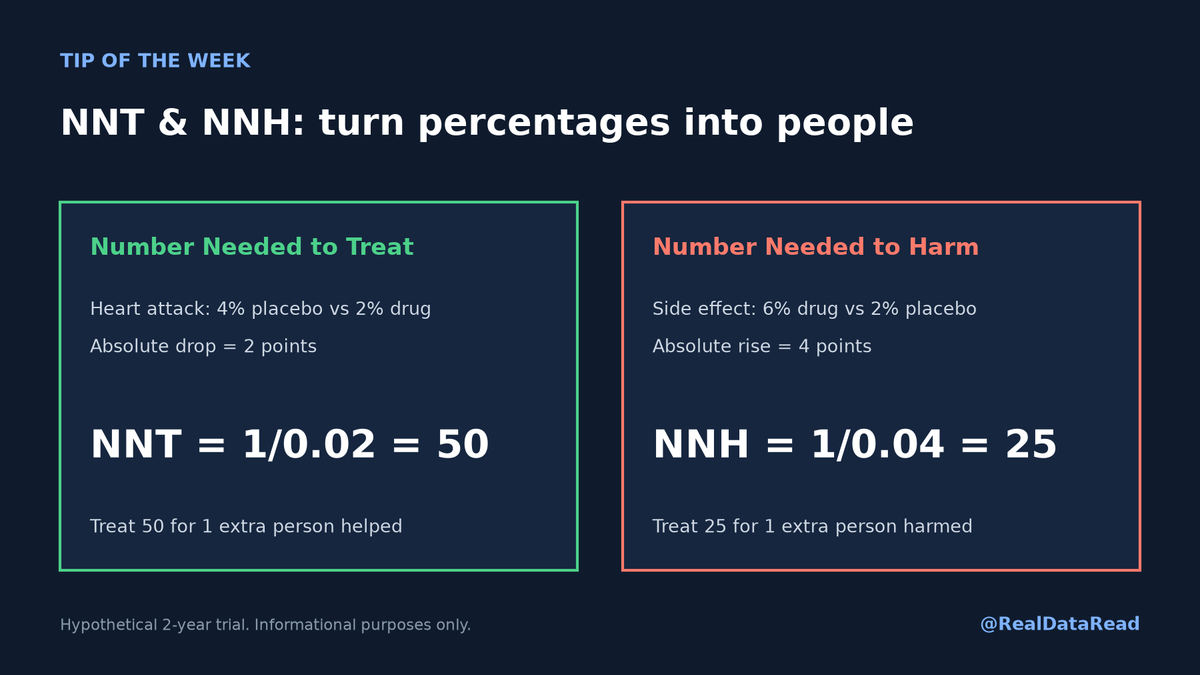
Number Needed to Treat (NNT) is how many people have to take a drug for one extra person to benefit. Number Needed to Harm (NNH) is how many have to take it for one extra person to be harmed. Both turn a percentage into people you can picture.
Read NNH next to NNT. When NNH is close to or lower than NNT, the net balance can tip toward harm. A high NNT also costs resources: 91 people × 7.4 yrs ≈ 670 person-years of daily pills, plus visits and monitoring, per event prevented in ASCEND.
Go deeper (free): Cook & Sackett, BMJ 1995, "The number needed to treat" https://t.co/7DVi7ghlqY
Also: JAMA Users' Guides to the Medical Literature https://t.co/neeVgyf5IB
Informational purposes only. Next week: confidence intervals and what it means when one crosses 1.
Tip of the Week: NNT and NNH.
Number Needed to Treat (NNT) is how many people have to take a drug for one extra person to benefit. Number Needed to Harm (NNH) is how many have to take it for one extra person to be harmed. Both turn a percentage into people you can picture.
The spin: a press release says the drug "cut heart attacks in half" and skips the NNT of 50, or drops the timeframe, since an NNT over 5 years looks better than one over 1. Harms often show up as raw rates with no NNH, which makes them easy to skim past.
$ROIV $MRNA $MRK $ABBV $TGTX $EYPT Weekly Evidence Check, Oct 17-23
Not "did it hit" but how strong the proof is.
NNT = how many patients you treat for 1 to benefit (our math from published rates). More on NNT Thursday. Informational purposes only. 🧵