I believe the gap between natural deflation from AI and other technology, and forced inflation from central banks, will produce the greatest wealth transfer in history.
Wealth is not going to vanish.
It is simply going to change hands…
From those who do not understand what is happening… to those who do.
In fact, this historic transfer of wealth is already underway, and for most people, it could be financially devastating.
Consider that the US recently experienced the most severe bout of inflation in 40 years.
That means the government has been printing so much money that even the most revolutionary technologies of recent years—the internet, smartphones, social media, advanced computing, and more—have not been enough to bring down the cost of goods and services in the face of rampant currency debasement.
With AI, I believe we are going to see this dynamic on steroids.
Most people are going to be squeezed in a tightening vice—on one side by the most deflationary technology in human history, and on the other by the most severe currency debasement of their lifetimes.
The key variable isn’t whether AI is impressive or useful (it is).
The key variable is whether AI becomes a true profit engine or remains a subsidized cost center dressed up in a hoodie and a TED talk.
No matter what happens, we are confident the Iran war will be a major tailwind for gold.
Here is an overview of how we see the conflict unfolding and its major financial implications.
1. The Strait of Hormuz is the world’s most important energy corridor.
2. Iran now has undisputed control over Hormuz.
3. Stripping Iran of that control would require a successful full-scale ground invasion of Iran, a country roughly 40 times the size of Switzerland.
4. A full-scale ground invasion is unlikely to happen, and even if it somehow does, it is unlikely to succeed.
5. Iran is therefore likely to retain control over Hormuz.
6. The US is likely to suffer a historic strategic defeat, no matter how it tries to spin it.
7. The US was already on the verge of a debt crisis before the Iran war.
8. The direct and indirect effects of the Iran war are likely to worsen that debt crisis.
9. The US government will likely debase the currency in an attempt to deal with its worsening debt problems.
10. The US dollar’s status as the world’s reserve currency is likely to be lost amid a debt crisis, rising inflation, and a major geopolitical defeat.
11. As a hard-money alternative to the dollar, gold is likely to be a primary beneficiary.
Fear-driven narratives are a poor guide for investors, while disciplined risk management, diversification, and focus on controllable probabilities offer a sounder path to returns and peace of mind.
Fear Is Not an Investment Strategy
https://t.co/GCSsSnaqK7
Once upon a time, America was a high-trust society. It now seems the ethos is to grab the money and run.
Americans were once encouraged to delay gratification, to put off consumption today in order to be more prosperous tomorrow. But with increasing currency debasement, who wants to wait?
In a high-inflation economy, everyone is forced to get rid of their fiat currency as fast as they can. They either wind up promiscuously consuming because there’s no way to get ahead.
So why not eat, drink, and be merry, for tomorrow we die anyway. Or gambling, even if they think they’re speculating. Or, if they’re especially ill-informed, they think they’re investing.
The transformation of the markets from a convenient way to raise capital for production into a type of casino is a warning sign. As is the participation of the masses through outfits like Robinhood, a broker that democratized gambling, disguising it as speculation or investing.
It’s a tip-off we’re probably at a top in the broad market.
The 10-year Treasury yield is perhaps the most important financial benchmark in the global fiat system, as it drives valuations and market trends worldwide. It is widely—and erroneously—regarded as the risk-free rate of return.
The 10-year Treasury yield can be thought of as a key barometer of the US dollar-based fiat system—a critical measure akin to its beating heart.
Bond yields move inversely to bond prices. When bond prices fall, bond yields rise.
A rising 10-year Treasury yield signals trouble for the US dollar because it means investors are selling Treasuries, which pushes up the US government’s borrowing costs. That is why the 10-year Treasury yield is a major pain point for the US government.
The 10-year Treasury yield was 3.97% when the war started. Now it is around 4.60%, an increase of roughly 63 basis points.
I expect the 10-year Treasury yield to keep climbing over the coming weeks and months—until it forces the Fed’s hand. At that point, the intervention will be sold as “stability,” but the mechanism will be familiar: suppress yields by debasing the currency.
At today’s debt levels, every 1 basis point increase in the government’s average borrowing cost adds roughly $3.9 billion in annual interest expense. So a 63 bps rise is not trivial—it translates to nearly $250 billion in additional yearly interest costs, materially widening a 2025 budget deficit that was already around $1.8 trillion.
Higher yields mean the US government must pay tens or even hundreds of billions more in interest on its debt. At the same time, the global economy faces even greater added costs because Treasury rates serve as the benchmark for borrowing worldwide.
That is not an insignificant move. However, given all the headwinds I have discussed, I suspect the 10-year Treasury yield is headed much higher because investors will demand higher yields to compensate for rising inflation. Further, if Hormuz remains closed, drastically higher oil prices are all but certain. Higher energy prices mean higher prices across the economy and higher official inflation rates, which means investors will demand still higher yields to compensate.
The problem is that interest on the federal debt is already over $1.2 trillion and is now the second-largest item in the budget. The US government cannot afford yields going much higher because the interest expense would push it toward bankruptcy.
I am not sure how—or even if—the US government can manage this situation. Something has to give, and we will not have to wait long to find out what.
The Iran war may prove to be more than another foreign policy disaster. It could be the trigger that exposes the fragility of the entire dollar-based financial system.
The UAE didn’t simply “leave” OPEC after nearly 60 years. It was bought out.
After the Strait of Hormuz crisis crushed revenues and drained dollar liquidity, Washington stepped in with swap lines—less a lifeline than a leash. These facilities keep Gulf allies liquid, discourage CNY oil settlement, and help prevent forced selling of U.S. Treasuries when America still needs buyers to fund its wars.
The market may read this as more oil production, but the bigger story is monetary control. Refineries have been hit, capacity is impaired, and the UAE is now more dependent on U.S. credit and security guarantees than ever.
The real war is not just in the Middle East. It is in central bank boardrooms. As currency blocs fracture and payment rails become weapons, neutral stores of value like gold and silver matter more than ever.
Taxes are destroyers of civilization and society.
They impoverish the average man.
They support welfare programs that anchor the lower classes at the bottom of society.
They underwrite a gigantic bureaucracy that serves only to raise costs and quash incentive.
They pay for public works programs (once called “pork barrel projects,” but now rechristened “infrastructure investment”) that are usually ten times more costly than their privately financed counterparts, whether needed or not.
They maintain programs that cause huge distortions in the economy (such as deposit insurance for banks).
And they foster a climate of fear and dishonesty.
The list of evils goes on.
But the simple truth is that anything needed or wanted by society would be provided by profit-seeking entrepreneurs, if only the tax collector would retire.
Protesting against taxes because they’re a costly or inefficient way of providing services, however, is in good measure futile. It’s like saying that the mugger shouldn’t rob you because there might be a better way for him to get what he wants.
How serious is the tax problem in the long run?
I believe it will become less, not more serious, despite the government’s increasingly high tax rates and draconian enforcement measures.
The major long-term trend of society is toward decentralization and smaller-scale organizations.
The US government will prove no more able to deal with a rapidly evolving economy than was the Soviet government.
More and more Americans will see the government as meaningless and irrelevant, as serving no useful purpose.
“The first panacea for a mismanaged nation is inflation of the currency; the second is war. Both bring a temporary prosperity; both bring a permanent ruin. But both are the refuge of political and economic opportunists.”
— Ernest Hemingway
Thanks to the fiat currency system, governments at war can tap into a nation’s savings by financing conflict through currency debasement.
Under a gold standard, governments had to have the gold or impose taxes if they wanted the funds to prosecute a war. When the gold ran out, the war stopped. But not in a fiat currency system. They can continue debasing the currency until they hyperinflate it.
That’s why there’s a simple equation you should sear into your memory:
War = Inflation
The historical pattern is clear.
The price of diesel fuel was about $3.55/gallon both a year ago and as of early January 2026, but has since soared by more than+$2.00 per gallon to around $5.60 recently.
That’s a 56% rise in the cost of pumping goods and commodities through the arteries of the US economy.
On an annualized basis, the diesel fuel bill for the US truck fleet went from $155 billion per year to $250 billion per year at current oil prices.
The big question, of course, is through which channel these drastically higher fuel acquisition costs will be absorbed—in higher prices or reduced output?
Prices for necessities—food, shelter, gasoline, medical care—are certain to go up much faster than his wages.
Warsh will find himself painted into a corner. He can either create trillions of new dollars to maintain the US government. Or fail to do so and invite a catastrophic deflation as America’s mountain of debt collapses upon itself.
I have no question that he’ll choose the first alternative.
In the past, the powers that be talked about the Fed “fine-tuning” the economy. That term is no longer used.
Everybody recognizes that unless the Fed prints up adequate money, “this sucker is going down,” as the Baby Bush once termed it during the 2008 financial crisis.
I suspect the next crisis will be much, much bigger.
I think the biggest risk to the average American is that, to finance itself, the government will require all pensions and 401(k)s to invest in a certain percentage of government debt.
That may hold the system together for a while, but at the expense of driving the final nails into the average American’s financial coffin.
We are likely witnessing the end of US global dominance, much like the fall of the British Empire in the wake of the world wars and the 1956 Suez Canal Crisis, but significantly more consequential.
No matter what happens, the outcome of the Iran war will make it clear to the world that the emperor has no clothes.
Many people are unprepared for such a historic shift. But when you put all the pieces together, the Big Picture becomes clear.
Changes in the world order are rare, history-defining events—with massive implications, both geopolitical and financial.
We are living through one of those rare moments right now.
That’s why it’s critical to tune out the noise, cut through the propaganda, and understand the true geopolitical landscape.
The New Zealand fuel crisis rationing plan is not even a particularly radical one by contemporary standards. That is precisely what makes it worth scrutinising carefully.
It is the latest iteration of a governance model that has been quietly consolidating for decades: the state and large capital as co-administrators of the economy, with small business and the individual citizen positioned as residual claimants on whatever resources remain after the primary beneficiaries have been served.
Call it economic fascism, corporate statism, or crony capitalism — the label matters less than the mechanism. And the mechanism is, once again, hiding in plain sight inside a document described as emergency planning.
Full article below.
You should plan on severe energy shortages.
We’re looking at something much worse than another lockdown, as bad as that was.
We’ve already seen hints of this: four-day government workweeks, travel restrictions, remote schooling, scheduled power cuts, and flight cancellations.
There’s already fuel rationing in the Philippines, Sri Lanka, Bangladesh, Pakistan, and Vietnam.
The US is shipping emergency gasoline and diesel to Australia, whose Green government idiotically has made it impossible for them to refine any themselves.
Full article below.
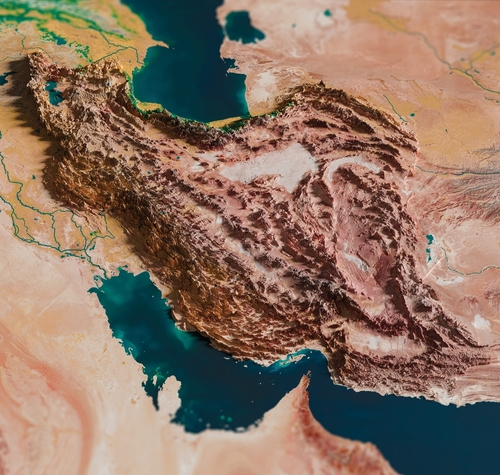
Look at Iran’s topography.
Similarly, Switzerland’s rugged mountainous terrain has helped protect it from invasion for centuries.
And Iran (1,630,848 sq km) is not just the size of Switzerland (41,291 sq km), but the equivalent of roughly 40 Switzerlands.
When you consider all the factors, it becomes clear that a full-scale ground invasion of Iran is simply not workable.
But that doesn’t mean the US won’t try.