Imagine the confident version of you who already speaks English perfectly.
This is the future you.
Now treat every mistake you make today as a normal step that ‘future you’ already went through.
City and Countryside Words
🔹Metropolitan (met-ro-POL-i-tan)
= A large, important city and its surrounding areas.
Example:
"New York is a metropolitan area with millions of people."
✍️Use: Often describes big, busy modern cities.
🔹Rural (ROO-ral)
= Countryside area – places with farms, fields, small villages, and few buildings.
Example:
"My grandparents live in a rural area. They grow vegetables and have chickens."
✍️Opposite of urban.
🔹Suburban (sub-UR-ban)
= Residential area (housing area) just outside a big city.
Example:
"Many families live in suburban neighborhoods because houses are bigger and it's quieter than the city."
✍️Think: between the city and the countryside.
🔹Urban (UR-ban)
= City-related – everything connected to cities (buildings, traffic, lifestyle).
Example:
"Urban life is fast and exciting, but it can be expensive."
✍️Common phrase: "urban development" = building more things in the city.
🔹Rustic (RUS-tik)
= Simple countryside style – natural, old-fashioned, not modern or fancy.
Example:
"They stayed in a rustic cabin in the mountains. It had wooden walls and no Wi-Fi."
✍️Often used for decoration, houses, or food (rustic bread = simple, homemade bread).
🔹Cosmopolitan (koz-mo-POL-i-tan)
= Diverse, international city with people from many countries and cultures.
Example:
"London is very cosmopolitan – you can eat food from every country there."
✍️Means "worldly" or "multicultural."
🔹Provincial (pro-VIN-shul)
= Local, narrow views – sometimes means small-minded or old-fashioned (negative meaning).
Example:
"Some people in small towns have provincial attitudes and don't like new ideas."
✍️Also means "related to a province" (a region in a country).
🔹Infrastructure (in-fra-STRUK-cher)
= Basic system of a city/country (roads, bridges, electricity, water, internet, etc.).
Example:
"The government is improving the city's infrastructure by building new subway lines."
🔹Congestion (con-JES-chun)
= Overcrowding – usually traffic or too many people.
Example:
"There is terrible traffic congestion in the city center every morning."
🔹Amenities (a-MEN-i-ties)
= Useful facilities – things that make life comfortable (parks, shops, hospitals, gyms, restaurants, etc.).
Example:
"This apartment building has great amenities: a swimming pool, gym, and 24-hour security."
✍️Extra Useful Terms✍️
🔸Metropolis (me-TROP-o-lis) → A very large, important city.
Example: "Tokyo is one of the world's biggest metropolises."
🔸Downtown → The center of a city (business area).
Example: "I work downtown, but I live in the suburbs."
🔸Outskirts → The outer edges of a city.
Example: "The airport is on the outskirts of the city."
🔸Village → Very small rural community (smaller than a town).
Example: "She grew up in a small fishing village."
🔸Town → Bigger than a village, smaller than a city.
Example: "It's a quiet college town."
🔸Megacity → A city with more than 10 million people.
Example: "Delhi and Shanghai are megacities."
🔸Urban sprawl → When a city grows and spreads out too much into the countryside.
Example: "Many cities suffer from urban sprawl."
🔸Commute (verb/noun) → Travel from home to work every day.
Example: "I have a long commute from the suburbs to the city."
🔸Gentrification (jen-tri-fi-KAY-shun) → When a poor area becomes more expensive and fashionable (new shops, higher rents).
Example: "The old neighborhood is going through gentrification."
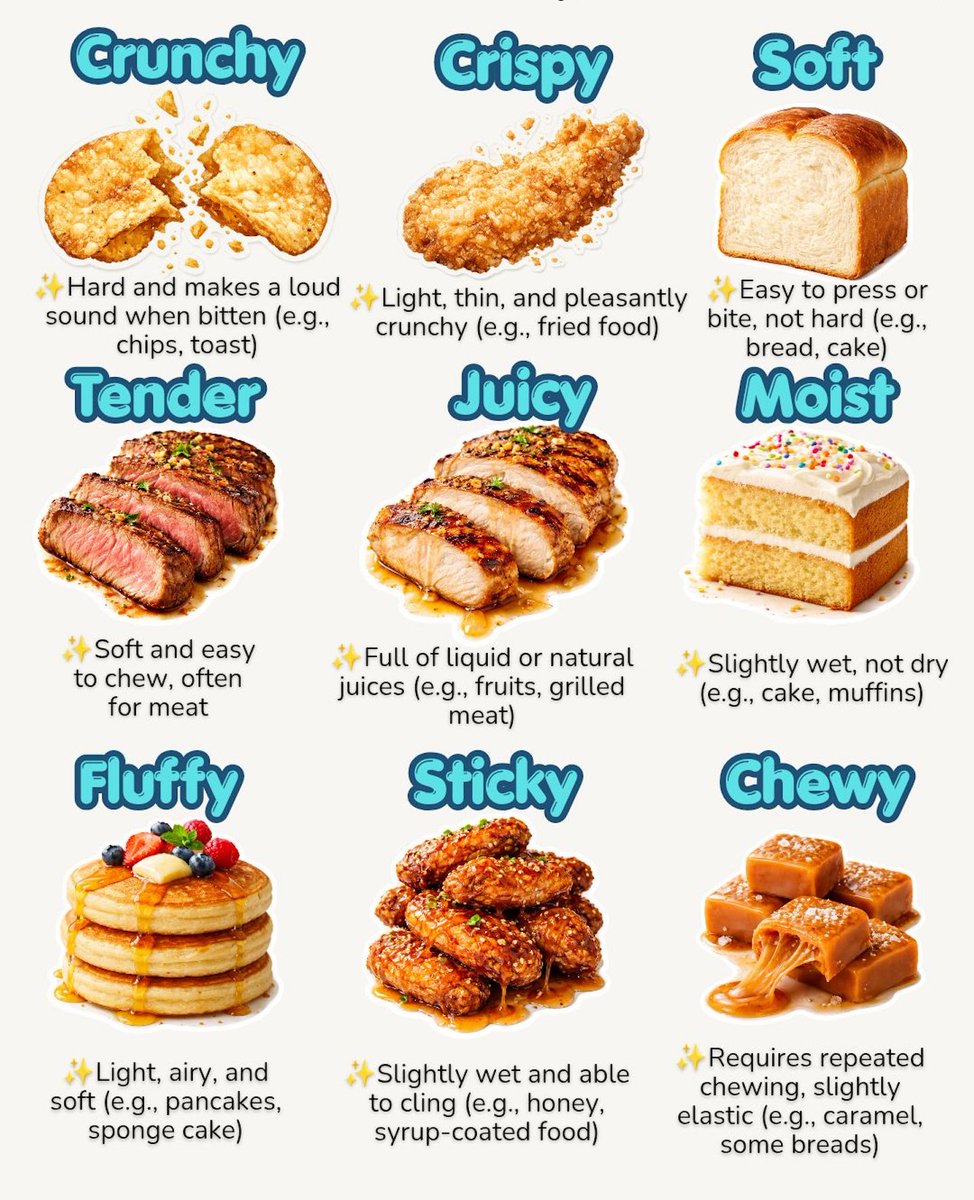
Food Texture
🔹Crunchy
= Hard and makes a loud crack sound when you bite it.
Feeling: Strong, sharp texture.
Examples:
Potato chips are crunchy.
I like crunchy carrots in my salad.
🔹Crispy
= Light, thin, and pleasantly crunchy (often fried or baked).
Difference from crunchy: Crispy is usually lighter and more delicate.
Examples:
The fried chicken skin is crispy.
I love crispy bacon.
🔹Soft
= Easy to press, cut, or bite. Not hard at all.
Examples:
This bread is soft and fresh.
The pillow is very soft.
🔹Tender
= Soft and easy to chew, especially for meat.
Examples:
This steak is very tender.
The chicken was tender and delicious.
🔹Juicy
= Full of liquid (juice) inside.
Examples:
The watermelon is sweet and juicy.
That burger looks really juicy.
🔹Moist
= Slightly wet in a good way (not dry). Often used for cakes.
Examples:
This cake is moist and fluffy.
The brownies are moist inside.
🔹Fluffy
= Light, airy, and soft (full of tiny air pockets).
Examples:
These pancakes are fluffy.
The cake is soft and fluffy.
🔹Sticky
= Slightly wet and able to cling or stick to things.
Examples:
The rice is sticky.
My hands are sticky from the candy.
🔹Chewy
= Needs a lot of chewing; slightly elastic.
Examples:
Caramel is chewy.
This bread is soft but a little chewy.
🔥 Quick Comparison
Crunchy vs Crispy
Crunchy = hard, loud
Crispy = light, delicate crunch
Soft vs Tender
Soft = general
Tender = usually for meat
Juicy vs Moist
Juicy = lots of liquid inside
Moist = slightly wet, not dry
Common Idioms
🔹Itchy Feet
= A strong desire to travel or move to a new place.
Example:
“After living in the same city for five years, I have itchy feet. I want to visit Europe next summer!”
✍️Extra info: We say “I have itchy feet” (not “my feet are itchy”). It’s often used for people who love traveling or get restless staying in one place for too long.
🔹Out of My Hands
= Something is no longer under your control. You can’t change or decide it anymore.
Example:
“I tried to help with the project, but it’s out of my hands now. The manager will make the final decision.”
✍️Extra info: People often say this when they feel frustrated because they can’t fix a situation.
🔹Let Your Hair Down
= To relax, stop being formal, and enjoy yourself.
Example:
“You always work so hard! Come to the party tonight and let your hair down!”
✍️Extra info: This comes from the old idea that women kept their hair tied up during the day (formal) and let it down at home to relax. We use it for both men and women now.
🔹Over My Dead Body
= Absolutely not! I will never allow this to happen. (Very strong refusal)
Example:
“Dad, can I get a motorcycle?”
“Over my dead body!”
✍️Extra info: This is dramatic and emotional. It’s usually said by parents, bosses, or people in authority.
🔹Save Face
= To protect your reputation or dignity; to avoid looking bad or embarrassed in front of others.
Example:
“He apologized quickly to save face after making a mistake in the meeting.”
✍️Extra info: This idiom is very common in many Asian cultures too. It’s about maintaining respect and pride.
🔹Turn a Blind Eye
= To deliberately ignore something wrong or illegal.
Example:
“The teacher turned a blind eye when she saw the students sharing answers during the test.”
✍️Extra info: Comes from the idea of covering one eye so you can’t see the problem. It’s often used when someone in power chooses not to act.
🔹Pick Someone’s Brain
= To ask someone (usually an expert) for advice or information.
Example:
“I’m starting a business. Can I pick your brain about marketing strategies?”
✍️Extra info: Very useful in professional situations. It sounds polite and shows respect for the other person’s knowledge.
🔹Throw In The Towel
= To give up; to admit defeat.
Example:
“After trying for three hours to fix the computer, I finally threw in the towel and called a technician.”
✍️Extra info: This comes from boxing — when a fighter’s coach throws a towel into the ring, it means the boxer is surrendering.
🔹Keep Your Nose Out
= Mind your own business; don’t get involved in other people’s affairs.
Example:
“This is a private conversation. Keep your nose out!”
✍️Extra info: A stronger, slightly rude version is “Keep your nose out of my business!”
Farm Items
Can you find them all?
the silo
the orchard
the stable
the pond
the hay bale
the farmer
the tractor
the pig
the pigpen
the cow
the horse
the scarecrow
the chicken
the sheep
the rooster
the crops
the fence
Crime Phrasal Verbs
🔹Break into
= To enter a building or place illegally by force (usually to steal something).
Example:
The thieves broke into the jewelry store through the back window.
🔹Get away with
= To do something wrong (usually a crime) and escape punishment or consequences.
Example:
He got away with cheating on the test because the teacher didn’t notice.
🔹Turn in
= To hand someone over to the police or authorities (often someone who committed a crime).
Example:
The neighbors turned in the suspect after recognizing him from the news.
🔹Lock up
= To put someone in prison or jail.
Example:
The police locked him up for six months after the robbery.
🔹Carry out
= To perform or complete a plan, action, or crime.
Example:
The gang carried out the bank robbery exactly as they had planned.
🔹 Let off
= To not punish someone, or to give them a light punishment instead of a serious one.
Example:
The judge let him off with just a fine because it was his first offense.
Bonus:
Full story using all the phrases (for better understanding)
Someone broke into the house last night. Luckily, the police managed to catch the thief. Two witnesses turned him in after seeing him running away. The court decided not to let him off easily. They locked him up for two years. Even though he almost got away with it, he couldn’t because his friends carried out the plan very sloppily.
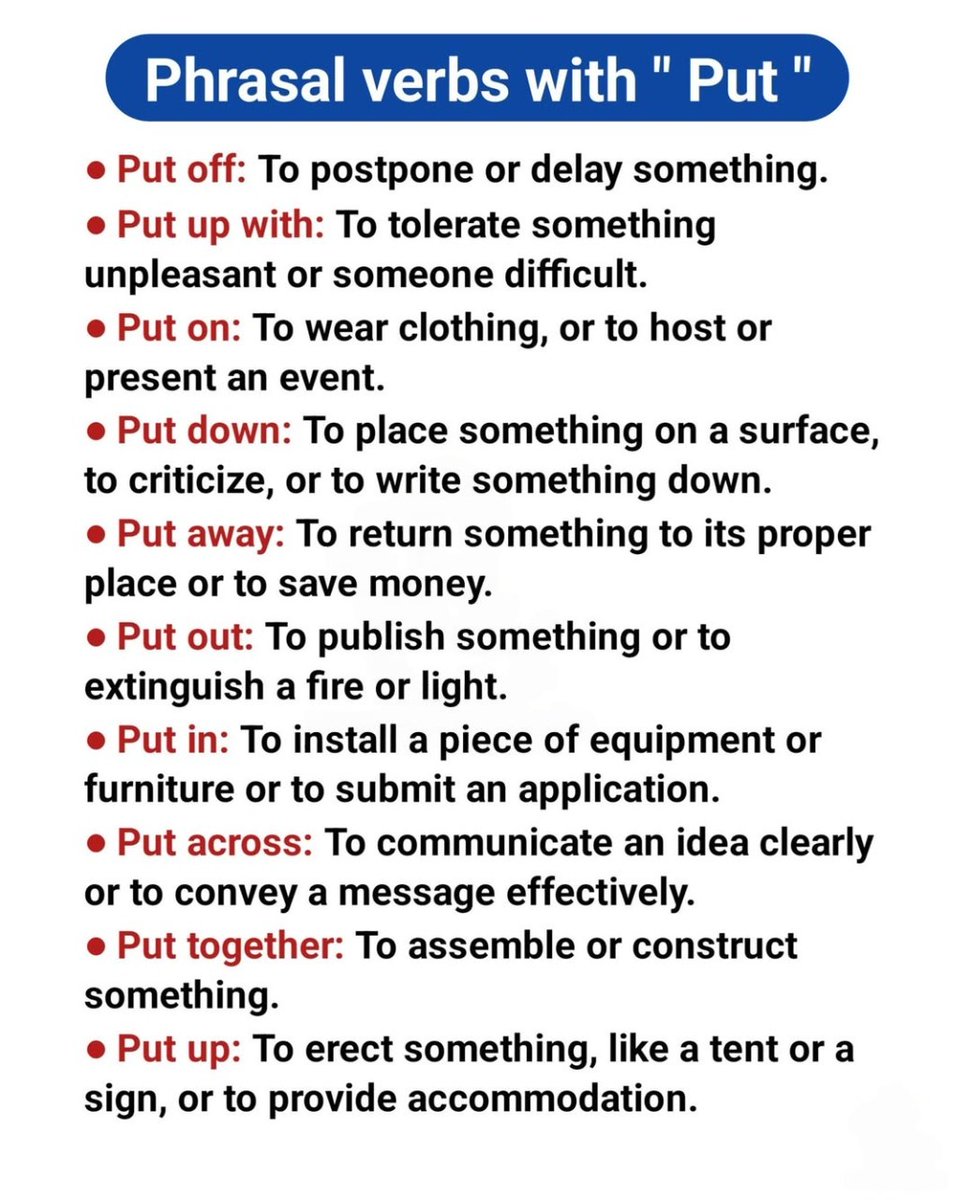
Phrasal Verbs With "Put"
"Put" is one of the most useful verbs for phrasal verbs.
🔹Put off
= To postpone or delay something.
We put off the meeting until next week because of the storm.
Stop putting off your homework! Do it now.
✍️Tip: Often used for things we don’t want to do (procrastination).
🔹Put up with
= To tolerate or accept something unpleasant or annoying.
I can’t put up with this loud noise anymore.
She has to put up with her difficult boss every day.
✍️Tip: This is very common in complaints. Synonym: tolerate.
🔹Put on
Two main meanings:
a) To wear clothing:
It’s cold outside — put on your jacket!
b) To organize or host an event:
Our school is putting on a play next month.
✍️Extra: We also say “put on makeup” or “put on weight” (gain weight).
🔹Put down
Three common meanings:
a) To place something on a surface:
Put the books down on the table, please.
b) To criticize or insult someone:
Don’t put him down just because he made a mistake.
c) To write something:
Put down your name and phone number here.
✍️Tip: Be careful — “put someone down” can hurt feelings.
🔹Put away
Two meanings:
a) To return something to its proper place:
Please put away your toys before dinner.
b) To save money:
They put away $200 every month for their vacation.
✍️Extra: “Put away” can also mean to eat a lot of food informally (“He put away three burgers!”).
🔹Put out
Three meanings:
a) To extinguish (stop) a fire or light:
The firefighters put out the fire quickly.
Put out the candles before you leave.
b) To publish or release something:
The company put out a new smartphone last month.
✍️Tip: “Put out” can also mean to inconvenience someone (“I don’t want to put you out”).
🔹Put in
Two meanings:
a) To install equipment or furniture:
We’re putting in new kitchen cabinets next week.
b) To submit an application or request:
She put in her application for the job yesterday.
✍️Extra: “Put in time/hours/effort” = to work hard on something.
🔹Put across
= To communicate or explain an idea clearly.
The teacher put the difficult concept across very well.
He’s good at putting his ideas across in meetings.
✍️Synonym: get across.
🔹Put together
= To assemble or construct something.
It took me two hours to put the IKEA shelf together.
We put together a beautiful presentation for the client.
✍️Tip: Also used for organizing information (“put together a report”).
🔹Put up
Two main meanings:
a) To erect or build something (tent, sign, poster):
They put up the tent in the backyard.
Let’s put up some decorations for the party.
b) To provide accommodation:
My aunt said she can put us up for the weekend.
✍️Extra: “Put up with” (from #2) and “put up” are different!
More Common “Put” Phrasal Verbs
Here are a few more useful ones not in the image:
🔸Put off (another meaning): to make someone dislike something.
The smell of the food put me off.
🔸Put forward: to suggest an idea or plan.
She put forward a great proposal.
🔸Put back: to return something to its place or to delay.
🔸Put the book back on the shelf. / The meeting was put back by one hour.
🔸Put through: to connect someone on the phone.
I’ll put you through to the manager.
✍️Learning Tips✍️
✍️Context is everything: The same phrasal verb can have different meanings depending on the situation.
✍️Practice with pictures: Try to visualize each action (e.g., putting on a jacket, putting out a fire).
✍️Make your own sentences: Write 2–3 personal examples for each verb.
✍️Common mistake: Don’t separate the verb and particle with a pronoun in some cases (especially “put up with”; you cannot say “put it up with”).
✍️Review daily: Phrasal verbs are best learned through repetition and real-life use.
This photo proves my point, not yours.
Yes, North and South Koreans are the same people, and institutions matter tremendously, as amplifiers of a people's capabilities. But they don't float above human biology and culture.
South Korea's success came from Korean traits (discipline, intelligence, work ethic, low time preference) building and sustaining those institutions. North Korea's system crushed that potential, but the underlying human capital didn't vanish. That photo proves human capital + culture create/sustain institutions, not the reverse.
Look at North Korean defectors in the South. They struggle at first (trauma, nutrition deficits, indoctrination), but their kids close gaps fast. Same ethnicity, freed from bad institutions, succeeds.
Your pic backfires for mass migration:
Japan/South Korea work because homogeneous high-human-capital peoples maintain functional institutions.
Replace Koreans with lower-average groups (e.g., from failed states with different norms, lower IQs, higher impulsivity), and the institutions erode. Again, see Western Europe’s parallel societies, trust collapse (Putnam), and persistent outcome gaps despite the same "rules."
Nations are their core people first. Good institutions are downstream products of those people, not universal plug-and-play software. Japan knows this. South Korea built on it. Denying the demographic foundation is why "same rules + diversity" keeps failing to replicate East Asian outcomes.
What's your actual evidence that any random population sustains Japanese/Korean-level society under the same institutions?
What's your actual counter?
That ideas float free of human biology and history?
You are capable of understanding that it can’t possibly be true.
Culture and institutions are downstream of the people who build and sustain them.
Expats do get treated as human beings in Japan. They just don't become Japanese, and the Japanese are right to maintain that boundary. Japan keeps foreign residents at ~3%, rejects transformative low-skill migration, and preserves its nation. It's not rocket science.
If we swapped Japan's population with, say, a random global mix tomorrow, the 'institutions' wouldn't save the outcomes. Behavioral genetics shows intelligence and key personality traits (conscientiousness, time preference etc) are 40-80% heritable, with national IQ gaps persisting. The uncomfortable truth that many don’t want to grapple with is that diverse societies reliably show eroded trust, even within groups (go see Robert Putnam's research).
Nations ARE their core people first. Everything else flows from that. Denying the demographic foundation is why 'enrichment’ experiments keep failing.
Common Idioms
🔹Hit the sack
= To go to bed or go to sleep.
Example:
I’m really tired. I’m going to hit the sack early tonight.
🔹Under the weather
= Feeling sick or unwell.
Example:
She didn’t come to school because she was under the weather.
🔹Call it a day
= To stop working for the day.
Example:
We’ve done enough work, so let’s call it a day.
🔹 In hot water
Meaning: In trouble or in a difficult situation.
Example:
He got in hot water for missing the deadline.
🔹On the same page
= To agree or have the same understanding.
Example:
Before we start the project, let’s make sure we’re on the same page.
🔹Break a leg
= A way to wish someone good luck (especially before a performance).
Example:
You’ll do great in the play. Break a leg!
🔹Miss the boat
Meaning: To miss an opportunity.
Example:
I missed the boat by not applying for that job earlier.
🔹Pull yourself together
= To calm down and control your emotions or behavior.
Example:
He needed a moment to pull himself together after hearing the news.
🔹Make a big deal
= To treat something as more important than it really is.
Example:
It’s just a small mistake. Don’t make a big deal out of it.
Immature Personalities
🔹Childish
= Behaves in a silly or immature way, like a young child.
Example:
He was being childish when he refused to share his toys.
🔹Irresponsible
= Does not take care of duties or obligations.
Example:
It was irresponsible of her to forget her homework again.
🔹Dismissive
= Shows that something is not important or not worth attention.
Example:
He was dismissive of my idea without even listening.
🔹Impulsive
= Acts quickly without thinking about the consequences.
Example:
She made an impulsive decision to buy the expensive shoes.
🔹Clingy
= Depends too much on others and wants constant attention or closeness.
Example:
The child became clingy when meeting new people.
🔹Whiny
= Complains in an annoying, high-pitched, or childish way.
Example:
He sounded whiny when he kept complaining about the weather.
🔹Stubborn
= Refuses to change opinions or actions, even when it’s reasonable to do so.
Example:
My grandfather is too stubborn to ask for help.
🔹Attention-seeking
= Always trying to get others to notice or focus on them.
Example:
Posting constantly for likes can seem attention-seeking.
🔹Unreliable
= Cannot be trusted to do what they say they will do.
Example:
He is unreliable, so I never depend on him for important tasks.
"Eat [your] Words"
= to admit that you were wrong about something you said earlier, often in a reluctant or embarrassed way
It involves taking back a statement, promise, or strong opinion because it turned out to be incorrect or impossible to keep
Origin:
The expression comes from the idea of literally swallowing your own words; like forcing yourself to consume something unpleasant. It has been used in English since at least the 1500s. Another similar older phrase is “to eat crow” (also meaning to admit you were wrong in a humiliating way).
Examples:
🔹“I said the new restaurant would be terrible, but the food was delicious. I have to eat my words!”
🔹“She bragged that her team would win easily, but after the loss she had to eat her words.”
🔹“I promised I’d never use social media again… looks like I’m eating my words this week.”
In professional or formal settings:
🔹“The expert predicted the company would fail, but after its huge success, he was forced to eat his words.”
Grammar & Usage Tips
✍️Subject + eat one’s words (possessive: my, your, his, her, our, their)
✍️Common structures:
have to / be forced to / will eat one’s words
eat my words (very common in spoken English)
✍️Tense is flexible: present (“I eat my words”), past (“he ate his words”), future (“she’ll eat her words”)
Similar Idioms
🔸Backpedal – to change your position (less dramatic)
🔸Admit defeat / Swallow your pride
🔸Eat crow (American English, slightly stronger/humiliating)
🔸Put your foot in your mouth – saying something embarrassing (different from admitting you were wrong)
Common Grammar Mistakes
❌Mistake: She don't like coffee.
✅Correction: She doesn't like coffee.
✍️Explanation:
Subject-Verb Agreement (Don't vs. Doesn't)
Rule:
Use [doesn't] with he, she, it (third person singular).
Use [don't] with I, you, we, they.
Tip: Think of "does" as the helper verb for one person (he/she/it).
Extra examples:
He doesn't speak Spanish.
It doesn't work.
My sister doesn't like mornings.
❌Mistake: Me and him went to the store.
✅Correction: He and I went to the store.
✍️Explanation:
Pronoun Order & Subject Pronouns
Rules:
When talking about yourself and another person, put the other person first (politeness rule).
Use subject pronouns (I, he, she, we, they) when they are the subject of the sentence.
Never start with "Me" when it's the subject.
Tip: Remove the other person and test the sentence:
"Me went to the store" → sounds wrong → so it must be "I went."
❌Mistake: They was at the party last night.
✅Correction: They were at the party last night.
✍️Explanation:
Past Tense of "To Be" (Was vs. Were)
Rule:
Was → singular (I/he/she/it)
Were → plural (we/you/they) + "you" (singular or plural)
Extra examples:
We were tired.
You were right.
The children were happy.
❌Mistake: I have less books than you.
✅Correction: I have fewer books than you.
✍️Explanation:
Countable vs. Uncountable (Fewer vs. Less)
Rule:
Fewer → countable nouns (you can count them: 1 book, 2 books...)
Less → uncountable nouns (you can't count them easily: less water, less time, less money)
Tip: If you can put a number in front, use fewer.
Extra examples:
I have fewer friends than before.
There is less sugar in my coffee.
She spends less money now.
❌Mistake: The cat laid on the bed.
✅Correction: The cat lay on the bed.
✍️Explanation:
Lie vs. Lay (Irregular Verbs)
Quick Reference:
Lie = to rest/recline → Present: lie | Past: lay | Past Participle: lain
Lay = to put something down → Present: lay | Past: laid | Past Participle: laid
Remember:
The cat lies on the bed every day. (present)
Yesterday the cat lay on the bed. (past)
She laid the book on the table. (past of lay)
Normal English → Native Spoken English
Stop talking --> Zip it
I’m very sad --> I’m devastated
I’m very excited --> I’m pumped
Let’s go --> Let’s roll
I’m angry --> I’m pissed off
I understand --> I get it
I’m leaving --> I’m heading out
I’m not sure --> I have no clue
I don’t know --> Beats me
Good luck --> Fingers crossed
I’m very tired --> I’m exhausted
I’m not interested --> I’ll pass
I’m shocked --> I’m blown away
He is rich --> He’s loaded
It’s easy --> It’s a piece of cake
Relax --> Chill out
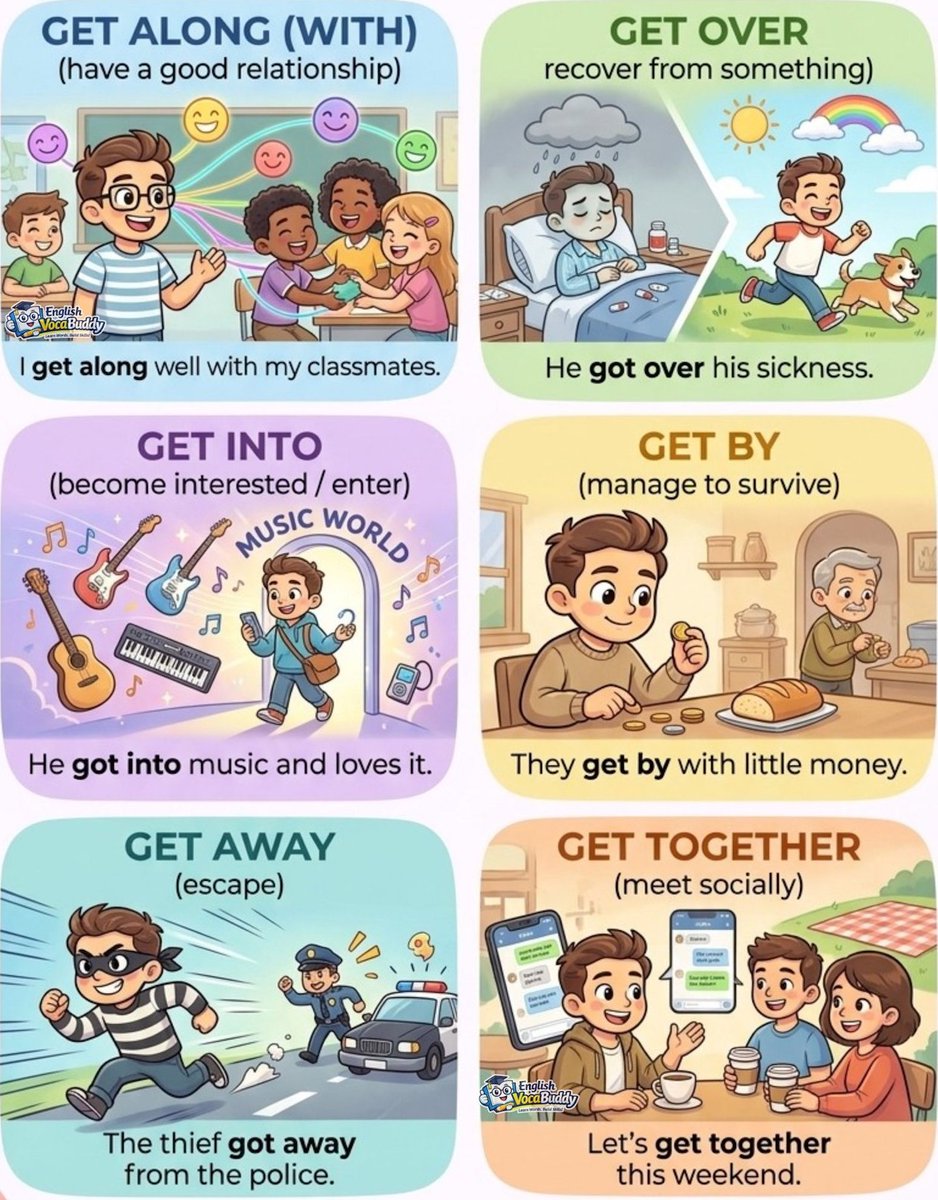
Phrasal Verbs With "Get"
🔹Get along (with)
= To have a good, friendly relationship with someone.
Example:
I get along well with my coworkers.
🔹Get over
= To recover from something (an illness, disappointment, or emotional problem).
Example:
It took her a long time to get over the breakup.
🔹Get into
= To become interested in something or start being involved in it.
Example:
He recently got into photography.
🔹Get by
= To manage or survive, especially with limited resources (money, time, etc.).
Example:
They get by on a small salary.
🔹Get away
= To escape from a place or situation.
Example:
The suspect got away before the police arrived.
🔹Get together
= To meet socially with friends or family.
Example:
We should get together for dinner sometime.
Different Words, Same Sound
🔹Gorilla (noun)
/gəˈrɪlə/
(guh-RIL-uh)
= A large, powerful ape (the animal you see on the left).
Example:
The gorilla beat its chest to show dominance.
Key point: This is the animal. It comes from Greek/Latin origins, referring to a tribe of hairy people, later applied to the ape.
🔸Guerrilla (noun or adjective)
/gəˈrɪlə/
(guh-RIL-uh)
= A member of a small independent group fighting against a larger army, usually using surprise attacks and unconventional warfare. It can also describe the style of fighting itself.
Examples:
The guerrillas hid in the jungle and ambushed the soldiers."
Guerrilla warfare is very different from traditional battles.
Key point: This word comes from Spanish "guerra" (war) → "guerrilla" means "little war." The double "r" and "ll" are silent in English pronunciation, just like in "gorilla."









![RealEvilEnglish's tweet photo. "Eat [your] Words"
= to admit that you were wrong about something you said earlier, often in a reluctant or embarrassed way
It involves taking back a statement, promise, or strong opinion because it turned out to be incorrect or impossible to keep
Origin:
The expression comes from the idea of literally swallowing your own words; like forcing yourself to consume something unpleasant. It has been used in English since at least the 1500s. Another similar older phrase is “to eat crow” (also meaning to admit you were wrong in a humiliating way).
Examples:
🔹“I said the new restaurant would be terrible, but the food was delicious. I have to eat my words!”
🔹“She bragged that her team would win easily, but after the loss she had to eat her words.”
🔹“I promised I’d never use social media again… looks like I’m eating my words this week.”
In professional or formal settings:
🔹“The expert predicted the company would fail, but after its huge success, he was forced to eat his words.”
Grammar & Usage Tips
✍️Subject + eat one’s words (possessive: my, your, his, her, our, their)
✍️Common structures:
have to / be forced to / will eat one’s words
eat my words (very common in spoken English)
✍️Tense is flexible: present (“I eat my words”), past (“he ate his words”), future (“she’ll eat her words”)
Similar Idioms
🔸Backpedal – to change your position (less dramatic)
🔸Admit defeat / Swallow your pride
🔸Eat crow (American English, slightly stronger/humiliating)
🔸Put your foot in your mouth – saying something embarrassing (different from admitting you were wrong)](https://pbs.twimg.com/media/HJxUKE2W0AAtMee.jpg)
![RealEvilEnglish's tweet photo. Common Grammar Mistakes
❌Mistake: She don't like coffee.
✅Correction: She doesn't like coffee.
✍️Explanation:
Subject-Verb Agreement (Don't vs. Doesn't)
Rule:
Use [doesn't] with he, she, it (third person singular).
Use [don't] with I, you, we, they.
Tip: Think of "does" as the helper verb for one person (he/she/it).
Extra examples:
He doesn't speak Spanish.
It doesn't work.
My sister doesn't like mornings.
❌Mistake: Me and him went to the store.
✅Correction: He and I went to the store.
✍️Explanation:
Pronoun Order & Subject Pronouns
Rules:
When talking about yourself and another person, put the other person first (politeness rule).
Use subject pronouns (I, he, she, we, they) when they are the subject of the sentence.
Never start with "Me" when it's the subject.
Tip: Remove the other person and test the sentence:
"Me went to the store" → sounds wrong → so it must be "I went."
❌Mistake: They was at the party last night.
✅Correction: They were at the party last night.
✍️Explanation:
Past Tense of "To Be" (Was vs. Were)
Rule:
Was → singular (I/he/she/it)
Were → plural (we/you/they) + "you" (singular or plural)
Extra examples:
We were tired.
You were right.
The children were happy.
❌Mistake: I have less books than you.
✅Correction: I have fewer books than you.
✍️Explanation:
Countable vs. Uncountable (Fewer vs. Less)
Rule:
Fewer → countable nouns (you can count them: 1 book, 2 books...)
Less → uncountable nouns (you can't count them easily: less water, less time, less money)
Tip: If you can put a number in front, use fewer.
Extra examples:
I have fewer friends than before.
There is less sugar in my coffee.
She spends less money now.
❌Mistake: The cat laid on the bed.
✅Correction: The cat lay on the bed.
✍️Explanation:
Lie vs. Lay (Irregular Verbs)
Quick Reference:
Lie = to rest/recline → Present: lie | Past: lay | Past Participle: lain
Lay = to put something down → Present: lay | Past: laid | Past Participle: laid
Remember:
The cat lies on the bed every day. (present)
Yesterday the cat lay on the bed. (past)
She laid the book on the table. (past of lay)](https://pbs.twimg.com/media/HJwPI7UW4AA-eR5.jpg)