@jarretblaze@paulg There is an entire section of their website on exactly this... https://t.co/3qETNn1YCf Some it become vynil records with Coldplay, car accessories with Kia, sunglasses...
Actually it’s better to look at unit economics as total spending in past few years has included a lot of dev cost. Actual cost/yr to maintain current rate of interception incl depreciation is <10m. Long term I think we can get to ~2m/yr per percentage point of emissions cut. We already achieve this in our best deployment.
Our new research exploring how plastic moves through vast river systems just commenced in the Amazon River in Manaus.🇧🇷 Just days into this research, we have already observed impressive transport distances (more than 500km in less than 5 days for some drifters).
And this is why the West should be deeply concerned by this chart. Held back by fossil lobbyists, electrification is being made too slow and too expensive in most western countries.
Stonehaven aren’t pollsters, they’re lobbyists, being paid by the gas industry to prolong unhealthy, dirty, climate-destroying boilers.
As it happens, all electric homes are cheaper to run, better to live in and healthier.
The gas industry know this and are shitting themselves.
One underappreciated fact about the ocean plastic problem is that plastic pollution is persistent in some places but not in others.
For most of the world's oceans, plastic only persists for a few weeks or months before ending up back on land. In our models, we see that 80% leaves the ocean again within a month and 97% within a year.
What this means is that, when we reduce the amount of plastic flowing into the ocean, we should see an almost immediate reduction in the amount of plastic in the ocean.
It also means that most plastic pollution you see is hyper-local. Unlike something like CO₂, countries and cities therefore have a "selfish" incentive to curb their plastic emissions. For example, want to eliminate plastic pollution in Bali's waters and coastlines? Then stop plastic from leaking from Bali's towns and cities!
Another consequence is that, for most of the world's oceans, there is no need to sweep the ocean surface; it cleanses itself once we stop putting new waste in.
The exception to this is the ocean garbage patches, where currents trap the plastic and keep the trash away from coastlines, preventing it from washing up.
This is why The Ocean Cleanup employs a two-pronged approach: intercepting plastic in rivers to stop inflow and cleaning up the legacy pollution in the ocean garbage patches.
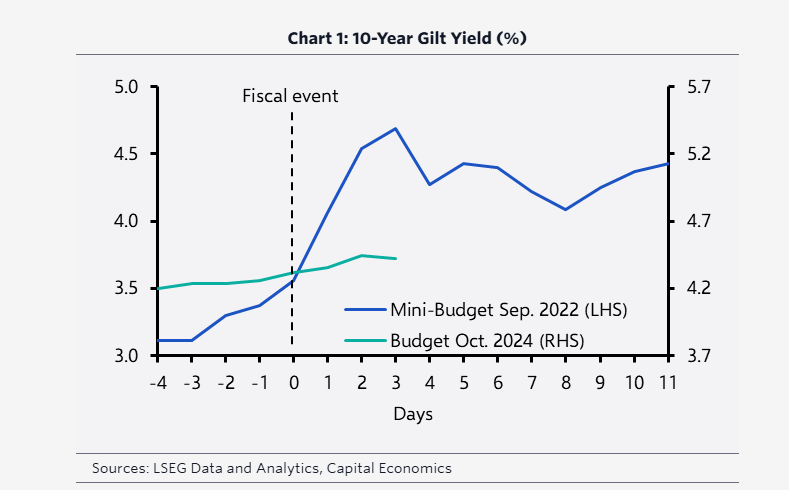
Capital Economics helpfully puts the post #Budget UK government debt market moves in context.
There's been a rise in 10 year Gilt yields - a sign of market repricing in response to the extra borrowing - but nothing really comparable to what happened after the Sep 2022 Truss mini-Budget...
On September 25th, the first trash flood of the rainy season occurred on the Rio Motagua in Guatemala - Interceptor 021 stopped it from reaching the Gulf of Honduras.
@BoyanSlat I keep seeing more and more meeting rooms after you, alongside inspirational engineers who strive for a better world.
Your approach to the clean up (regardless of outcome) is already inspirational to kids and engineers all over the world.