@NHL94King@JomboyMedia Not racism, my dad indoctrinated me on men only having short hair also. Cis men are so jealous of good hair for no reason. Like why are you mad at another man having good hair U jealous fuck. @NHL94King u are a faggot, eat shit and die you cock sucking bitch. Hockey homo ,fag bag
@DoDeportations This is a you problem, show the form where there is literally no option to declare as Spanish/hispanic. SHOW THE FORM BITCH. You force us to declare white or black and we always choose white because that influences the judges decision
@mattvanswol I got processed one time in Ohio back in like 2010 and there was no options for Spanish or other. It was white, black and asian as the only options and you had to choose. So given that choice what would you go with?
@jyammagames you dumb fucks didn’t include a map for Entoria: the last song. Great game but fuckn unplayable without a map. RETARDS had one job. Put a map in your next game dick heads stope being cute
What if you could walk past a surveillance camera and remain unrecognizable to artificial intelligence, while still looking completely normal to other people?
That is exactly what Dutch designer Jip van Leeuwenstein set out to achieve. He created a transparent face mask specifically designed to confuse AI-powered facial recognition systems without hiding the wearer’s identity from human observers.
At first glance, the mask appears almost invisible. Its clever design subtly alters the geometric relationships between key facial features, eyes, nose, mouth, and jawline, that AI systems rely on to identify individuals. To the human eye, the wearer’s face and expressions remain clearly visible and recognizable. To facial recognition algorithms, however, the facial data becomes distorted and much harder to process accurately.
The project was developed as part of the Surveillance Exclusion initiative, which examines the tension between privacy, technology, and the rapid spread of facial recognition in public spaces. Although the mask was first introduced several years ago, it has regained attention as AI surveillance becomes more widespread in airports, smartphones, security systems, and cities worldwide.
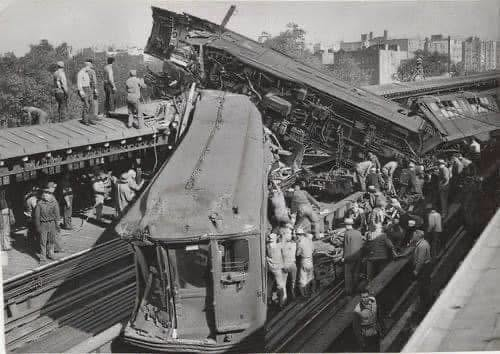
This shows the aftermath of the IRT 4 train crash at the Mosholu Parkway Station in The Bronx.
The accident took place on October 23, 1952, when one train rammed into a stopped train at full speed.
The impact caused the trains to completely detach from their axles.
Following the accident, emergency brakes were implemented on NYC subway tracks to prevent similar collisions.