THREAD — BENKAN
What if the AES stopped copying political models from elsewhere and created a new one of its own?
I call this idea Benkan.
Here is how it could work. 🧵
BENKAN
A proposal for a new model of governance for the AES
For decades, Africa has been told that it must learn to govern by copying the political models of others.
Yet West Africa governed great empires long before colonialism. Our ancestors created institutions suited to their societies and their time.
So why couldn’t the AES imagine a new way of governing?
I call this idea Benkan.
In Bambara, Benkan means agreement, unity, and the willingness to move forward together.
The idea is simple.
Mali, Burkina Faso, and Niger would each keep their own institutions, administrations, and governments.
But the presidency would become a service, not a possession.
Each leader would continue forming and leading a government in their own country.
But after one year, the presidents would exchange positions.
The president of Mali would govern Burkina Faso.
The president of Burkina Faso would govern Niger.
The president of Niger would govern Mali.
Then the rotation would continue until each president had governed all three countries.
Why?
Because a leader who governs all three peoples can no longer think only as a national leader.
They would learn the realities of each country.
They would govern with the interests of the entire Confederation in mind.
And they would build a political trust that goes beyond national borders.
This is not a revolution.
It is an experiment.
At the end of the cycle, the citizens of the three countries would decide by referendum:
Continue.
Modify.
Or abandon it.
The final word would always belong to the people.
Every great institution in the world began as an idea.
Benkan is simply an idea.
But perhaps, one day, it could become something more.
Je ne cherche ni les likes ni les interactions Plusieurs vidéos insultant notre pays circulent et ça m’a vraiment touchée J’ai simplement réagi avec sincérité pour défendre mon pays. Rien de plus J’espère que personne ne le prendra mal 🥺🙏🏽
@AfricanPatriot_
Exactement. C'est regrettable de voir les débats politiques internes au Nigeria—notamment entre partisans du gouvernement et de l'opposition—dériver vers un dénigrement inutile du Sahel et du Mali.
Nous partageons des liens historiques profonds, des siècles d'échanges et une fraternité culturelle bien ancrée (de nos relations séculaires avec le pays Hausa jusqu'à notre avenir régional commun). Ne laissons pas des manœuvres politiques passagères fracturer une amitié bâtie sur le respect mutuel.
À vrai dire, ce sont généralement les Nigérians favorables à Tinubu qui partagent ce genre de vidéos en réponse à une partie de l’opposition nigériane, laquelle critique leur gestion des conflits tout en présentant les États du Sahel comme des exemples à suivre. Mais au lieu de répondre directement à leurs propres opposants et à leurs critiques internes, certains préfèrent détourner le débat en passant leur temps à dénigrer les États du Sahel.
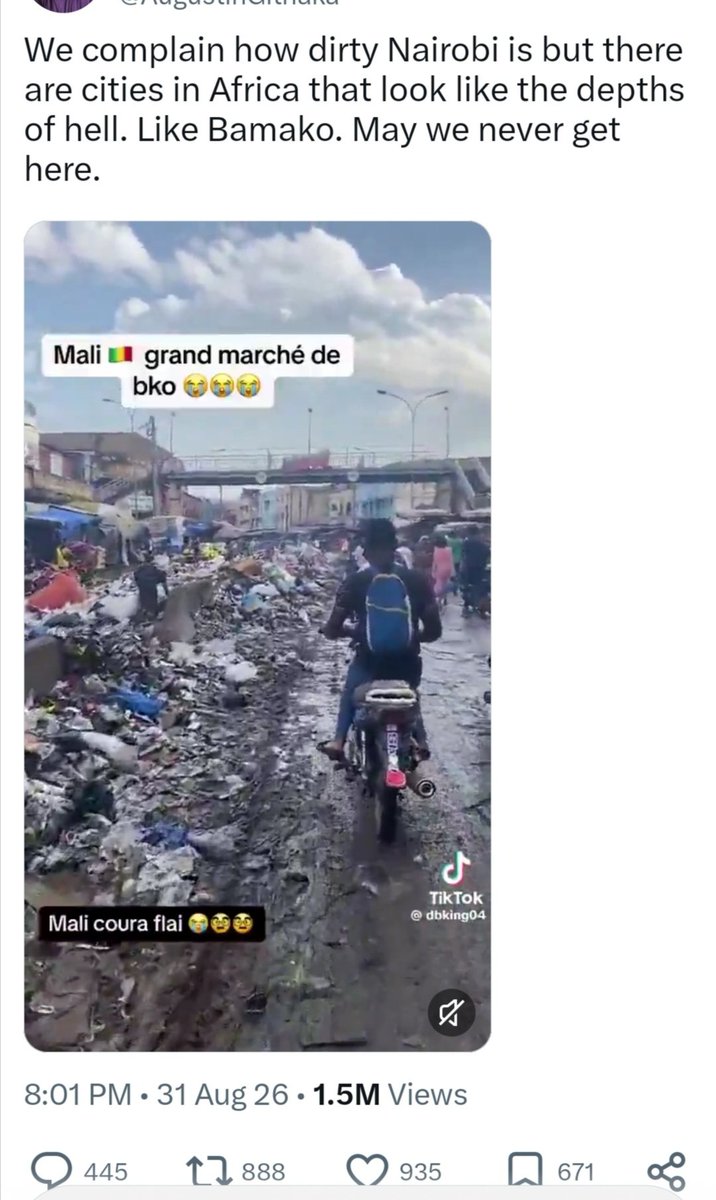
Les vidéos anciennes ou modifiées par l’IA ne changent pas la réalité Voici le même endroit au Grand Marché de Bamako aujourd’hui propre animé et plein de vie Arrêtez de diffuser de fausses informations sur le Mali
Posting old or manipulated AI-generated trash videos doesn’t change reality. Here is the exact same location in Grand Marché, Bamako today—completely clear of that fake mess and moving with normal daily life. Stop spreading cheap digital disinformation to push a false narrative about Mali.
Effectivement, et bizarrement elle refait surface aujourd’hui et relayée par les comptes et blogs des ennemis.
Faites attention ⚠️, car il y’a des vendeurs de rêve 💭 parmi nous !
@Grace4226415@finally_STONE@Kahouba1 "Just wanted to share this with you—the image isn't real and is actually quite old (several years back), not from a recent event. Thought it would be helpful to pass along so you have the right context, whatever you choose to do with it!"
This video is 3 to 4 years old and does not represent what Bamako looks like today. Let’s stop spreading outdated footage and misinformation just to push a narrative. Please verify before posting.
This is Bamako, the capital of Mali.
This is the country Pan Africans use to insult Nigeria and claim is on the path to greatness.
At least Abuja is not like this.
@finally_STONE@Grace4226415@Kahouba1 Je ne peux pas confirmer si cette vidéo est générée par AI ou pas. Par contre, ce que je sais, c’est que ce n’est pas une vidéo récente. Elle date de très longtemps, peut-être d’il y a environ cinq ans. Ce n’est pas une vidéo de maintenant.
🇲🇱 Good bye to French history for Malian learners, instead children with be taught on the Malian empire and great African kingdoms.
Why must Africans be forced to learn about Foreign history when we have a wealth of interesting history to teach our young future leaders..
When many people hear the word “Sahel,” they imagine a dry, empty landscape beneath the Sahara — a place of sand, drought, conflict and distance.
But that picture is incomplete.
The Sahel was never empty. And the desert was never simply a wall.
For generations, people moved through this region by river, across the desert, between villages and from one market to another. They traveled by boat, donkey, horse, camel and on foot. They carried food, animals, goods and stories — but most importantly, they carried connections between communities.
The Niger River was much more than water. For the people living along its banks, the river was a road. Songhai, Fulani, Bambara, fishermen, farmers, blacksmiths, traders and others depended on this network of water, villages and markets.
But the desert was a road too.
Tamasheq and Arab communities traveled through the desert along routes connecting settlements, water points and markets. They knew the land and knew how to move through it.
And the markets were where these worlds met.
Fish came from the river. Farmers brought grain and vegetables. Blacksmiths brought what they had made. People from the desert brought handmade goods and other products. The market was not just a place to buy and sell. It was where people exchanged goods, news, stories and relationships.
Modern borders can make us forget this history.
Mali, Niger, Mauritania, Senegal, Burkina Faso and Algeria are separate countries today. But rivers crossed borders. Trade routes crossed deserts. Families and communities were connected across territories long before modern borders existed.
The Sahel was not an empty space between the Sahara and the rest of Africa.
It was a network — of rivers, deserts, markets and people constantly moving between them.
And if we want to understand the Sahel today, we have to understand that history first.