I just want ONE Republican to grow some balls and ask two basic questions of RFK JR:
1) "You once described gun owners as a terror group. Do you still hold that view and can you clarify?"
2) "You once called oil and gas heads 'traitors who should be jailed for all eternity' and demanded they be put to 'corporate death.' Do you still hold that view and can you clarify?"
Why is clarifying these questions important? Because HHS has been weaponized to target firearm owners (remember the push to classify firearm homicide as a "health epidemic") and the CDC-directed pause on rents during COVID. There is always mission creep that includes the animus of the person leading the agency.
We have a right to ask these questions and no one should be afraid to ask them or have them asked. We did not create these statements which require explanation.
I'm not looking for a pound of flesh, I and others just want assurances. We do not get them without these questions. You should question the character of these senators if they fail to do their duty to voters by omitting these questions.
https://t.co/rMzGLX5INP
https://t.co/vftMwzaGrf
https://t.co/ZMfp5XX76l
https://t.co/s3DPRyBNeh
People need to stop overreacting about Kamala’s plan to reduce food inflation, as if it would lead to communism, mass starvation, and the end of America.
I worked in M&A in the food industry. Here’s a step-by-step summary of what would actually happen:
1. The government announces that grocery retailers aren’t allowed to raise prices.
2. Grocery stores, which operate on 1-2% net margins, can’t survive if their suppliers raise prices. So the government announces that food producers (Kraft Heinz, ConAgra, Tyson, Hormel, et. al.) also aren’t allowed to raise prices.
3. Not all grocery stores are created equal. Stores in lower-income areas make less money than those in higher-income areas, as the former disproportionately sell lower-margin prepackaged foods (“center of the store”) instead of higher-margin fresh products like meat (“perimeter of the store”). Because stores in lower-income areas aren’t able to cover overhead (remember, even if their wholesale costs are fixed, their labor, utilities, insurance, and other operating expenses aren’t fixed… yet), grocery chains start to shut them down. Food deserts in rural areas and in low-income urban areas alike become worse.
4. Meanwhile, margins for food producers are also quickly eroding. Their primary costs (ingredients, energy, and labor) aren’t fixed, and their shrinking gross profits leave less cash flow available to cover overhead, maintain facilities, and reinvest in additional production capacity.
5. Grocery chains, which have finite shelf space, start to repurpose their stores (those they didn’t have to shut down, I should say) to sell more non-price-controlled items—everything from nutrition supplements to kitchenware to apparel—and less price-controlled food products. Your local Kroger or Safeway starts to look and feel more like a Walmart.
6. Food producers stop making products with lower margins. Grocery chain start competing with each other to secure inventory. Since they can’t compete by offering stronger prices (remember, producers aren’t allowed to raise prices here, and, even if they could, grocery chains no longer have the gross profit to bear price increases), they compete on things like payment terms.
7. Small grocery chains start to shut down entirely, or get sold to larger chains like Kroger. In addition to not being able to cover fixed costs, a major reason for this is because they can no longer reliably secure delivery of products, due to producers prioritizing sales to larger customers, which are able to leverage their stronger balance sheets to offer superior payment terms.
8. Smaller food producers—which typically sell via distributors, rather than directly to grocery chains—start to go out of business. Because these producers have an additional step their value chains, and because they have lower volumes over which to spread their fixed costs, their cost structure is inherently disadvantaged compared to major food producers. When grocery stores aren’t able to raise prices, cutting product costs becomes all the more important, and deprioritizing purchases from smaller producers is an easy way to do so.
9. As supply chains break down, lines start to form outside grocery stores every morning. Cities assign police officers to patrol store parking lots, and food producers draft contingency plans to assign armed escorts to delivery trucks.
10. The federal government announces a program to issue block grants for states to purchase and operate shuttered grocery stores. The USDA also seizes closed-down production facilities.
11. The government announces that prices for all key food costs—corn, wheat, cattle, energy, etc.—are also now fixed, to stop “profiteers” from gouging the now-government-operated food industry.
12. Shockingly, the government struggles to operate one of the most complex industries on the planet. The entire food supply chain starts imploding.
13. Communism, mass starvation, and the end of America quickly ensue.
Hey wait a second
For those who don't understand what Chevron Deference is, and why SCOTUS ended it, here's the long and short of it:
A family fishing company, Loper Bright Enterprises, was being driven out of business, because they couldn't afford the $700 per day they were being charged by the National Marine Fisheries Service to monitor their company.
The thing is, federal law doesn't authorize NMFS to charge businesses for this. They just decided to start doing it in 2013.
Why did they think they could away with just charging people without any legal authorization?
Because in 1984, in the Chevron decision, the Supreme Court decided that regulatory agencies were the "experts" in their field, and the courts should just defer to their "interpretation" of the law.
So for the past 40 years, federal agencies have been able to "interpret" laws to mean whatever they want, and the courts had to just go with it.
It was called Chevron Deference, and it put bureaucrats in charge of the country.
It's how the OHSA was able to decide that everyone who worked for a large company had to get the jab, or be fired.
No law gave them that authority, they just made it up.
It's how the ATF was able to decide a piece of plastic was a "machine gun".
It's how the NCRS was able to decide that a small puddle was a "protected wetlands".
It's how out-of-control agencies have been able to create rules out of thin air, and force you to comply, and the courts had to simply defer to them, because they were the "experts".
Imagine if your local police could just arrest you, for any reason, and no judge or jury was allowed to determine if you'd actually committed a crime or not. Just off to jail you go.
That's what Chevron Deference was.
It was not only blatantly unconstitutional, it caused immeasurable harm to everyone.
Thankfully, it's now gone.
We haven't even begun to feel the effects of this decision in the courts. It will be used, for years to come, to roll back federal agencies, and we'll all be better of for it.
And that's why politicians and corporate media are freaking out about it.
This should come as no suprise. @CO_Municipal@COcounties & @sdacolorado all opposed SB23-303 that put HH on the ballot. This, after trying to work with proponents but being cut out of the secret, backroom meetings that actually led to 303. #NoOnHH https://t.co/5YXOlgmCgu
Sadly, this taxpayer-funded self promotion by Jena is exactly why @AndersonCOSoS is running for Secretary of State. We need leaders who prop up the people, not themselves. #copolitics
Yes, I’m a Mom on a Mission to make Colorado affordable again while keeping hard-earned dollars in your pockets, ensure our safety, protect our kids’ futures, and be a voice for rural Colorado. #heidiforgov#MomOnAMission
https://t.co/bMawhS1wgo
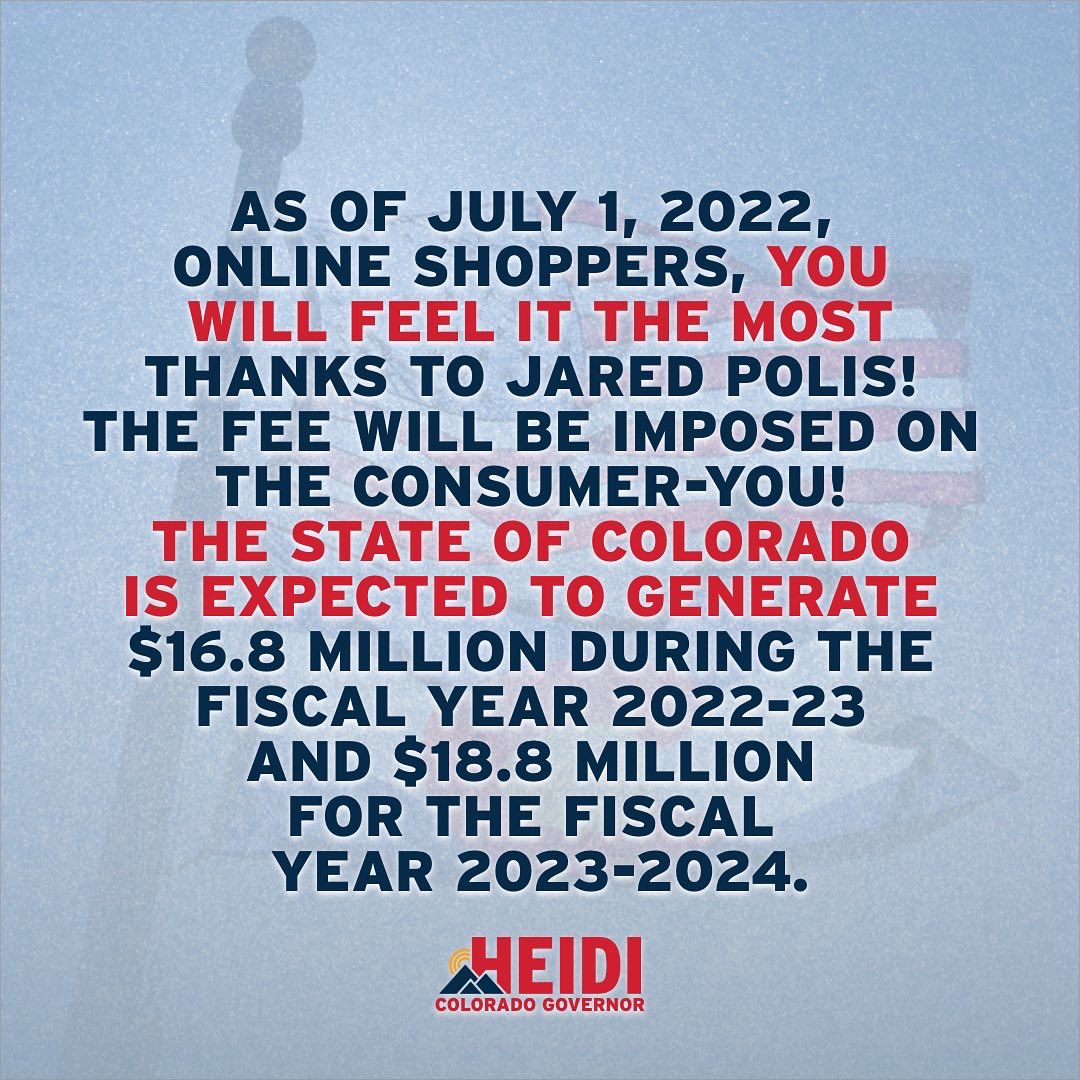
Don't be fooled by Election Year Polis' and his "I'm Saving You Money" tactics. Since Polis has been in office, he's implemented over 85 new taxes which is taking money straight out of your pocket, Colorado! #heidiforgov