7/7
The Gernsheim entry on the event, he tells us about a “clear readable image” from a flash of light “1/100,00 of a second or less” in ‘The History of Photography, ……’ Helmut & Alison Gernsheim, Thames & Hudson, London, 1969 p445. -30-
Talbot understood the two most important factors required to bring the photographing of fast-moving objects into reality. He stressed the illumination that was required.
Soon, sequential photographs will replace posed photographs.
Talbot understood the two most important factors required to bring the photographing of fast-moving objects into reality. He stressed the illumination that was required.
Soon, sequential photographs will replace posed photographs.
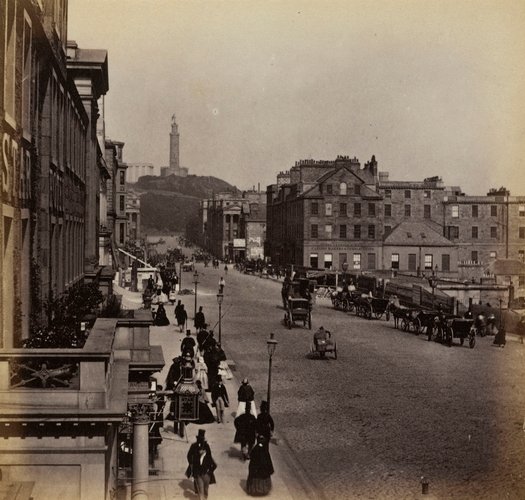
You will recall that 8 years later in 1859, that George Wilson published instantaneous images, including one of Edinburgh's Princes Street, below which I showed earlier this week.
However, as opposed to Talbot, 40,000 of Wilson's instantaneous photographs exist.
I spoke on Wilson not long ago.
You will recall that 8 years later in 1859, that George Wilson published instantaneous images, including one of Edinburgh's Princes Street, below which I showed earlier this week.
However, as opposed to Talbot, 40,000 of Wilson's instantaneous photographs exist.
I spoke on Wilson not long ago.
Other sources have documented a slower shutter speed of 1/2000th/sec with an f/32 aperture (Lincoln L. Endelman ‘A Brief History of High-Speed Photography 1851-1930,’ 1988).
Talbot found the resulting photograph to be “just as sharp as if they had been motionless.”
Talbot developed the picture in a darkened room in front of his audience and a “clear readable image of the printed page” was produced.
Even though the photograph has not survived, I congratulate Talbot on his witnessed accomplishment.
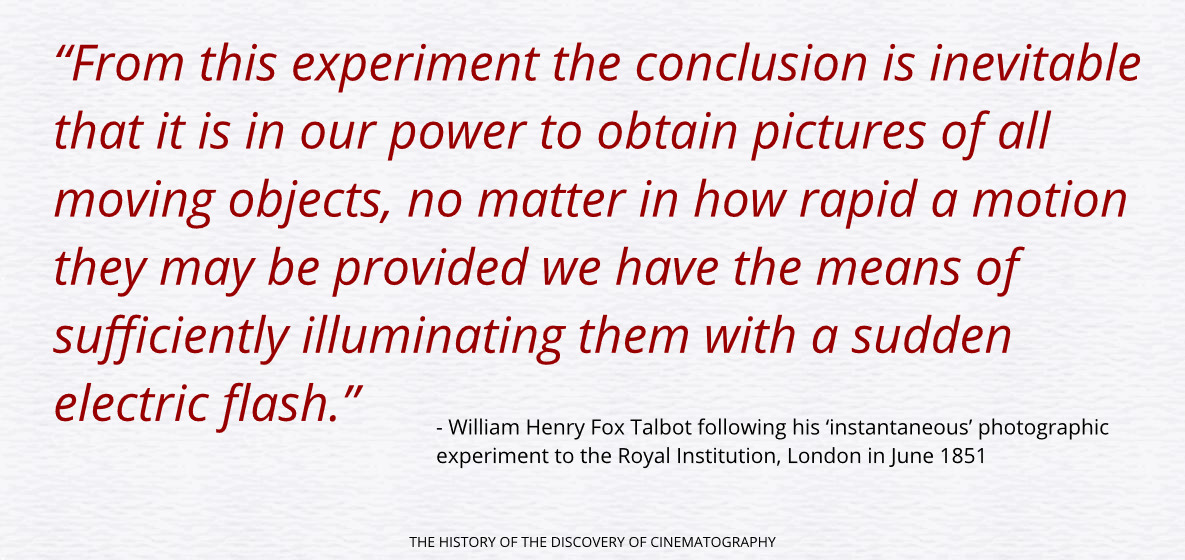
Talbot secured a page of newspaper to a rapidly spinning wheel, and with lights out, he created a spark from a set of Leyden jars, obtaining an ‘instantaneous’ exposure that is documented to have been up to “1/100 000th of a second or less”(Gernsheim p445).
Talbot presented related findings, including "On the Production of Instantaneous Photographic Images," and included aspects in his 1851 patent.
It built on earlier work with electric sparks and high-speed phenomena (e.g., inspired by devices like Wheatstone's) but was a major step for photography, showing exposures far shorter than sunlight or continuous light allowed at the time.
This experiment is well-documented in historical accounts of photography and flash technology, though practical high-speed flash only became widespread much later.
Talbot's demonstration remains a landmark in freezing motion photographically.
1851
INSTANTANEOUS PHOTOGRAPHY
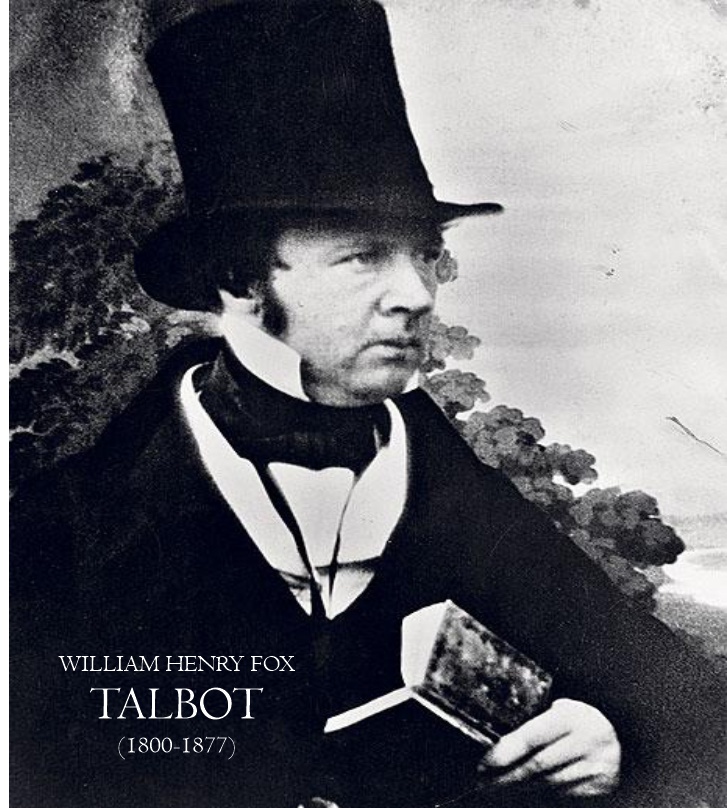
WILLIAM HENRY FOX TALBOT (1800-1877)
In the summer of this year on 14th June, twenty years before Instantaneous Photography was generally accepted by the photographic world [1871], Talbot not only proposed photographing pictures clearly when in rapid motion, he demonstrated it to an audience at the Royal Institution, London.
He used an electric spark from a set of charged Leyden jars (early capacitors) to illuminate the moving page for a tiny fraction of a second, exposing a photographic plate (an albumen or Amphitype plate) in a camera.
The result was a sharp, legible image of the text on the newspaper, with every letter appearing pin-sharp despite the high speed of rotation—proving that photography could "freeze" motion too fast for the human eye.
This brought us so much closer to what we know today as cinematography. ─ Talbot Catalogue Raisonné.
1/1
HONOURABLE MENTION
THE LATE PRE CINEMA PERIOD
THE DIARAMISCOPE
Over the years I have stumbled upon the names Diaramiscope and Diaramascope, where the latter could have some kind of relationship to the Diorama.
Nonetheless, I have never been able to clearly identify what this contraption, which appears to have existed, is.
I have seen it mentioned in the proverbial framework of historical optical devices, specifically in texts discussing early motion picture projectors and cameras, such as in the Hopwood book Living Pictures; Their History, Photoproduction and Practical Working.
In these references, Diaramiscope is listed alongside other better-known devices in the pre cinema category, suggesting it may be a specialized optical instrument or projector used for displaying images or transparencies, possibly related to early cinema or microscopic imaging.
Nothing more to say for now, except I’m still looking. -30-
8/8
This article https://t.co/YHZMO5s9qL on David Acheson Woodward first appeared in ‘Forays,’a cross-disciplinary review published by the Maryland Institute, College of Art, in the Spring of 1996.
Written by Jack Wilgus.
Image Bright Bytes https://t.co/IR7HaM6VJ8 -30-
A cross section schematic image for the first model of David Woodward's Solar Enlarging Camera, 1857.
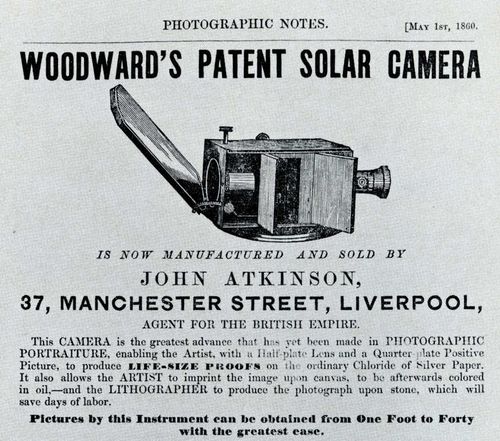
Anthony's Advertisement for 1858 showing Woodward's Solar Enlarging Camera, patented February 1857.
A cross section schematic image for the first model of David Woodward's Solar Enlarging Camera, 1857.
Anthony's Advertisement for 1858 showing Woodward's Solar Enlarging Camera, patented February 1857.
Right: A 1/4 plate camera from Roberts sitting on top of the Woodward enlarger for scale. The box is about four feet long from front of lens to back of mirror, with a height and width of a little over 14 inches.
Left: Woodward's patented Solar Enlarging Camera by itself.
Right: A 1/4 plate camera from Roberts sitting on top of the Woodward enlarger for scale. The box is about four feet long from front of lens to back of mirror, with a height and width of a little over 14 inches.
Left: Woodward's patented Solar Enlarging Camera by itself.
With this camera, he could create life-sized portraits (18 inches by 22 inches) from a half plate negative in about 45 minutes.
In 1859, he showed Antoine Claudet and according to Claudet, it was "…one of the most significant improvements introduced into the art of photography."
With this camera, he could create life-sized portraits (18 inches by 22 inches) from a half plate negative in about 45 minutes.
In 1859, he showed Antoine Claudet and according to Claudet, it was "…one of the most significant improvements introduced into the art of photography."
1
Then came along the photo printing system of enlarging a negative onto a sheet of photo paper.
Pictured: Woodward’s solar enlarger from the ‘Annual Encyclopedia’ by Daniel Appleton and Company, 1891.
2, 3
There were two sizes of the solar camera: a half plate with a 9-inch condenser and a quarter plate with a 5-inch condenser. Woodward was drawn to the idea of making larger duplicates of images on canvas to paint over. Images The National Gallery of Canada via Luminous-Lint.
Patents in the 1860s and 1870s added a heliostat — a clockwork motor to rotate the mirror to track the sun, and concentrate light on the condenser lens.
Pictured: seven of Woodward’s solar enlargers at the Enoch Long establishment in St. Louis. Image National Gallery of Canada.
Taken from ‘The History of Photography - From the Camera Obscura to The Beginning of The Modern Era,’ (Helmut and Alison Gernsheim, Thames and Hudson, London, 1969), on p312 we read what Gernsheim says about Woodward’s Solar Enlarging Camera.
Woodward patented the enlarging camera in 1857. Usually placed in a shuttered window of a dark room, this example at Woodward’s home studio. Its mirror and condenser lens focused sunlight through the negative and a copy lens onto the photographic paper.
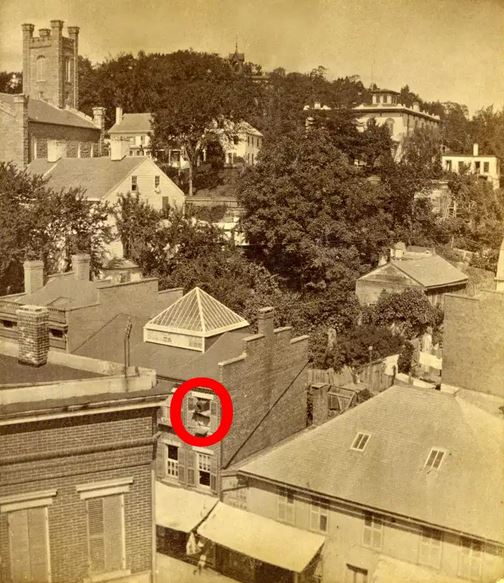
Here, a close up of the Woodward Solar Enlarging Camera placed into his home studio window just like an air conditioning unit. These cameras were typically positioned on the roof or in a window of a studio and were designed to rotate to follow the sun.
1857
SOLAR ENLARGING CAMERAS
DAVID ACHESON WOODWARD (1823–1909)
David Acheson Woodward was an American businessman and inventor, primarily known for his contributions to the development of solar energy technology.
Born in 1823, Woodward was a pioneer in the field of solar power during the late 19th century, a time when such concepts were in their infancy.
Woodward’s Solar Enlarging Camera was first introduced in 1857.
It could enlarge quarter plate and half plate portrait negatives to life-size with an exposure of about forty-five minutes using the intense light of the sun.
8/8
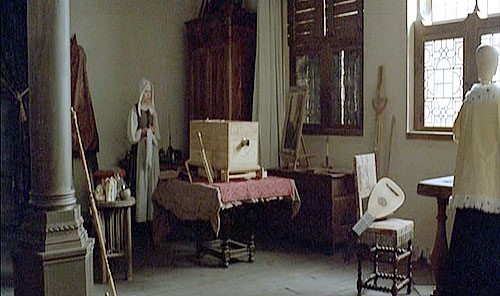
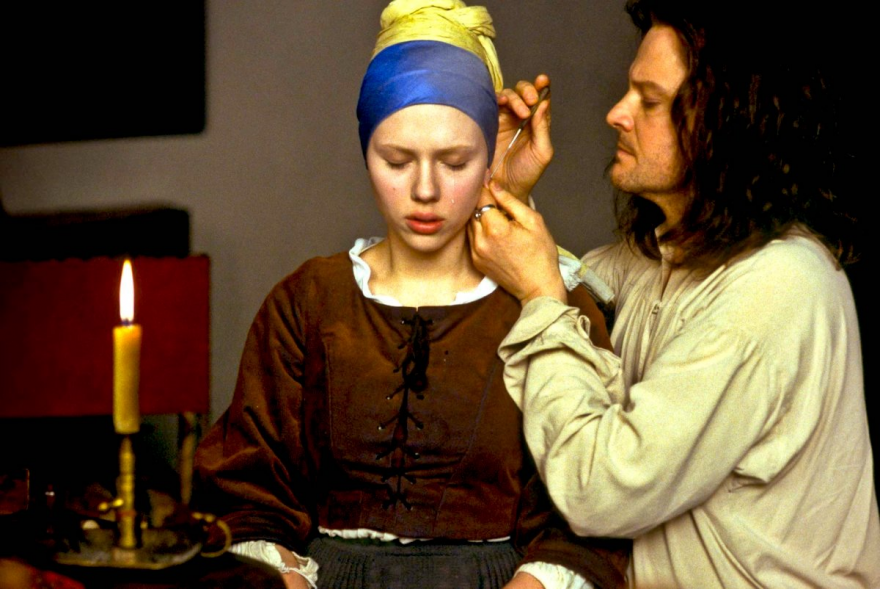
Here is the “how did it get in there?” scene from Peter Webber’s Vermeer biopic ‘Girl with a Pearl Earring’ from 2003 (Pathé Productions, Lions Gate Films) https://t.co/eQM4Y7sBFu -30-
G. J. Gravesande, a post-contemporary of Vermeer who was born 13 years after his death had this to say of Vermeer’s use of the camera, found in Jonathan Janson’s ‘Essential Vermeer 5.0 https://t.co/AOdPjWf0Vz:
G. J. Gravesande, a post-contemporary of Vermeer who was born 13 years after his death had this to say of Vermeer’s use of the camera, found in Jonathan Janson’s ‘Essential Vermeer 5.0 https://t.co/AOdPjWf0Vz:
By Vermeer's time, the camera was no longer just the size of rooms, but was portable too, and easier for artists to maneuver and set up. The lenses provided sharper and more vivid images.
Below, ‘Girl with a Pearl Earring’ (2003) the Vermeer biopic by Peter Webber with Scarlett Johansson and Colin Firth, showcased the Camera Obscura in some scenes.
As Vermeer presented the “circles of confusion” in ‘View of Delft’ as seen through the Camera Obscura lens, so did he present the natural blur of the drapery on the table and the sharpness of the painter himself in perfect focus just as the camera provides.