Our refrigerator just died... again. This is our second refrigerator in ten years. It was a Whirlpool, a "plain Jane" model with no bells, no whistles, and no fancy screens. We bought it for its simplicity, thinking it would be the one thing in our house that just worked.
It lasted five years and one month, exactly thirty days past the warranty.
The repairman’s verdict? A dead compressor. But the real diagnosis... it was Built to Break.
Under the guise of "green" regulations and "energy efficiency," we’ve traded tanks that lasted thirty years for plastic-heavy shells that barely last five.
We are forced to pay a premium for "high-efficiency" tech that saves ten cents a month on electricity, only to be told to throw the whole $1,500 + unit into a landfill when a single internal component fails.
It’s a racket. The government mandates the specs, the manufacturers cut the quality, and the consumer is left holding a bag of spoiled milk. We don’t own appliances anymore; we just lease them from the scrap yard.
@Jobeyfootball I have a rabbit hole theory. That if somehow Mike T retires after this year or somehow isn’t coaching in Pittsburgh next year Mike McCarthy the Pittsburgh boy becomes next HC. Pittsburgh draft, A Rod decides to run it back one more year with the coach he won a SB with. Lol 😂
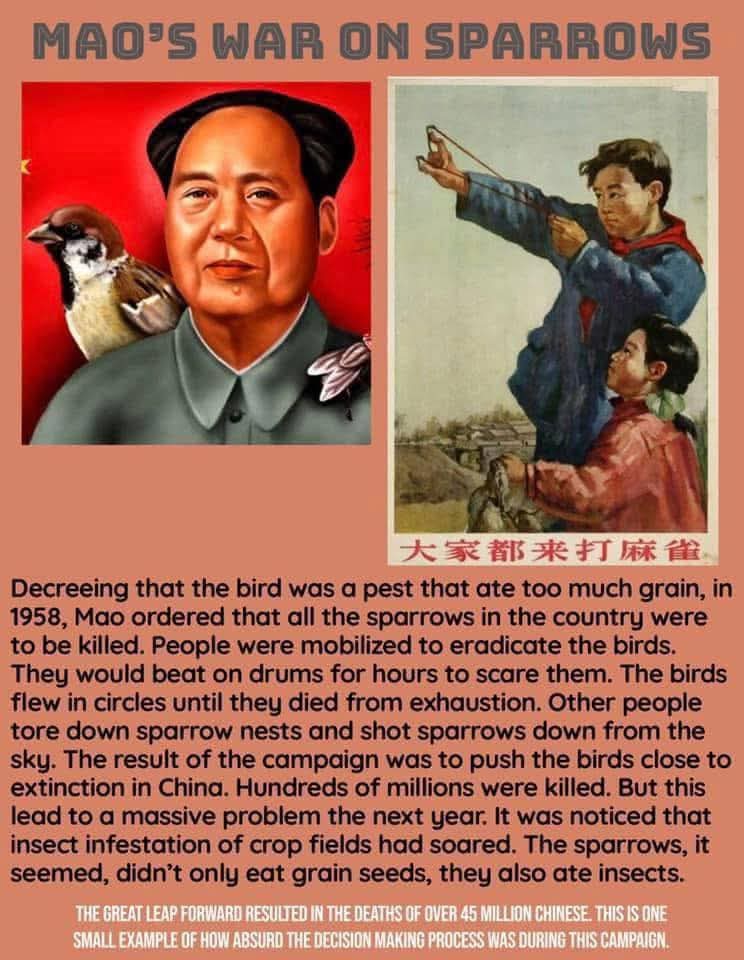
It’s fairly well known that Mao Zedong’s so-called Great Leap Forward (1958–1962) ended in the greatest man-made famine in human history—some 45 million dead, fields littered with corpses, villages emptied by hunger, and the sound of chewing bark mistaken for the crackle of grain. What’s less well known is that Mao’s revolution didn’t just declare war on landlords, capitalists, and reason—it declared war on nature itself.
In 1958, the Chairman launched what he called the Four Pests Campaign, a crusade against rats, flies, mosquitoes—and, inexplicably, sparrows. The tiny birds, Mao decreed, were “enemies of the people” for daring to eat the people’s grain. And so, as one historian put it, an entire civilization mobilized against the feathered menace. Schoolchildren banged pots and pans in the streets, peasants drummed on washbasins, and factory sirens screamed for hours to keep the birds in flight until they fell dead from exhaustion. Nests were torn down, eggs smashed, and chicks stomped into the earth.
The results were biblical. In Beijing alone, more than a million sparrows were killed in a matter of weeks. Rural communes competed to see who could pile the highest mountain of avian corpses, a kind of grotesque festival of progress. But victory, when it came, was short-lived. The sparrows, it turned out, had been eating more insects than grain. Within a year, the skies were empty, and the earth was crawling. Locusts rose like living clouds, devouring fields from horizon to horizon. Peasants watched in horror as the crops disappeared into the mandibles of an unstoppable plague of their own making.
Rather than admit his mistake, Mao doubled down on absurdities. He replaced the sparrows with imported Soviet “science”—the theories of Trofim Lysenko, an agronomist who believed that crops could be re-educated through hard labor. Genetics was bourgeois nonsense, Lysenko said; what mattered was enthusiasm. If you plowed deeper, planted closer, and shouted revolutionary slogans loudly enough, the harvest would multiply. Yes, they actually believed that. So fields were churned to depths that strangled their roots, seedlings planted shoulder to shoulder until none could breathe, and bureaucrats inflated yields to impossible heights. Mountains of fake grain were reported; much of the real grain exported to show socialist success.
By 1960, China was starving. Whole provinces were dying in silence. Peasants boiled leather belts for soup, mothers abandoned their infants by the roadside, and in some villages, desperate men turned cannibal. Still, the propaganda blared: “The people’s communes are good!” Mao’s war on sparrows was part of a nationwide war on reality itself.
Years later, a survivor put it simply: “We killed the birds, and then the insects ate everything else.” It was the perfect epitaph for Mao’s age—a revolution so blinded by ideology that it devoured not only its people, but the very balance of life that sustained them.
#archaeohistories
November 26, 1998
Thanksgiving Overtime Coin Toss Fiasco
Referee Phil Luckett asks #Steelers captain Jerome Bettis to call it in the air. It lands on "tails".
Bettis says he called "tails", but Luckett says Bettis called "heads" and awards the #Lions the ball
Lions win, 19-16