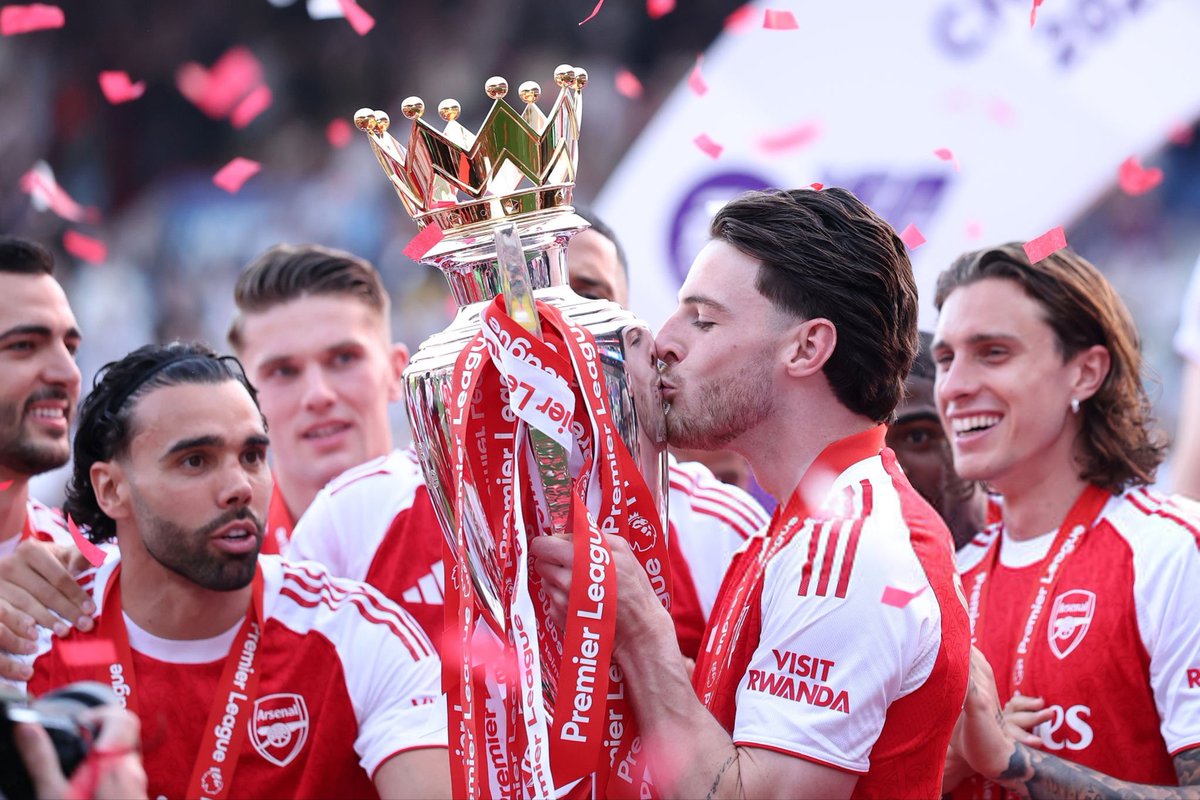
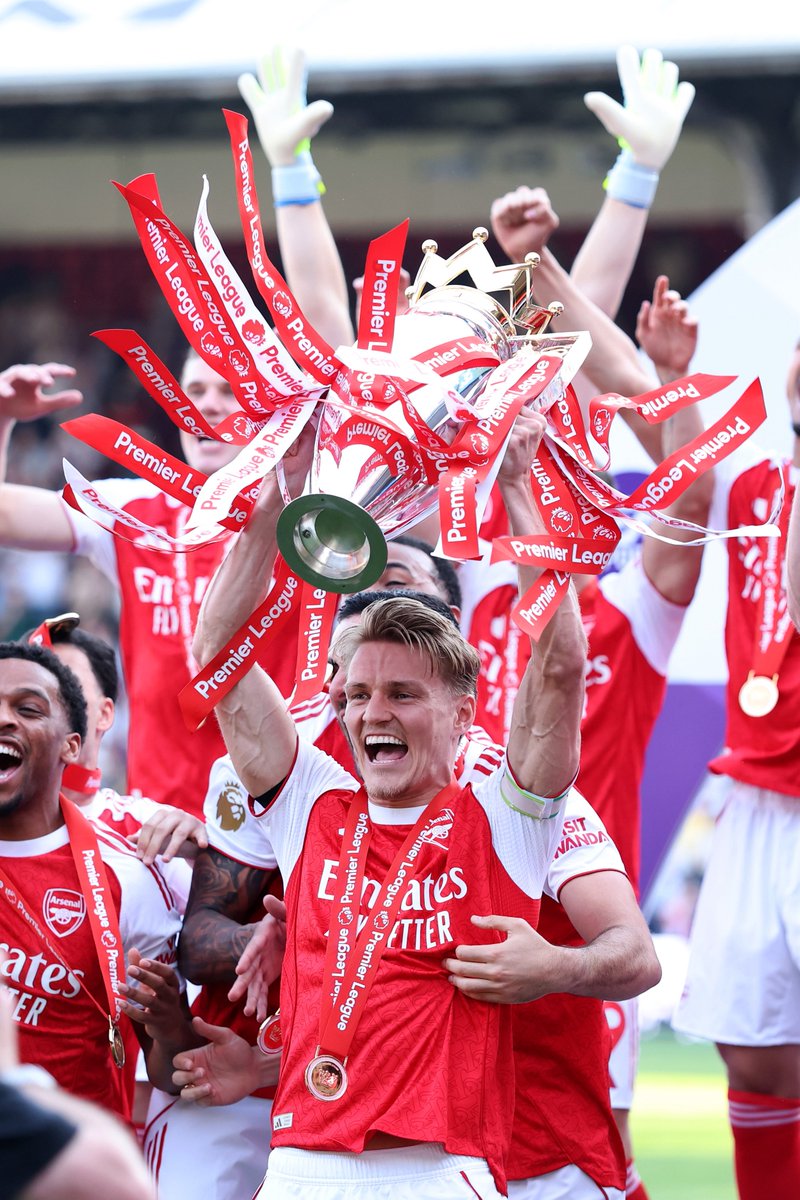
**The Arteta Project: From Doubt to Proof**
When Mikel Arteta arrived at Arsenal in December 2019, he did not inherit a team close to glory. He inherited a club with damaged confidence, weak standards, confused recruitment and no clear identity. Arsenal were not just losing games — they had lost their authority.
That is why the Arteta project was never only tactical. It was cultural first.
The early FA Cup win in 2020 gave him credibility, but the league form showed how much work still had to be done. Arsenal were still inconsistent, emotionally fragile and carrying too many players who did not fit the direction of the club.
Then came the hard part: the reset.
Arteta moved Arsenal away from comfort. Big names left. Young players became central. The squad got younger, hungrier and more coachable. The club stopped trying to patch problems and started building a proper spine.
That spine became the foundation:
Saliba and Gabriel gave Arsenal defensive security.
Saka became the face of the attack.
Ødegaard became the creative brain.
Rice became the leader and emotional engine.
Raya improved control from the back.
The squad became less about names and more about functions.
Tactically, Arsenal evolved massively.
They went from being a team trying to play good football to a team that controls games through structure. The biggest change has been out of possession: pressing, rest defence, compact spacing, transition control and set-piece dominance.
That is where Arteta separated this Arsenal from previous versions.
Old Arsenal could play beautifully but still feel vulnerable. This Arsenal can suffer, defend, manage pressure and win ugly. That is the difference between a good team and a title-winning team.
The real genius of the project is that Arteta changed the club’s expectations.
At first, fans wanted progress.
Then they wanted top four.
Then they wanted a title challenge.
Now a Champions League final and a Premier League title feel like the standard.
That is the transformation.
Arteta did not just build a better Arsenal team. He rebuilt Arsenal’s belief system.
From “trust the process” to “finish the job.”
From being mocked to being feared.
From potential to proof.
This Premier League title is not just a trophy. It is the receipt for every hard decision the project survived.
As you gradually realize that with people who can’t tune into your wavelength, no matter what you say, it’s all just wasted breath, you slowly learn to keep your mouth shut. When you see clearly that no matter how you put it, that person just lets it go in one ear and out the other, not taking it seriously at all, you understand that your words are utterly worthless to them.
PSG vs Arsenal: Champions League Final Tactical Analysis
This final is the cleanest clash of styles you can ask for.
PSG are the chaos team. Arsenal are the control team.
PSG want the game to open up. They want broken phases, fast attacks, 1v1s, rotations, and space for Dembélé, Doué and Kvaratskhelia to attack defenders before Arsenal can reset.
Arsenal want the opposite.
Arteta’s team need the game to be compact, controlled and played on their terms. The key is not just possession. It is what Arsenal do after losing the ball. Their rest defence has to be perfect, because PSG are probably the most dangerous transition team in Europe.
This final is not just attack vs defence.
It is chaos vs control.
PSG need space.
Arsenal need structure.
If PSG turn the game into transitions, they can hurt anyone.
If Arsenal control the middle, kill counters and dominate set-pieces, they can make history.
PSG vs Arsenal: Champions League Final Tactical Analysis
This final is the cleanest clash of styles you can ask for.
PSG are the chaos team. Arsenal are the control team.
PSG want the game to open up. They want broken phases, fast attacks, 1v1s, rotations, and space for Dembélé, Doué and Kvaratskhelia to attack defenders before Arsenal can reset.
Arsenal want the opposite.
Arteta’s team need the game to be compact, controlled and played on their terms. The key is not just possession. It is what Arsenal do after losing the ball. Their rest defence has to be perfect, because PSG are probably the most dangerous transition team in Europe.
Set-pieces are Arsenal’s biggest weapon.
PSG can prepare for them all week, but defending Arsenal corners under final pressure is different. Gabriel, Saliba, Rice, Havertz and Gyökeres give Arsenal serious aerial power. If the final is tight, one corner or free-kick could decide everything.
For PSG, the key player is Dembélé. If he starts and is physically sharp, he gives PSG the kind of chaos that can break structure. If he is limited, PSG lose a major part of their unpredictability.
For Arsenal, Declan Rice is the key. He has to win duels, protect transitions, control second balls and help Arsenal manage the emotional weight of the final.
Truly exceptional people aren't those who work harder than others. Rather, they are those who see the underlying structures earlier than others. To do that, you must understand these theories:
1. Kondratiev Wave: Wealth doesn't flow randomly; it migrates along cycles of technological revolution.
2. Wave Theory: Behind market prices, the essence is the cyclical oscillation of collective emotions.
3. Fractal Theory: The world repeats itself across scales; small structures often map onto large ones.
4. Power Law Distribution: The world is never even— a few people take the lion's share of the results.
5. Matthew Effect: The strong don't just win once; their advantages continually self-reinforce.
6. Black Swan Theory: Events that truly change the world are often impossible to predict in advance.
7. Antifragility Theory: Advanced systems don't resist fluctuations; they grow by leveraging them.
8. Complex Systems Theory: The world isn't a machine—it's a network that continually self-evolves.
9. Chaos Theory: Even tiny variables can trigger system-level outcomes.
10. Big Cycle Theory: Nations, currencies, and hegemony all follow cycles of rise and fall.
11. Technological Singularity Theory: Technological development isn't linear—it's exponentially accelerating.
12. Energy Determinism: The essence of civilization is the ability to acquire and utilize energy.
13. Game Theory: Many outcomes in human society aren't about right or wrong, but strategic equilibrium.
14. Information Entropy Theory: The more chaotic a system, the higher the cost to maintain order.
15. Path Dependence: Many people aren't limited by ability, but locked in by early choices.
16. Systems Dynamics: Many problems aren't isolated errors, but structural feedback loops.
17. Occam's Razor: The more fundamental the rule, the simpler it often is.
18. First Principles: Don't start from experience—start from the indivisible essence.
19. Evolutionary Dynamics: What eliminates you isn't often competitors, but changes in the environment.
20. Attention Economy: The scarcest resource in the future isn't money—it's attention.
You know what? Those porn bots in the comment sections—they're the ones who understand the X rules the best. Whichever post of yours gets recommended by the system, they're the first to show up.
Rivals spent years laughing at “trust the process.”
Now Arsenal have the Premier League trophy, a Champions League final, and every timeline watching nervously.
Funny how patience becomes unbearable when it starts winning.
Arsenal are Premier League champions, but the job isn’t finished.
PSG is the final boss now.
Best attack vs best defence.
Chaos vs control.
Firepower vs structure.
Budapest decides whether this becomes a great season or a legendary one.
Arsenal lifting the Premier League trophy and still having a Champions League final ahead is insane.
The project went from being mocked to standing one game away from immortality.
Arteta didn’t just rebuild a team.
He rebuilt belief.
Rival fans said Arsenal were irrelevant, then spent the whole season tracking our fixtures, injuries and set-piece routines.
That’s not irrelevance.
That’s unpaid scouting.
There are many benefits to going to prison:
1. Forced daily meditation and reflection
2. Quitting internet addiction
3. Quitting smoking addiction
4. Quitting alcohol addiction
5. Quitting porn addiction
6. Cutting off retreat paths (most important for entrepreneurs)
In this life, there's no choice to work a regular job anymore, only the option to go all in on entrepreneurship
10 Mind-Blowing Truths About Sales That Challenge Your Perceptions:
1. The world doesn’t automatically reward the best people; it rewards those who are “seen.”
2. Sales isn’t about deceiving people; it’s about delivering value to the world.
3. What’s truly scarce in entrepreneurship isn’t the product—it’s the ability to distribute.
4. The core of sales isn’t persuasion; it’s reducing the cost of understanding.
5. People don’t buy products; they buy “who I will become.”
6. Personal branding is essentially the channel and traffic gateway of the new era.
7. The highest level of sales isn’t hard-selling; it’s building trust over the long term.
8. Free content is often the most powerful form of sales in the internet age.
9. People who can’t sell will, in all likelihood, end up working for those who can.
10. Truly top-tier people don’t just create—they also spread the word.
@goalsside Olise is the dream, Barcola is the statement, Diomandé is the project.
Liverpool need one of them badly because that attack needs fresh 1v1 power and transition threat.