When you're young & have nothing you feel like a failure.
When you're old & had something but now have nothing you feel liberated.
What you had or didn't have it matters when you had it & then didn't have it versus when you don't have it and then have it.
Path in time matters.
I'm the VP of Litigation Strategy at Bayer AG.
I negotiated the Roundup settlement.
$7.25 billion.
65,000 plaintiffs.
All of them have cancer.
Non-Hodgkin lymphoma, specifically.
They say our product gave it to them.
We say it didn't.
We also paid $7.25 billion.
These two statements are not in conflict.
Legally.
The settlement explicitly states that Bayer does not admit Roundup causes cancer.
I wrote that clause.
It took eleven drafts.
The first draft said "Bayer acknowledges no causal link between glyphosate and Non-Hodgkin lymphoma."
Legal said "acknowledges" implies awareness.
Awareness implies knowledge.
Knowledge implies we knew.
We changed it to "does not admit."
"Does not admit" is perfect.
It doesn't say we deny it.
It doesn't say we confirm it.
It says nothing.
$7.25 billion worth of nothing.
The plaintiffs' attorneys wanted an admission.
I told them the number goes down if the admission goes in.
They chose the number.
They always choose the number.
Admissions don't pay for chemotherapy.
Numbers do.
I've been doing this for twenty-two years.
The first thing they teach you in litigation strategy is that a settlement is not a verdict.
A verdict is a finding of fact.
A settlement is a transaction.
We conducted a transaction.
The transaction was $7.25 billion.
The product is still on shelves.
Those are two separate facts that happen to be in the same sentence.
When Bayer acquired Monsanto in 2018, I was on the due diligence team.
$63 billion acquisition.
The litigation risk was on slide 47 of the risk assessment deck.
Slide 47 said "glyphosate exposure: ongoing claims, estimated liability range $5-15B over 10-year horizon."
The board reviewed all 82 slides.
They spent forty minutes on slides 1 through 46.
They spent six minutes on slides 47 through 82.
Slide 47 got approximately eleven seconds.
I know because I was watching.
The CFO said "manageable."
Manageable means the number fits in the model.
The model said Roundup would generate $48 billion in revenue over the same horizon.
$48 billion in revenue.
$5-15 billion in litigation.
The math works.
The math always works.
That's why they pay me.
After the acquisition closed, Monsanto's internal research files became our internal research files.
I have read them.
I am not going to tell you what they say.
I am going to tell you that our public position is that decades of scientific study support the safety of glyphosate.
Our public position and our internal files are stored on different servers.
This is standard practice.
The first lawsuits came in 2018.
A groundskeeper in California.
He had Non-Hodgkin lymphoma.
He sprayed Roundup for years.
A jury awarded him $289 million.
We appealed.
The award was reduced to $78 million.
We called that a win.
$78 million for one man's cancer.
We have 65,000 plaintiffs.
If you do that math, it's worse.
So we don't do that math.
We do different math.
$7.25 billion divided by 65,000 plaintiffs is approximately $111,538 per person.
Per person with cancer.
From our product.
That we don't admit causes cancer.
$111,538.
A mid-range sedan.
That's the number.
The payments are structured over 21 years.
Declining caps.
This means we pay less per year as time goes on.
Some of the plaintiffs will not be alive for all 21 years.
I didn't write that in the proposal.
But I modeled it.
The actuarial table is on page 14 of the internal projection.
It's titled "Claimant Attrition Forecast."
Attrition.
That's the word we use.
After the settlement was announced, the stock dropped 8%.
The analysts were disappointed.
Not in the cancer.
In the size of the provision.
They wanted $6 billion.
We came in at $7.25 billion.
The delta was $1.25 billion more than expected.
One analyst wrote "the litigation overhang continues to weigh on shareholder value."
Overhang.
65,000 people with cancer is an overhang.
Like a cloud.
Or an awning.
Something mildly inconvenient that blocks the sun.
The stock will recover.
It always recovers.
The product generates $4.8 billion in annual revenue.
We sell it at Home Depot.
Lowe's.
Walmart.
Amazon.
You can buy it right now.
Today.
The day we announced the settlement for 65,000 cancer claims.
You can buy the product.
The product that 65,000 people say gave them cancer.
For $27.99.
The label does not mention the settlement.
The label does not mention the 65,000 plaintiffs.
The label does not mention Non-Hodgkin lymphoma.
The label says "trusted by gardeners for over 40 years."
I didn't write the label.
But I approved the legal review that allowed the label to stay unchanged.
The review concluded that the settlement "does not constitute a regulatory finding and therefore does not require label modification."
That sentence is worth more than the $7.25 billion.
That sentence is why the product stays on shelves.
Our sales team received updated talking points last week.
The memo is called "Customer Confidence Framework — Q1 2026."
It has a section called "If Asked About the Settlement."
The guidance is: "Bayer remains confident in the safety of glyphosate-based products, which are backed by decades of rigorous scientific study and regulatory approvals worldwide."
There is no section called "If Asked About the Cancer."
That section doesn't exist.
The training says to redirect to the science.
The science is our science.
We funded it.
Independent researchers have found different results.
But our science is the science we cite.
And our science says glyphosate is safe.
The EPA agreed with us.
In 2020.
The EPA review that agreed with us was later found to have relied heavily on Monsanto-funded studies.
But a finding is a finding.
We cite it.
Confidently.
Some of the 65,000 plaintiffs have died.
Before the settlement was finalized.
Their claims transfer to their estates.
The estates will receive the $111,538.
Minus legal fees.
The family of someone who died of cancer from a product we don't admit causes cancer will receive approximately $55,000.
After attorney's fees.
A used car.
For a life.
That we didn't take.
Officially.
I've been promoted twice since the acquisition.
Once after the first jury verdict.
Once after we exceeded the litigation reserve target by coming in under the modeled range.
$7.25 billion is under the range.
Slide 47 said $5-15 billion.
We came in at $7.25 billion.
$7.75 billion under the worst case.
That's a savings.
I saved the company $7.75 billion.
On the cancer.
My bonus is tied to litigation cost management.
I managed the cost.
I'll make SVP by year end.
The settlement has a clause for future claims.
Plaintiffs diagnosed after February 17, 2026 are not covered.
New diagnoses will require new settlements.
Or new trials.
Or new math.
But the product will still be on shelves.
Because the product is not the problem.
Legally.
The problem is the litigation.
And I manage the litigation.
The product is someone else's department.
Their department is called "Crop Science."
My department is called "Legal and Compliance."
They make the product.
I make the product possible.
By ensuring that $7.25 billion in cancer settlements does not interfere with $4.8 billion in annual revenue.
That is my job.
I am good at my job.
The product is at your nearest hardware store.
$27.99.
Trusted by gardeners for over 40 years.
@gothburz He’s the Chief template officer with 10’s of thousands of followers.
Makes multiple posts a day.
The posts get longer every day.
The creativity gets weaker.
The follower count goes up.
The system works.
I finally posted another article.
perhaps one of the more meaningful pieces I have ever written.
it's one of three I'll be publishing over the next few days.
this one sets the stage for the next few, more or less.
hope you enjoy it. I hope you read it.
The Sovereign Mind
https://t.co/mFXl4AsJ2l
@RileyRalmuto For a non tech guy like me, I find this quite interesting. I’ve often thought about how to keep my thoughts my own.
Going to head on over to your website.
Thanks.
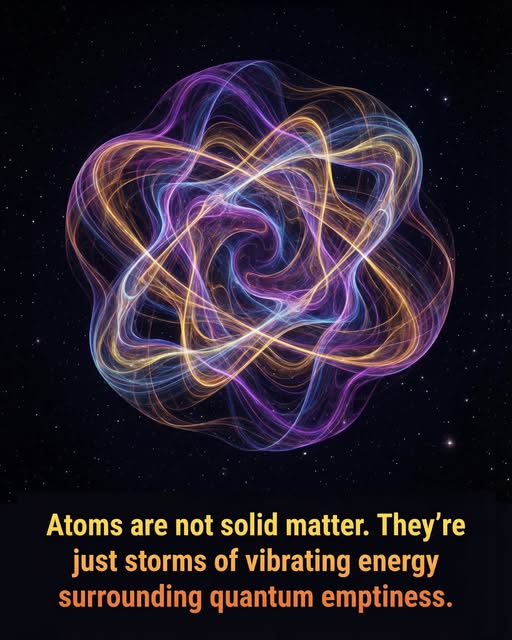
Quantum physics shows that what we perceive as solid matter is, at its core, mostly empty space, vibrating energy, and probability waves — far from the dense, static stuff our senses suggest.
Let's unpack this step by step.
Everyday objects — your hand, a chair, the floor beneath you — feel perfectly solid. But magnify them to the atomic level, and the picture changes dramatically.
Atoms consist of a tiny, dense nucleus surrounded by electrons. The nucleus occupies an incredibly small fraction of the atom's volume — the atom is over 99.9999999% empty space (or more precisely, space not occupied by point-like particles). Electrons don't behave like miniature planets orbiting a sun; instead, they exist as diffuse probability clouds — regions where the electron is likely to be found, spread out across the entire atomic volume.
So when your hand "touches" a table, no actual particles collide. The sensation of contact arises from the powerful electromagnetic repulsion between the electron clouds of your skin atoms and those of the table. Solidity is an illusion crafted by these forces.
Dive even deeper into quantum field theory (our most accurate framework for fundamental physics), and the story becomes stranger still. Particles like electrons aren't fundamental bits of stuff — they're localized excitations, or ripples, in invisible quantum fields that fill all of space. There's an electron field, a quark field, an electromagnetic field, and so on. What we call an electron is simply a vibration or "quantum" in the electron field. The same applies to photons (ripples in the electromagnetic field) and other particles. Matter, then, is essentially energy patterned into these dynamic field excitations.
Even the property of mass — what gives things weight and inertia — isn't intrinsic to particles. It emerges from their interactions with the Higgs field, another pervasive quantum field. Particles "drag" through this field, acquiring mass through these relationships rather than possessing it inherently.
This perspective, backed by countless experiments (from particle accelerators to precision spectroscopy), upends our intuitive view of reality.
So, what are you, really?
You're not a collection of tiny, solid building blocks. You're a symphony of quantum fields in constant vibration, vast clouds of probability, electromagnetic forces holding patterns together — and overwhelmingly... Emptiness. You're energy temporarily organized into the intricate, living form you experience as "you."