🔥 JUST 5 narrow sea routes control TRILLIONS of dollars in global trade every year… 🌍🚢⚠️
If even ONE gets blocked, oil prices, shipping costs & global inflation can explode overnight.
Here are the world’s most important trade chokepoints 🧵👇
🌍 KEY DATA:
🛢️ Strait of Hormuz
• Handles nearly 20% of global oil supply
• ~20 million barrels/day pass through
🚢 Suez Canal
• Carries ~12% of global trade
• Saves ships 7–15 days of travel time
🌏 Malacca Strait
• One of the busiest shipping lanes on Earth
• Critical for China, Japan & South Korea imports
⚠️ Bab-el-Mandeb
• Major Europe-Asia trade route
• Red Sea tensions increased shipping costs globally
🌎 Panama Canal
• Connects Atlantic ↔ Pacific trade
• Climate-driven droughts reduced ship traffic recently
📦 Around 80% of global trade by volume moves through sea routes.
The entire global economy depends on a few narrow chokepoints most people never think about. 🌐⚠️
#Geopolitics #Economy #GlobalTrade #Shipping #WorldMap #Oil #China #India #TradeRoutes #Infographic #Trendva #WorldNews
💰 What if India unlocked even a fraction of the gold sitting inside its temples?
Could it strengthen the economy… or trigger one of the biggest cultural debates in the country? 🇮🇳🛕
📊 India’s Estimated Temple Gold Wealth
🏦 RBI Official Gold Reserve: 🪙 ~880 tonnes
🛕 Estimated Gold In Indian Temples: 🪙 6,000+ tonnes
(Some estimates go even higher when including ornaments, donations & historic assets)
⚡ That could be worth: 💵 $700+ Billion equivalent (approx.)
�� Major temples believed to hold massive gold wealth: • Padmanabhaswamy Temple
• Tirupati Balaji
• Vaishno Devi
• Golden Temple
• Shirdi Sai Baba
• Siddhivinayak
• Jagannath Temple
• Meenakshi Temple
📊 What if even 10% entered the economy? ≈ 600+ tonnes of gold
Potential impacts: ✅ Stronger forex reserves
✅ Reduced gold imports
✅ Infrastructure funding
✅ Lower pressure on the rupee
✅ More economic liquidity
🌍 Important context: India imports large amounts of gold every year, affecting: • trade deficit
• dollar outflow
• forex balance
Some economists believe idle gold could become “productive capital” if monetized voluntarily.
⚠️ But the issue is extremely sensitive.
Major concerns: ❌ Religious sentiments
❌ Ownership & trust issues
❌ Political controversy
❌ Fear of misuse
❌ “Faith vs economy” debate
📌 Important: Most temple gold estimates are unofficial because many temple assets are not publicly audited in detail.
The discussion is not about “taking” temple gold.
It’s about a hypothetical economic scenario: 👉 What if a small voluntary portion was financially mobilized?
🇮🇳 India may already possess one of the world’s largest hidden gold ecosystems: • households
• temples
• jewelry
• institutions
📊 Total Indian private gold estimates: 🪙 25,000+ tonnes
That is larger than the official reserves of most countries combined.
💬 Comment bait: Should temple gold remain completely untouched as sacred wealth — or could voluntary monetization help India’s future economy? 👀
Sources: • RBI
• World Gold Council
• IIMA Temple Gold Report
• Reuters
• Economic Times
• Open-source temple wealth estimates
⚠️ In modern politics, memes are no longer “just jokes.”
They can shape narratives, influence youth opinion and slowly build political sentiment before elections even begin. 🌍📱
📊 Why “Cockroach Janta Party (CJP)” Suddenly Went Viral
📌 Key observations from public online activity:
• Rapid follower growth within days
• Heavy meme-based political messaging
• Strong anti-establishment tone
• Focus on youth frustration, unemployment & “system failure” narratives
• Viral traction through satire & dark humor
📌 Founder background discussed online: Multiple public reports link founder Abhijeet Dipke to: • political communication
• digital campaigning
• earlier association with AAP-linked social media ecosystem (as claimed in reports)
⚠️ Important: These are publicly discussed claims/reports — not proof of any secret coordination.
📌 Why some BJP supporters are suspicious: Many noticed: • Opposition-linked handles interacting early
• Anti-BJP influencers amplifying content
• Meme pages pushing similar narratives simultaneously
Visible engagement reportedly included: • TMC-linked personalities interacting online
• Left/liberal ecosystem accounts sharing memes
• Anti-establishment youth pages amplifying the trend
📊 Strategic political interpretation: Some analysts believe this may reflect: ➡️ “meme-based political mobilization”
➡️ digital narrative warfare
➡️ soft influence-building before 2029
Because modern elections increasingly depend on: • social media psychology
• emotional narratives
• youth digital culture
• meme ecosystems
📌 Common themes visible in viral posts/comments: • “System failed”
• “All parties same”
• “Need new politics”
• anti-incumbency humor
• anti-BJP frustration
⚠️ But very important: As of now, there is: ❌ no public proof of a coordinated conspiracy
❌ no verified evidence of official opposition control
Much of the discussion remains: • political interpretation
• pattern analysis
• social media observation
🌍 Bigger picture: Political influence today no longer spreads only through speeches or TV debates.
It spreads through: 📱 memes
🎭 satire
🎥 reels
🧠 emotions
⚡ viral culture
And by the time people realize it…
the narrative may already be built.
💬 Comment bait: Do you think meme-based political movements can genuinely influence future elections in India? 👀
Sources: • Times of India
• The Week
• Economic Times
• Public social media interactions
• Open-source political commentary & reports
⚠️ In modern politics, memes are no longer “just jokes.”
They can shape narratives, influence youth opinion and slowly build political sentiment before elections even begin. 🌍📱
📊 Why “Cockroach Janta Party (CJP)” Suddenly Went Viral
📌 Key observations from public online activity:
• Rapid follower growth within days
• Heavy meme-based political messaging
• Strong anti-establishment tone
• Focus on youth frustration, unemployment & “system failure” narratives
• Viral traction through satire & dark humor
📌 Founder background discussed online:
Multiple public reports link founder Abhijeet Dipke to:
• political communication
• digital campaigning
• earlier association with AAP-linked social media ecosystem (as claimed in reports)
⚠️ Important:
These are publicly discussed claims/reports — not proof of any secret coordination.
📌 Why some BJP supporters are suspicious:
Many noticed:
• Opposition-linked handles interacting early
• Anti-BJP influencers amplifying content
• Meme pages pushing similar narratives simultaneously
Visible engagement reportedly included:
• TMC-linked personalities interacting online
• Left/liberal ecosystem accounts sharing memes
• Anti-establishment youth pages amplifying the trend
📊 Strategic political interpretation:
Some analysts believe this may reflect:
➡️ “meme-based political mobilization”
➡️ digital narrative warfare
➡️ soft influence-building before 2029
Because modern elections increasingly depend on:
• social media psychology
• emotional narratives
• youth digital culture
• meme ecosystems
📌 Common themes visible in viral posts/comments:
• “System failed”
• “All parties same”
• “Need new politics”
• anti-incumbency humor
• anti-BJP frustration
⚠️ But very important:
As of now, there is:
❌ no public proof of a coordinated conspiracy
❌ no verified evidence of official opposition control
Much of the discussion remains:
• political interpretation
• pattern analysis
• social media observation
🌍 Bigger picture:
Political influence today no longer spreads only through speeches or TV debates.
It spreads through:
📱 memes
🎭 satire
🎥 reels
🧠 emotions
⚡ viral culture
And by the time people realize it…
the narrative may already be built.
💬 Comment bait:
Do you think meme-based political movements can genuinely influence future elections in India? 👀
Sources:
• Times of India
• The Week
• Economic Times
• Public social media interactions
• Open-source political commentary & reports
⚠️ In modern politics, memes are no longer “just jokes.”
They can shape narratives, influence youth opinion and slowly build political sentiment before elections even begin. 🌍📱
📊 Why “Cockroach Janta Party (CJP)” Suddenly Went Viral
📌 Key observations from public online activity:
• Rapid follower growth within days
• Heavy meme-based political messaging
• Strong anti-establishment tone
• Focus on youth frustration, unemployment & “system failure” narratives
• Viral traction through satire & dark humor
📌 Founder background discussed online: Multiple public reports link founder Abhijeet Dipke to: • political communication
• digital campaigning
• earlier association with AAP-linked social media ecosystem (as claimed in reports)
⚠️ Important: These are publicly discussed claims/reports — not proof of any secret coordination.
📌 Why some BJP supporters are suspicious: Many noticed: • Opposition-linked handles interacting early
• Anti-BJP influencers amplifying content
• Meme pages pushing similar narratives simultaneously
Visible engagement reportedly included: • TMC-linked personalities interacting online
• Left/liberal ecosystem accounts sharing memes
• Anti-establishment youth pages amplifying the trend
📊 Strategic political interpretation: Some analysts believe this may reflect: ➡️ “meme-based political mobilization”
➡️ digital narrative warfare
➡️ soft influence-building before 2029
Because modern elections increasingly depend on: • social media psychology
• emotional narratives
• youth digital culture
• meme ecosystems
📌 Common themes visible in viral posts/comments: • “System failed”
• “All parties same”
• “Need new politics”
• anti-incumbency humor
• anti-BJP frustration
⚠️ But very important: As of now, there is: ❌ no public proof of a coordinated conspiracy
❌ no verified evidence of official opposition control
Much of the discussion remains: • political interpretation
• pattern analysis
• social media observation
🌍 Bigger picture: Political influence today no longer spreads only through speeches or TV debates.
It spreads through: 📱 memes
🎭 satire
🎥 reels
🧠 emotions
⚡ viral culture
And by the time people realize it…
the narrative may already be built.
💬 Comment bait: Do you think meme-based political movements can genuinely influence future elections in India? 👀
Sources: • Times of India
• The Week
• Economic Times
• Public social media interactions
• Open-source political commentary & reports
⚠️ In modern politics, memes are no longer “just jokes.”
They can shape narratives, influence youth opinion and slowly build political sentiment before elections even begin. 🌍📱
📊 Why “Cockroach Janta Party (CJP)” Suddenly Went Viral
📌 Key observations from public online activity:
• Rapid follower growth within days
• Heavy meme-based political messaging
• Strong anti-establishment tone
• Focus on youth frustration, unemployment & “system failure” narratives
• Viral traction through satire & dark humor
📌 Founder background discussed online: Multiple public reports link founder Abhijeet Dipke to: • political communication
• digital campaigning
• earlier association with AAP-linked social media ecosystem (as claimed in reports)
⚠️ Important: These are publicly discussed claims/reports — not proof of any secret coordination.
📌 Why some BJP supporters are suspicious: Many noticed: • Opposition-linked handles interacting early
• Anti-BJP influencers amplifying content
• Meme pages pushing similar narratives simultaneously
Visible engagement reportedly included: • TMC-linked personalities interacting online
• Left/liberal ecosystem accounts sharing memes
• Anti-establishment youth pages amplifying the trend
📊 Strategic political interpretation: Some analysts believe this may reflect: ➡️ “meme-based political mobilization”
➡️ digital narrative warfare
➡️ soft influence-building before 2029
Because modern elections increasingly depend on: • social media psychology
• emotional narratives
• youth digital culture
• meme ecosystems
📌 Common themes visible in viral posts/comments: • “System failed”
• “All parties same”
��� “Need new politics”
• anti-incumbency humor
• anti-BJP frustration
⚠️ But very important: As of now, there is: ❌ no public proof of a coordinated conspiracy
❌ no verified evidence of official opposition control
Much of the discussion remains: • political interpretation
• pattern analysis
• social media observation
🌍 Bigger picture: Political influence today no longer spreads only through speeches or TV debates.
It spreads through: 📱 memes
🎭 satire
🎥 reels
🧠 emotions
⚡ viral culture
And by the time people realize it…
the narrative may already be built.
💬 Comment bait: Do you think meme-based political movements can genuinely influence future elections in India? 👀
Sources: • Times of India
• The Week
• Economic Times
• Public social media interactions
• Open-source political commentary & reports
#CJP #CockroachJantaParty
🌮 Some countries don’t just have famous food…
They have streets filled with aromas so powerful that tourists remember them for life. 🌍🔥
From smoky grills to spicy curries and sizzling noodles — street food is one of the strongest cultural experiences on Earth.
📊 Countries Famous For Their Strongest Street Food Aromas
1️⃣ 🇮🇳 India
🌶️ Famous for: • Chaat
• Tandoori
• Biryani
• Pav Bhaji
📌 Strong spice blends, frying oils & smoky tandoors create intense aromas
2️⃣ 🇹🇭 Thailand
🍜 Famous for: • Pad Thai
• Tom Yum
• Grilled seafood
📌 Garlic, fish sauce & herbs dominate street markets
3️⃣ 🇨🇳 China
🥟 Famous for: • Dumplings
• BBQ skewers
• Stir-fried noodles
📌 Wok cooking creates the famous “wok hei” smoky aroma
4️⃣ 🇹🇷 Turkey
🥙 Famous for: • Döner kebab
• Lahmacun
• Simit
📌 Grilled meats & warm spices fill the streets
5️⃣ 🇲🇽 Mexico
🌮 Famous for: • Tacos
• Elote
• Tamales
📌 Chili, grilled corn & smoky meats create vibrant aromas
6️⃣ 🇮🇹 Italy
🍕 Famous for: • Pizza
• Panini
• Arancini
📌 Garlic, basil, olive oil & baked bread aromas
7️⃣ 🇻🇳 Vietnam
🍲 Famous for: • Pho
• Banh Mi
• Bun Cha
📌 Fresh herbs & broth-based street foods
8️�� 🇮🇩 Indonesia
🍢 Famous for: • Satay
• Nasi Goreng
📌 Peanut sauces, spices & charcoal grilling
9️⃣ 🇲🇦 Morocco
🥘 Famous for: • Tagine
• Kebabs
📌 Rich spice markets & slow-cooked foods
🔟 🇯🇵 Japan
🍢 Famous for: • Takoyaki
• Yakitori
• Ramen
📌 Soy sauce, seafood & grilled street snacks
📌 Why street food smells so strong: • High-heat cooking
• charcoal grilling
• spices & herbs
• fermentation
• frying oils
• open-air markets
🌍 Fun fact: Smell is strongly connected to memory — which is why many travelers remember food aromas more than monuments. 😄
Street food is more than food.
It’s culture, chaos, smoke, spices and identity — all mixed into one unforgettable experience. 🌮🔥
💬 Comment bait: Which country do you think has the most unforgettable street food smell? 👀
Sources: • CNN Travel
• TasteAtlas
• World Food Travel Association
• Food culture & tourism reports
⚡ The future of AI, electric vehicles, missiles, smartphones and clean energy may depend on a group of minerals most people have never even heard of.
Rare earth minerals are becoming the new oil of the technological era. 🌍🔋
📊 Top 10 Countries Mining Rare Earth Minerals
(Latest global production estimates)
1️⃣ 🇨🇳 China — ~240,000 metric tons
📌 Dominates global mining & refining
📌 Controls much of the world’s processing capacity
2️⃣ 🇺🇸 United States — ~43,000 tons
📌 Mountain Pass mine is a major producer
3️⃣ 🇲🇲 Myanmar — ~38,000 tons
📌 Important supplier of heavy rare earths
4️⃣ 🇦🇺 Australia — ~18,000 tons
📌 Lynas is one of the largest non-Chinese producers
5️⃣ 🇹🇭 Thailand — ~7,100 tons
6️⃣ 🇮🇳 India — ~2,900 tons 🇮🇳
📌 Growing strategic focus on rare earth independence
7️⃣ 🇷🇺 Russia — ~2,600 tons
8️⃣ 🇲🇬 Madagascar — ~2,600 tons
9️⃣ 🇻🇳 Vietnam — ~1,500 tons
📌 Huge untapped reserve potential
��� 🇧🇷 Brazil — ~1,300 tons
📌 Why rare earth minerals matter: They are critical for: • AI chips
• semiconductors
• electric vehicles
• fighter jets
• missiles
• wind turbines
• advanced electronics
📊 China currently produces: ⚠️ Over 60% of global rare earth supply
and dominates refining even more heavily.
🌍 Key rare earth elements include: • Neodymium → EV motors & magnets
• Dysprosium → defense systems
• Terbium → displays & green tech
• Yttrium → lasers & aerospace
⚠️ Why the world is worried: • Supply chains heavily depend on China
• Rare earth shortages could disrupt AI & EV industries
• Countries are racing to secure independent supply chains
📌 New geopolitical race: The next global competition may not only be about oil or semiconductors…
It may be about who controls the minerals powering future technology. ⚡
💬 Comment bait: Do you think rare earth minerals will become more strategically important than oil in the future? 👀
Sources: • USGS
• International Energy Agency (IEA)
• Reuters
• Statista
• Geoscience Australia
• Open-source mining estimates
💰 The world’s billionaires are no longer concentrated in just one region.
A massive shift in technology, manufacturing, finance and AI is creating new centers of global wealth. 🌍📈
📊 Top 10 Countries With The Most Billionaires (Latest Estimates)
1️⃣ 🇺🇸 United States — 1,097 billionaires
💵 Combined wealth: ~$5.3 Trillion+
📌 Dominates tech, finance & AI industries
2️⃣ 🇨🇳 China — 814 billionaires
💵 ~$1.6 Trillion+
📌 Manufacturing, tech & real estate giants
3️⃣ 🇮🇳 India — 271 billionaires 🇮🇳
💵 ~$950 Billion+
📌 Fast-growing wealth in energy, tech & infrastructure
4️⃣ 🇩🇪 Germany — 140 billionaires
5️⃣ 🇬🇧 United Kingdom — 122
6️⃣ 🇨🇭 Switzerland — 106
7️⃣ 🇷🇺 Russia — 76
8️⃣ 🇭🇰 Hong Kong — 66
9️⃣ 🇨🇦 Canada — 53
🔟 🇧🇷 Brazil — 52
📌 Key global trends: • The US still leads global billionaire wealth by a huge margin
• Asia is rapidly producing more billionaires than Europe
• AI, semiconductors & technology are creating new wealth faster than ever
📊 Industries creating the most billionaires: • Technology
• Finance
• Real estate
• Energy
• Manufacturing
⚠️ Interesting facts: • Over 70% of billionaires are considered self-made
• A new billionaire is created globally almost every few days during major market booms
• Nvidia, AI & tech stocks have accelerated wealth creation massively in recent years
🌍 Why this matters: Billionaire trends often reflect: • where innovation is happening
• where capital flows are growing
• which economies are expanding fastest
In the age of AI and global markets…
Wealth is becoming increasingly concentrated around technology, data and infrastructure. 💰⚡
💬 Comment bait: Do you think the rise of billionaires is good for innovation and economic growth — or a sign of growing inequality? 👀
Sources: • Hurun Global Rich List
• Forbes Billionaires List
• Bloomberg Billionaires Index
• Open-source wealth estimates
🖥️ The world’s most powerful weapons today may not be missiles or fighter jets…
They may be supercomputers capable of performing quintillions of calculations every second. 🌍⚡
📊 Top 10 Most Powerful Supercomputers (Latest Global Rankings)
1️⃣ 🇺🇸 Frontier
📍 Oak Ridge National Laboratory
⚡ ~1.19 ExaFLOPS
• First officially recognized exascale supercomputer
2️⃣ 🇺🇸 Aurora
📍 Argonne National Laboratory
⚡ ~1.01 ExaFLOPS
3️⃣ 🇺🇸 Eagle
⚡ ~561 PetaFLOPS
4️⃣ 🇯🇵 Fugaku / Fujitsu System
⚡ ~442 PetaFLOPS
5️⃣ 🇺🇸 Alps
⚡ ~434 PetaFLOPS
6️⃣ 🇮🇹 Leonardo
⚡ ~238 PetaFLOPS
7️⃣ 🇺🇸 Summit
⚡ ~200 PetaFLOPS
8️⃣ 🇺🇸 Sierra
⚡ ~125 PetaFLOPS
9️⃣ 🇨🇳 Sunway TaihuLight
⚡ ~125 PetaFLOPS
🔟 🇺🇸 Selene (Nvidia)
⚡ ~63 PetaFLOPS
📌 What are supercomputers used for? • AI model training
• nuclear simulations
• weather prediction
• climate research
• drug discovery
• military simulations
• space exploration
📊 What is an ExaFLOP? 1 ExaFLOP =
⚡ 1 quintillion calculations per second
(1,000,000,000,000,000,000 operations)
🌍 Why this matters: • AI race depends on computing power
• Countries with stronger computing infrastructure gain strategic advantages
• Supercomputers are becoming critical for defense, science & economic competitiveness
📌 Interesting trend: The global supercomputing race is dominated mainly by: 🇺🇸 USA
🇨🇳 China
🇯🇵 Japan
🇪🇺 Europe
⚠️ Experts say future geopolitical power may increasingly depend on: • AI capability
• semiconductor access
• energy supply
• advanced computing infrastructure
In the age of AI…
Computing power is becoming national power. 🖥️⚡
💬 Comment bait: Which country do you think will dominate the next decade of AI and supercomputing — USA, China or someone else? 👀
Sources: • TOP500 Supercomputer Rankings
• Oak Ridge National Laboratory
• Nvidia
• Argonne National Laboratory
• RIKEN
• Open-source HPC reports
🚀 The next arms race may not be about nuclear bombs alone…
It may be about who can strike the fastest — before anyone can react. 🌍⚠️
📊 Countries Developing Hypersonic Weapons
Hypersonic weapons travel at: ⚡ Mach 5 to Mach 27
(5–27 times the speed of sound)
Unlike traditional missiles, they can maneuver mid-flight, making them extremely difficult to detect and intercept.
🌍 Major Countries In The Hypersonic Race:
🇷🇺 Russia
• Avangard
• Kinzhal
• Zircon
📌 Some systems claimed operational
🇨🇳 China
• DF-17
• Hypersonic glide vehicle programs
📌 Massive investment in advanced missile systems
🇺🇸 USA
• Dark Eagle (LRHW)
• ARRW programs
📌 Accelerating development amid China-Russia competition
🇮🇳 India
• HSTDV program 🇮🇳
• BrahMos-II under development
📌 Focus on indigenous hypersonic capability
🇫🇷 France
• V-MAX program
🇬🇧 United Kingdom
• Hypersonic missile research initiatives
🇯🇵 Japan
• Advanced hypersonic glide vehicle programs
📌 Why hypersonic weapons matter: • Harder to intercept than traditional missiles
• Extremely high speed reduces reaction time
• Can threaten aircraft carriers & critical infrastructure
• May reshape future warfare & deterrence strategies
⚠️ Major concerns: • Increased global arms race
• Reduced decision-making time during conflict
• Challenges for missile defense systems
📊 Experts warn that hypersonic technology could become one of the defining military technologies of the 21st century.
The future of warfare may belong to whoever controls speed, detection and AI-assisted targeting first. 🚀
💬 Comment bait: Do hypersonic weapons make the world safer through deterrence — or more dangerous because of faster escalation risks? 👀
Sources: • CSIS Missile Defense Project
• SIPRI
• RAND Corporation
• Jane’s Defence
• Reuters
• Open-source defense estimates
🌐 The internet may look wireless…
But nearly everything online still depends on thousands of cables lying deep under the oceans. 🌍⚠️
📊 Around 99% of global internet traffic travels through undersea fiber-optic cables — not satellites.
These invisible networks power: • banking
• stock markets
• military communication
• cloud servers
• social media
• AI systems
• global trade
📌 Countries Leading Global Undersea Cable Infrastructure
🇺🇸 United States
• Largest influence in global cable ownership & tech infrastructure
• Home to Google, Meta, Microsoft & Amazon cloud networks
🇨🇳 China
• Expanding digital infrastructure through “Digital Silk Road” projects
• Increasing investment in Asia-Africa cable systems
🇯🇵 Japan
• Critical Asia-Pacific connectivity hub
🇬🇧 United Kingdom
• Major transatlantic internet exchange routes
🇫🇷 France
• Important Europe-Africa cable gateway
📊 Global cable network statistics: • 1.4 million+ km of active submarine cables
• 400+ major undersea cable systems worldwide
• Trillions of dollars in financial transactions depend on them daily
⚠️ Why this matters: A single cable disruption can impact: • internet speeds
• banking systems
• cloud services
• stock exchanges
• military communications
🌍 Critical chokepoints include: • Strait of Hormuz
• Suez region
• Malacca Strait
• Bab-el-Mandeb
📌 Growing concerns: • sabotage risks
• geopolitical tensions
• cyber warfare
• underwater infrastructure security
The future of global power may not only depend on oil, weapons or AI…
It may also depend on who controls the world’s digital highways. 🌐
💬 Comment bait: Should undersea internet cables be treated as critical global security infrastructure like oil pipelines and military bases? 👀
Sources: • TeleGeography
• Submarine Cable Map
• CSIS
• Reuters
• BBC
• Statista
📉 Some countries are shrinking faster than headlines can explain.
And the biggest crisis of this century may not be war, oil or AI…
It may be the collapse of population itself. 🌍⚠️
📊 Countries Facing Major Population Decline By 2100
(UN & demographic projections)
🇯🇵 Japan
• Population could fall from ~124M → ~87M
• One of the world’s oldest populations
🇰🇷 South Korea
• Fertility rate: ~0.72 (among the world’s lowest)
• Population projected to shrink dramatically
🇨🇳 China
• Population decline already began
• Aging workforce & economic pressure increasing
🇮🇹 Italy
• Low birth rates for decades
• Aging population crisis
🇷🇺 Russia
• Long-term demographic decline concerns
🇩🇪 Germany
• Increasing dependence on immigration for workforce stability
🇹🇭 Thailand
• Rapidly aging society in Southeast Asia
🇺🇦 Ukraine
• War + migration + low fertility impacting demographics
📌 Why this matters: • Fewer workers supporting more retirees
• Economic growth slows
• Pension & healthcare pressure rises
• Military recruitment pools shrink
• Entire towns & regions begin depopulating
📊 Global fertility trend: • Replacement fertility level ≈ 2.1 children per woman
• Many developed countries are now far below that level
🌍 At the same time: Countries in parts of Africa & South Asia are still seeing strong population growth — potentially reshaping future global power balances.
The future won’t just be shaped by technology or military power.
It may be shaped by who still has people. 📉
💬 Comment bait: What do you think is the biggest reason behind falling birth rates globally — economy, lifestyle, technology or something else? 👀
Sources: • UN Population Division
• World Bank
• OECD
• The Lancet demographic studies
• Open-source demographic projections
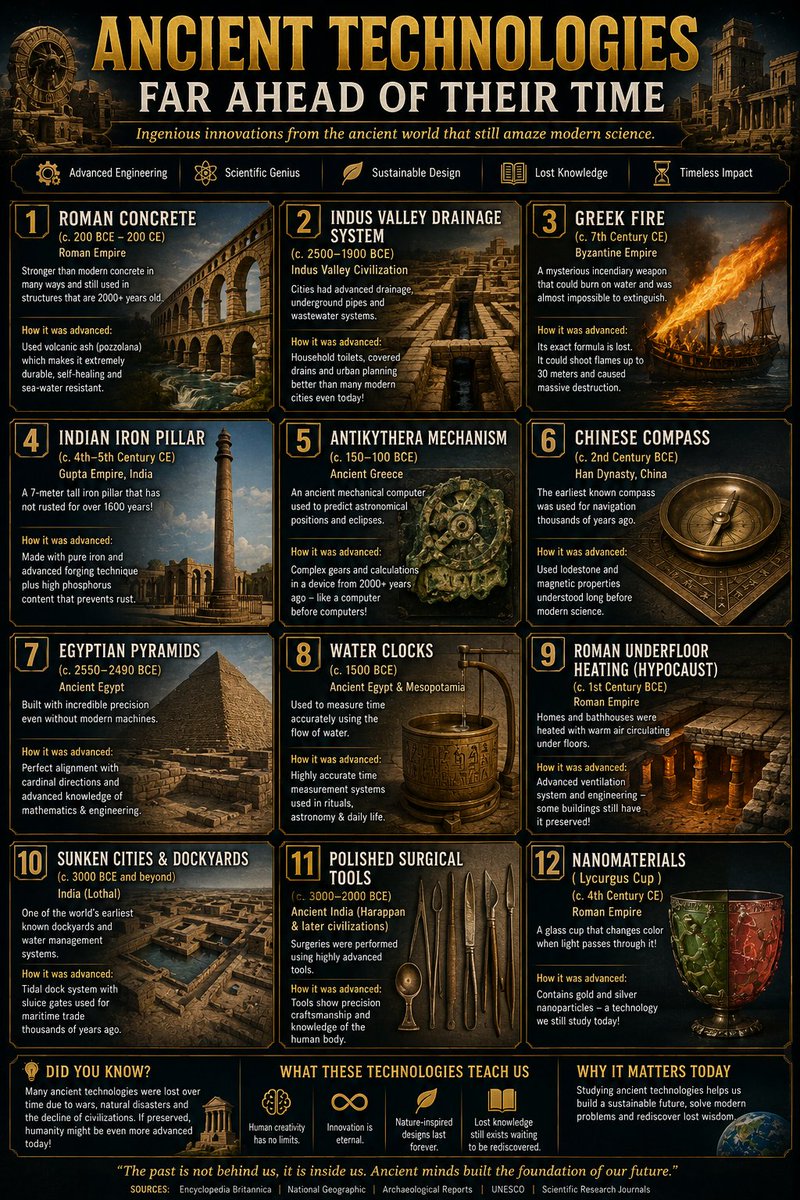
🏛️ Ancient civilizations built technologies so advanced that some still confuse scientists and engineers today.
Long before modern computers, steel factories or smart cities… humanity was already experimenting with innovation far ahead of its time. 🌍⚙️
📊 Ancient Technologies Far Ahead Of Their Time
1️⃣ Roman Concrete ����🇹
📍 Roman Empire
🛠️ Some Roman structures still stand after 2,000 years
• Used volcanic ash (pozzolana)
• Extremely durable & seawater resistant
2️⃣ Indus Valley Drainage System 🇮🇳
📍 Ancient India
🛠️ Advanced urban planning (2500–1900 BCE)
• Covered drains
• household sanitation
• organized city layouts
3️⃣ Greek Fire 🇬🇷
📍 Byzantine Empire
🛠️ Mysterious weapon that reportedly burned even on water
• Formula still debated today
4️⃣ Indian Iron Pillar 🇮🇳
📍 Delhi, India
🛠️ 1,600+ years old with minimal rusting
• Advanced metallurgy techniques
5️⃣ Antikythera Mechanism 🇬🇷
📍 Ancient Greece
🛠️ Often called the world’s first analog computer
• Predicted astronomical movements & eclipses
6️⃣ Chinese Compass 🇨🇳
📍 Han Dynasty China
🛠️ Revolutionized navigation & global exploration
7️⃣ Egyptian Pyramids 🇪🇬
📍 Ancient Egypt
🛠️ Built with astonishing precision thousands of years ago
• aligned closely with cardinal directions
8️⃣ Water Clocks
📍 Egypt & Mesopotamia
🛠️ Ancient time-measuring systems using water flow
9️⃣ Roman Hypocaust Heating System 🇮🇹
📍 Roman Empire
🛠️ Early underfloor heating technology
🔟 Ancient Indian Dockyards 🇮🇳
📍 Lothal Civilization
🛠️ One of the world’s earliest known dockyard systems for maritime trade
1️⃣1️⃣ Ancient Surgical Tools 🇮🇳
📍 Ancient India
🛠️ Detailed surgical practices documented in Sushruta Samhita
1️⃣2️⃣ Lycurgus Cup (Nanotechnology Effect) 🇮🇹
📍 Roman Empire
🛠️ Changes color under different lighting due to microscopic metal particles
📌 Why these technologies matter: • They shaped engineering & science
• Inspired modern innovation
• Proved ancient civilizations were highly advanced for their time
🌍 Many modern technologies have roots in ideas developed thousands of years ago.
The past wasn’t primitive.
It was innovative in ways we are still rediscovering today. ⚙️
Sources: • Encyclopedia Britannica
• UNESCO
• National Geographic
• Archaeological research journals
• Scientific historical studies
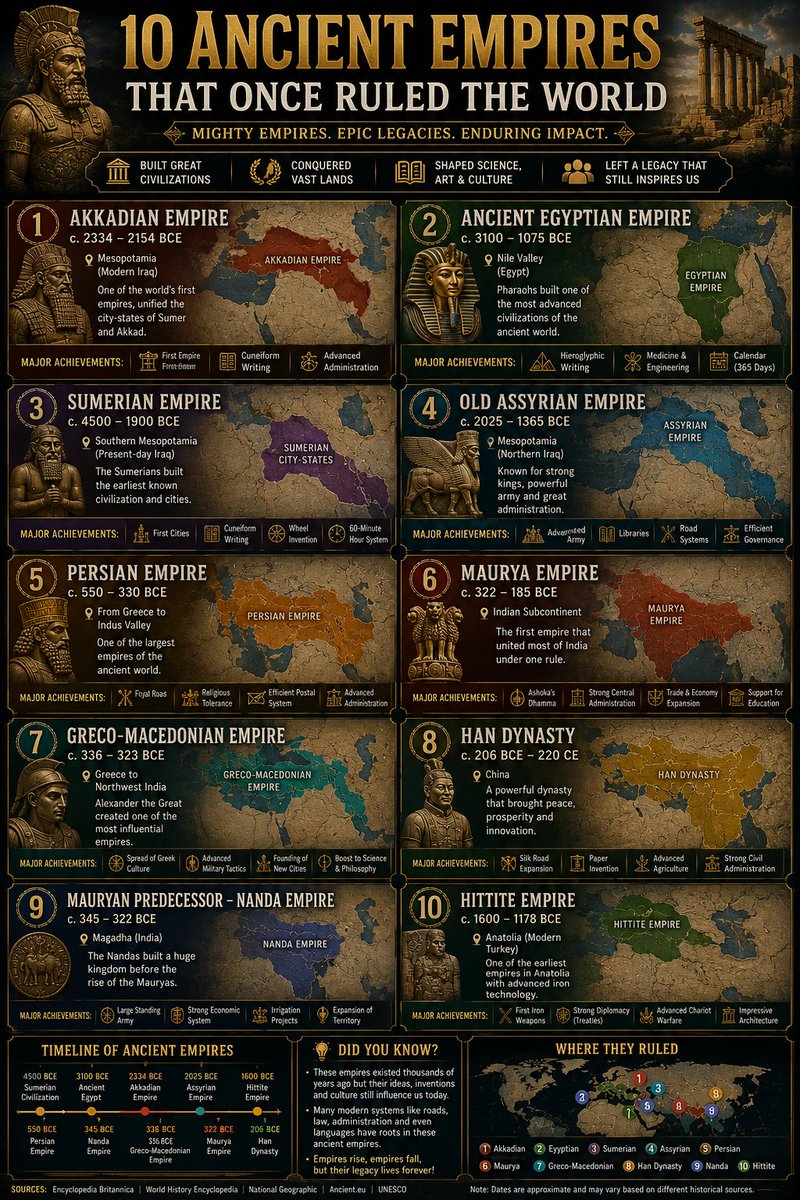
🏛️ Long before modern countries existed, ancient empires were already building cities, laws, trade routes and civilizations that shaped humanity forever.
Some disappeared.
But their legacy still influences the modern world today. 🌍📜
📊 10 Ancient Empires That Once Ruled The World
1️⃣ Akkadian Empire (c. 2334–2154 BCE)
📍 Mesopotamia (Modern Iraq)
• One of the world’s first empires
• Early centralized administration
2️⃣ Ancient Egyptian Empire (c. 3100 BCE onward)
📍 Nile Valley
• Pyramids & monumental engineering
• Hieroglyphic writing system
3️⃣ Sumerian Civilization / City States (c. 4500–1900 BCE)
📍 Southern Mesopotamia
• Earliest known cities
• Cuneiform writing
4️⃣ Old Assyrian Empire (c. 2025–1365 BCE)
📍 Mesopotamia
• Powerful military systems
• Advanced administration
5️⃣ Persian Empire (Achaemenid) (550–330 BCE)
📍 From Middle East to Indus Valley
• Royal Road trade network
• Religious tolerance policies
6️⃣ Maurya Empire (322–185 BCE) 🇮🇳
📍 Indian Subcontinent
• Unified large parts of India
• Ashoka spread Buddhism across Asia
7️⃣ Greco-Macedonian Empire (336–323 BCE)
📍 Alexander the Great’s empire
• Spread Greek culture across continents
8️⃣ Han Dynasty / Chinese Empire (206 BCE–220 CE) 🇨🇳
📍 China
• Silk Road expansion
• Major scientific & administrative growth
9️⃣ Nanda Empire (345–322 BCE) 🇮🇳
📍 Ancient India
• One of the most powerful kingdoms before Mauryas
🔟 Hittite Empire (1600–1178 BCE)
📍 Anatolia (Modern Turkey)
• Early iron weapon technology
• Strong military innovations
📌 Why these empires mattered: • Built early governments & law systems
• Expanded trade across continents
• Advanced science, engineering & philosophy
• Influenced religion, language & culture
🌍 Many modern ideas — roads, administration, taxation, diplomacy and warfare — evolved from systems first developed by ancient empires.
Empires rise.
Empires fall.
But their influence can survive for thousands of years. 🏛️
Sources: • Encyclopedia Britannica
• UNESCO
• National Geographic
• World History Encyclopedia
• Academic historical research