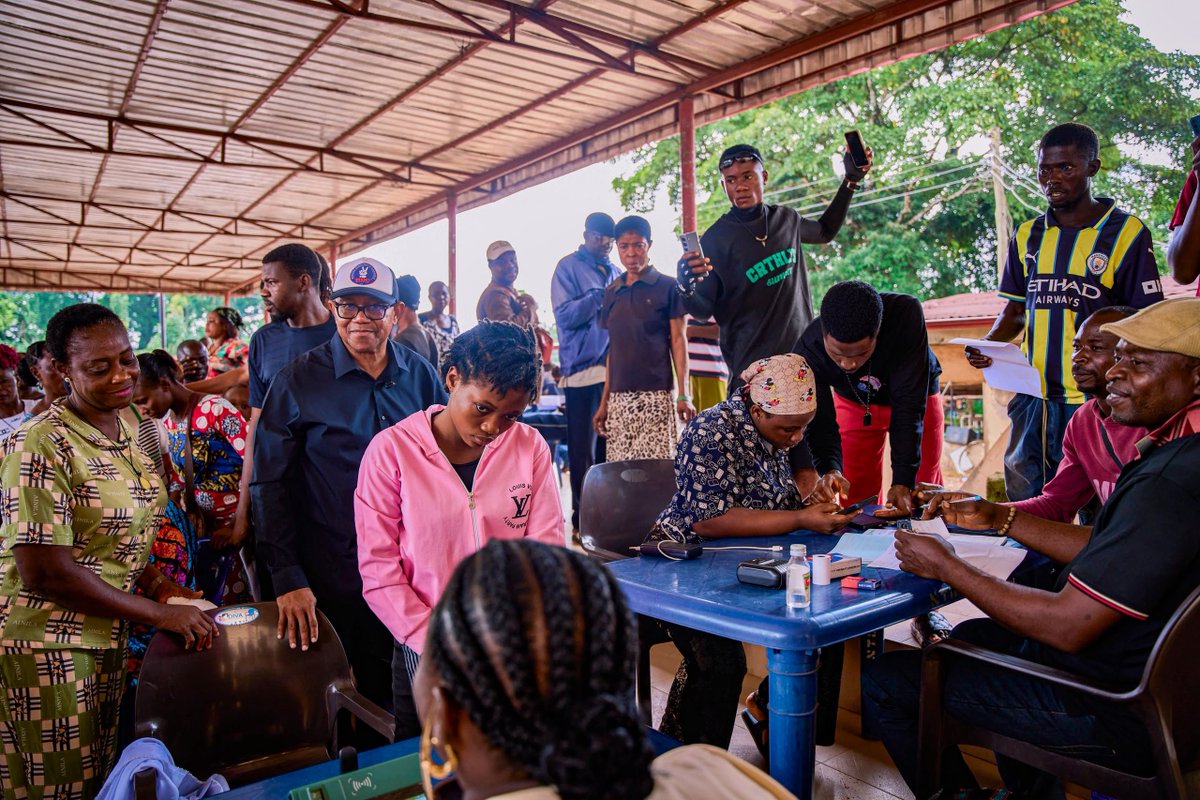
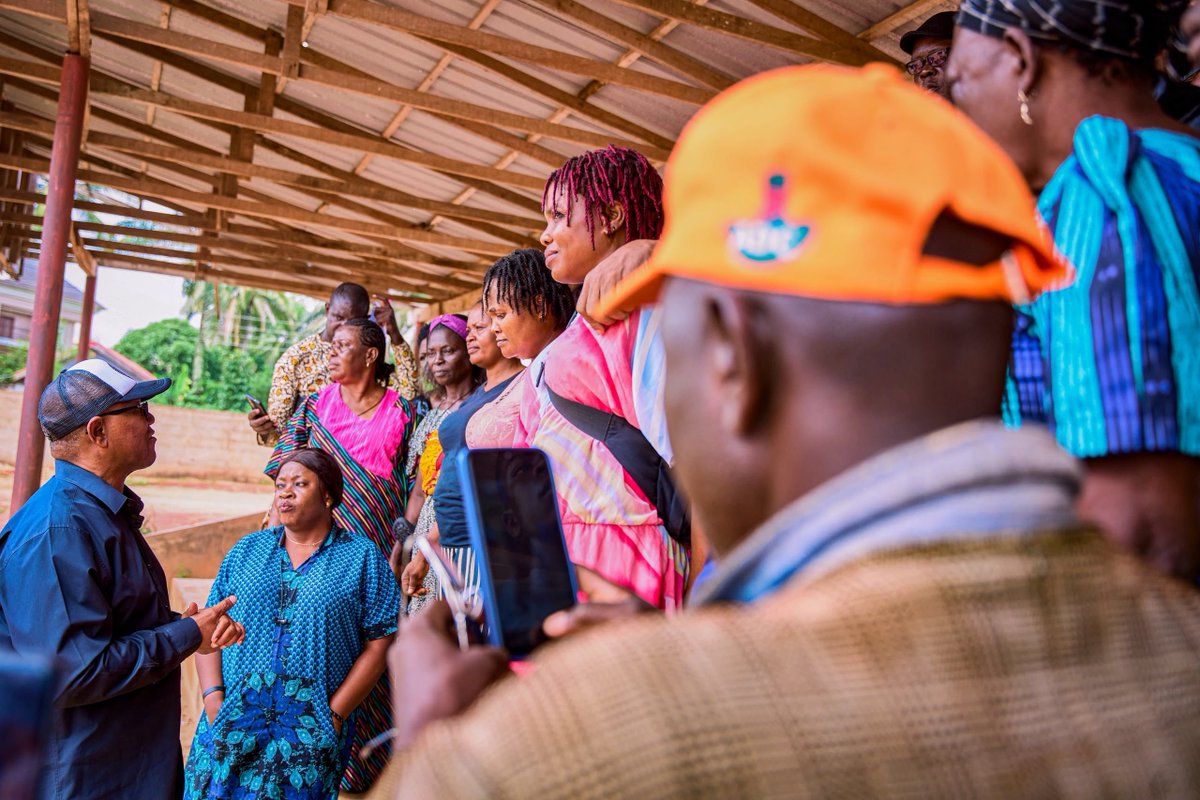
Chance Visits to INEC Registration Centres
On my return to Anambra State yesterday, and on my way to attend some scheduled engagements, I made impromptu visits to the INEC voter registration centres at the Civic Centre, Nibo, and Nrijiofor Primary School, Nri.
I was pleased to see Nigerians registering to vote. I took the opportunity to commend those who had turned out and to encourage every eligible citizen to do the same. I reminded them that the journey to good governance does not begin on Election Day; it begins with voter registration. Registering to vote is not just a civic responsibility — it is an investment in the Nigeria we all desire.
I urged everyone who is eligible but has not yet registered to do so without delay. I also appealed to those who have already registered to encourage their family members, friends, neighbours, and colleagues to take advantage of the ongoing exercise before the deadline.
Every registered voter strengthens our democracy and brings us one step closer to building the secure, united, productive, and prosperous Nigeria we all seek.
A New Nigeria is POssible. -PO
"Late President Buhari went to China to borrow money to construct a rail line from Nigeria to Niger. Look at the current condition of the rail track, and up till now, we are still paying for the loan. Rotimi Amaechi, look at your handiwork."
—Isaac Fayose
Voter Registration: The First Step in the Journey to a New Nigeria
Yesterday, while passing through Waru Wazobia in Abuja, I made a chance stop to interact with our people. I seized the opportunity to encourage them, especially our youths and women, to take advantage of the ongoing voter registration exercise.
The power to change Nigeria does not begin on Election Day; it begins with voter registration. Registering to vote is not just a civic responsibility; it is an investment in the future we all desire.
I urge every eligible Nigerian who has not yet registered to do so without delay. Those who already have their voter cards should encourage their family members, friends, neighbours, and colleagues to register as well.
A new Nigeria will not happen through wishful thinking. It will be built by citizens who participate, who believe, and who act. Let us continue to choose hope over despair, participation over apathy, and nation-building over division.
A New Nigeria is POssible. -PO
Engaging Tomorrow’s Leaders at Madonna University
Yesterday, I continued my engagement with future leaders in the country. I was at Madonna University, Okija Campus, where I had the privilege of interacting with students at the NextGen Mentorship & Leadership Initiative on the theme: “Beyond Now: Raising the Next Generation of Leaders.”
The session was highly engaging, with students asking thoughtful and probing questions. Their concerns reflected the frustration of many young Nigerians who feel constrained by poor governance and widespread corruption, which have denied them opportunities to realise their full potential. However, I was equally encouraged by their optimism and determination to be part of the solution.
I reminded them that leadership is the greatest determinant of a nation’s progress. A true leader must possess the character, competence, capacity, and compassion to make sacrifices for the good of the people. Nigeria’s future depends on leaders committed to safeguarding lives, investing in education, creating opportunities, and building effective institutions.
I encouraged the students to take their education seriously, to prepare themselves for leadership, and to see themselves not merely as spectators but as agents of change. Through active participation in the democratic process, they have the power to enthrone leaders with integrity and the capacity to propel our nation forward.
As part of my ongoing commitment to education, I presented a cheque of ₦15 million to the university to support its educational mission. Investing in education remains one of the most effective ways to develop the human capital necessary for national progress.
Together, by raising a new generation of responsible and visionary leaders, we can build the Nigeria of our dreams that is POssible. -PO
@Kelly_kingz001@instablog9ja The time belongs to us and the country is ours, because we are already against the wall, is more reason we should start pushing back now, before we hurt our backs and forced to our knees
Lokoja Judgment: An Unnecessary Serious Setback for Nigerian Democracy
Today was an exceptionally busy day. I left Lagos in the early hours for Emekuku, where I visited the School of Nursing Sciences, an institution I have consistently supported over the years. It was gratifying to inspect projects funded through my previous interventions, including the school’s computer laboratory. Such investments reaffirm my belief that education remains one of the strongest foundations for national development.
From there, I attended the 80th birthday celebration of the Emeritus Archbishop of Owerri, Most Rev. Dr Anthony Obinna, whose commitment to justice, peace, and the common good has inspired many, before proceeding to Madonna University for another engagement.
It was at Madonna University that I received the court news of the Lokoja court rulings through my brother, Senator Rabiu Musa Kwankwaso.
Every Nigerian committed to the country’s progress should be deeply concerned. This judgment represents another setback for our democracy and the institutions upon which our future depends.
It is regrettable that some who claim to champion democracy now appear determined to weaken the very institutions that sustain it. In doing so, they are undermining public confidence and endangering the future of millions of Nigerians.
The legislature and the judiciary are increasingly being drawn into this pattern of institutional decline. Democracy cannot thrive where institutions lose their independence and credibility.
Those who seek to weaken Nigeria’s democratic foundations will not ultimately prevail. When a similar situation recently affected the ADC, I condemned it without hesitation. I do so again today because my position has always been guided by principle.
My concern is not about who becomes President. My concern is that Nigeria works. Our politics must move beyond the quest for power and focus instead on building a united nation founded on justice, strong institutions, the rule of law, and equal opportunity. That is the Nigeria we owe ourselves and the one we must leave for future generations.
I therefore urge all well-meaning Nigerians to rise above partisan interests and defend our democracy. The survival of our institutions is inseparable from the survival of our nation. It's when we work together that a new Nigeria of our dream is made POssible. -PO
2 years ago today, WAEC deleted this 2016 video confirming that Peter Obi moved Anambra State from 27th to 1st in WAEC rankings, all because of that guy in Aso Rock.
Owning Up to Leadership Failures and Political Responsibility
This morning, I listened to the British Prime Minister’s speech announcing his planned resignation in July. As a keen observer of global politics, my primary interest lies in examining what successful nations do right and the structural factors that cause others to lag or struggle with governance and development.
The Prime Minister’s planned resignation comes amid mounting public frustration over a stagnant economy, a worsening cost-of-living crisis, and a perceived failure to honour key campaign pledges.
Looking inward in our dear country, we can recall our own situation. Before 2015, our President on several occasions championed the call for the then President Goodluck Jonathan to resign over economic hardship and insecurity affecting Nigerians. During the Chibok school kidnapping incident, he demanded the immediate resignation of President Jonathan, arguing that the government had failed in its most fundamental duty of protecting lives.
During the 2023 election campaign, President Bola Ahmed Tinubu made several promises, including improved electricity supply. He also challenged the electorate not to vote for him for a second term if he failed to deliver on those commitments—particularly in providing stable power, fighting corruption, and improving the welfare of Nigerians.
At present, however, these conditions have worsened. Electricity supply remains unreliable, insecurity has intensified in many areas, including kidnappings, and economic hardship has deepened rather than eased. Similar concerns are reflected across other critical sectors such as security, infrastructure, transportation, and anti-corruption efforts, all of which have regressed. We are in the worst possible condition.
I, therefore, join Nigerians of goodwill in calling for the resignation of the President over monumental failure in governance. Such a gesture would help enthrone a political culture rooted in accountability and responsibility, rather than further entrenching impunity. It would also send a powerful message that public office is a sacred trust, not an entitlement, and help build a society in which future leaders understand that failure carries consequences. Only by ending the culture of impunity can we secure a better future for the society our children will inherit in a New Nigeria that is possible. -PO
One thing has become increasingly clear, Mr. Peter Obi is no longer merely a politician seeking office. He has become a symbol of hope for millions of Nigerians who desire a different kind of leadership.
Whether in Lagos, Abuja, or other parts of the country, the crowds, the energy, and the genuine affection shown to him cannot be manufactured. They are not the product of state resources, political patronage, or ethnic mobilization. Rather, they are the result of years of consistency, simplicity, discipline, and a message that resonates deeply with ordinary Nigerians.
What continues to inspire many about Mr. Peter Obi is that he speaks less about power and more about purpose. He speaks about production rather than consumption, about investing in people rather than politics, and about building a nation where competence matters more than connections.
In every engagement, whether with business leaders, young professionals, market men and women, students, or community stakeholders, the same pattern emerges: people listen because they believe he understands their pain and shares their aspirations. His recent engagements in Lagos have once again reinforced his commitment to credible elections, national development, and a more productive Nigeria.
What many see in Mr. Peter Obi is not perfection. Rather, they see a leader who has consistently demonstrated prudence, accountability, and empathy in public service. They see a man whose personal lifestyle reflects many of the values he advocates publicly.
The excitement surrounding him is therefore not just about one man. It is about what he represents: the possibility that Nigeria can work, that leadership can be responsible, and that public office can once again become a platform for service rather than personal enrichment.
History often reminds us that great movements are built around ideas, not individuals. Mr. @PeterObi's greatest strength may not be Peter Obi himself, but the awakening of civic consciousness he has inspired among millions of Nigerians who now believe they have a stake in the future of their country.
Consistently unfolding events serve as yet another reminder that while political structures remain important, the most powerful force in any democracy is still the people.
As we celebrate Father's Day today, it is also fitting to acknowledge the fatherly role that true leadership plays in society, offering guidance, responsibility, sacrifice, and hope for future generations. Nigeria's yearning for better leadership is, at its core, a desire for a nation that cares for its people and secures a brighter future for its children.
Happy Father's Day to all fathers and father figures whose sacrifices, wisdom, and dedication continue to shape families, communities, and nations.
-DrMo
@PeterObi We must also keep pressuring @inecnigeria to register Nigerians and release their PVC, Nigerians will NEVER entertain any act of criminality in the 2027 presidential election. @inecnigeria if Nigeria burn in 2027 election it's on you and Tinubu, Nigerians will not accept rigging
Father’s Day: A Time for Reflection
Today is Father’s Day. After attending church service and in my routine reflection, I find myself once again asking a difficult question: Are we cursed, or are we the cause?
I grew up in a Nigeria that was more united and peaceful. In my primary, secondary school and university days, students related freely without divisions of religion, ethnicity, or region. We simply saw ourselves as Nigerians.
After university, I entered business in an environment where partnerships were built on trust and competence, not tribe or religion. I also lived in Nigeria, where the naira commanded respect, and Nigerians enjoyed dignity abroad, with easier global mobility and much respect for our passports.
I lived in Nigeria, where I travelled across the country—from Onitsha to Lagos, Maiduguri, and Calabar—without fear. Roads connected people, and life was more secure. Nigeria’s Armed Forces and the Police were also widely respected for their role in global peacekeeping and international stability.
Beyond security and unity, there was also a stronger sense of public trust in institutions, with greater confidence in elections, a clearer culture of accountability in governance, more stable universities that served as centres of intellectual excellence and national pride, a more functional and accessible healthcare system, and relatively better-performing basic infrastructure such as electricity, roads, and public utilities, which—though imperfect—were far less chaotic than what we experience today.
Today, as a father reflecting on Nigeria, I am pained that much of this has changed. Insecurity has grown, national unity has weakened, and many citizens no longer feel safe. Opportunities have also diminished for the younger generation compared to what we once had.
It is also worrisome that Nigeria’s influence in global affairs appears reduced, as seen in recent international gatherings such as the just-concluded G7 meeting, where African countries like Egypt and Kenya were invited, while Nigeria was absent. Whether symbolic or not, it reflects a decline in standing we cannot ignore.
As fathers, we must not only lament. We must not bequeath this reality to our children. We owe them a better Nigeria built on security, opportunity, fairness, and national pride.
A key part of achieving this is active civic participation. We must obtain our Permanent Voter Cards (PVCs), vote responsibly, and remain committed to protecting the integrity of our votes. Change will not come from complaints alone but from citizens who choose and defend accountable leadership.
With responsibility, unity, and determination, we can together build the new Nigeria that is POssible. -PO
I have just seen the VIDEO of Isaac Fayose revealing that INEC distributed voters' cards in Ekiti to only APC members, and non-indigenes were handed abandoned cards with N20k bribe to vote for APC in the ongoing governorship election.
This sounds similar to what is currently happening in Lagos. INEC machines are not available to capture the biometrics of residents in the state who come from certain parts of the country. But residents in areas that are considered APC strongholds have access to the machines and are massively registering freely.
INEC is proving to be the biggest threat to our elections and tottering democracy!✍️
Today is World Refugee Day.
Yet, millions of Nigerians have become refugees in their own country. Across the North and other parts of Nigeria, communities have been displaced by terrorism, banditry and violent attacks, with IDP camps now a painful symbol of our national failure to protect our people.
Many of these camps are grossly underfunded and inadequate for the thousands forced to live there. Families struggle daily for food, healthcare, education and basic dignity. For many, survival has become their only reality.
Children are abducted from schools. Families are forced to flee their homes. Farmers abandon their lands. Citizens live in fear of kidnapping and violence.
Worse still, with insecurity continuing to spread and intensify, there is little hope for many displaced Nigerians to return to their communities and rebuild their lives safely. This is not OK
On this World Refugee Day, we must remember that behind every statistic is a human life disrupted, a family uprooted, and a future put on hold. Nigerians deserve safety, dignity and the right to live peacefully in their own country.
A new Nigeria is POssible. -PO
Supporting Education with a visit to Shanahan University
I remain firmly convinced that no nation truly develops without investing deeply in human capital. The more a society invests in education, the more sustainable its development becomes. Education remains the most critical driver of progress; the more educated a state is, the more its prospects to develop become.
Guided by this conviction, I visited Shanahan University, Onitsha, Anambra State, again yesterday, an institution I have supported on several occasions. During the visit, I continued my support with an additional donation of 25 million Naira.
I wish to sincerely commend the management, lecturers, and staff of the university for their dedication and the excellent work they are doing in nurturing a new generation of morally upright, academically sound, and socially responsible leaders. I am particularly encouraged by the vision and commitment of the institution to building a better society through quality education.
I also urge the students to remain focused on their studies and to keep hope alive. The future belongs to them, and with discipline, hard work, and strong values, they can play a vital role in building the New Nigeria we all desire.
A New Nigeria is POssible. -PO
In Support of Healthcare Delivery and Human Dignity
Today, I visited the Mother of Christ Specialist Hospital, Enugu State, which was recently affected by a devastating fire incident. During the visit, I inspected the damaged sections of the hospital, including the children’s ward, and made a donation of ₦10 million to support the ongoing renovation efforts.
I commend the Reverend Sisters of the Immaculate Heart of Mary and the hospital management for their commitment to healthcare delivery and service to humanity. Their sacrifice and dedication, often carried out with little recognition, remain invaluable to our society.
Healthcare and education are among the most critical needs of any nation. No meaningful development can occur where these sectors are neglected. It is, therefore, imperative that we continue to support institutions and individuals working tirelessly to provide quality healthcare and educational services to our people.
I encourage the management not to relent in their noble mission despite the challenges they face. As a society, we must collectively invest in and strengthen facilities for healthcare, education, and poverty alleviation.
A new Nigeria is POssible. -PO
BREAKING!!! ONE OF THE BEST DOCUMENTARIES ON PETER OBI IS OUT... As an Obidient, you should be proud of your choice in Peter Obi. Retweet massively pls.
Accountable Borrowing: The South Africa Example.
I have consistently maintained that borrowing, in itself, is not a bad thing. Every nation borrows. The critical issue is not the act of borrowing, but what the borrowed funds are used for and whether citizens can clearly see and measure the impact of such borrowing in their daily lives.
There is a lot to learn in the open and transparent manner in which South Africa handled its recently secured a $1 billion loan from the New Development Bank, with a clearly defined purpose. Publicly announcing the targeted purpose of the loan for all to know and monitor, upgrading water supply systems, modernising sanitation infrastructure, improving electricity distribution, and strengthening waste management services across eight major metropolitan cities, including Johannesburg, Cape Town, and Durban.
This is indeed what accountable borrowing should look like; the purpose is clear, the projects are identifiable, and the expected benefits to citizens are measurable. Such investments directly improve living conditions, enhance productivity, and stimulate economic growth.
In Nigeria, however, the opposite is the case: public debt has risen dramatically under the current administration, and its deployment is shrouded in secrecy from the people who will indeed pay back the loan. Today, our total public debt has increased from about ₦87 trillion in 2023 to nearly ₦200 trillion.
Yet, despite this unprecedented accumulation of debt, Nigerians are often left without a clear and detailed account of how these borrowings are being deployed to improve critical sectors such as education, healthcare, power, security, and infrastructure.
Borrowing must never become an end in itself. Every loan obtained in the name of the Nigerian people must be tied to specific, productive investments capable of generating economic value, creating jobs, reducing poverty, and improving the welfare of citizens.
Good governance demands transparency and accountability. The government must be able to clearly explain what was borrowed, where it was invested, and what measurable outcomes have been achieved. The ordinary Nigerian should be able to see and feel the benefits of every debt incurred on their behalf.
At a time when millions of Nigerians are struggling with rising costs of living, unemployment, insecurity, and declining purchasing power, fiscal discipline and prudent management of public resources are no longer optional; they are imperative.
Every borrowing decision should answer one simple question: How does this improve the life of the ordinary Nigerian? If that question cannot be convincingly answered, then we risk merely transferring today's burdens to future generations.
A New Nigeria is POssible. - PO
BRICS bank approves $1 billion lifeline for South Africa’s struggling cities | Business Insider Africa https://t.co/VN0C0Xo8zp