What would a fourth spatial dimension look like?
This mesmerizing visualization explores geometry beyond the three dimensions we experience every day.
Our brains aren’t built to picture 4D space.
#Science#Math#4D
Earth is surrounded by thousands of satellites and pieces of space debris.
This visualization reveals just how crowded our planet’s orbit has become, raising concerns about collisions and the future of space exploration.
#Space#Satellites#Astronomy
Nature’s most spectacular light show.
Auroras form when charged particles from space interact with gases in Earth’s atmosphere, creating glowing curtains of light that dance across the night sky.
#Aurora#Space#Nature
Two neutron stars collide, unleashing a kilonova: one of the most powerful explosions in space.
These collisions can create gold and platinum, scattering heavy elements across the universe.
#Space#Astronomy#Science
Imagine witnessing Earth from hundreds of kilometres above its surface.
Towering cloud formations stretch across the planet, while the thin blue curve of our atmosphere separates everything we know from the darkness of space.
#Earth#Space#Astronomy
Astronomers spent 100 hours photographing Cassiopeia and found 3 ghostly nebulae hiding in plain sight.
One might be a planetary nebula. Another could trace a shock wave from a moving star.
Their origins remain a mystery.
#Space#Science
Deep in Venezuela's jungle, Salto Duruhuaya spills down a towering granite wall, creating a breathtaking curtain of water.
A remarkable natural wonder far from the usual tourist trails.
Video: christpheer
#Nature#Waterfalls#Venezuela
The Moon is constantly moving Earth's oceans.
Its gravitational pull creates tidal bulges, causing sea levels to rise and fall as Earth rotates.
Without the Moon, our tides would be much weaker, driven mainly by the Sun.
#Science#Moon#Earth
Imagine looking up at the night sky from Mars.
With almost no light pollution and a much thinner atmosphere than Earth, the stars could appear breathtakingly clear.
A glimpse of what the universe might look like from another world.
#Mars#Space#Astronomy
Our entire solar system is surrounded by an invisible bubble called the heliosphere.
Created by the Sun's solar wind, this enormous shield helps protect our planets from cosmic radiation originating beyond our solar system.
#Space#Astronomy#Science
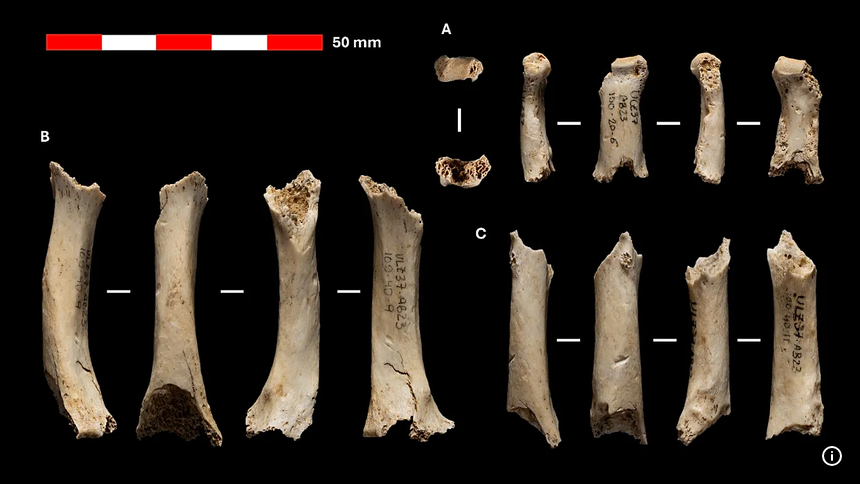
A 46,000-year-old hand has a story to tell.
Six bone fragments found in Spain's Abauntz Cave belonged to a male Neanderthal. Scientists even recovered ancient DNA.
They're the first Neanderthal skeletal remains identified in Navarre.
#Archaeology#Science
A humanoid robot with 20 degrees of freedom per hand is joining the AI race.
NVIDIA and Agile Robots unveiled Agile ONE SN, a 1.4-metre research robot with tactile fingers and onboard AI computing.
It's planned for 2027, not already in homes.
#Robotics#AI
ON THIS DAY IN 1965:
Comet Ikeya-Seki skimmed just 467,000 km above the Sun's surface.
It became so bright that people in Japan could see it in DAYLIGHT. Some called it the Great Comet of 1965.
#Space#History
@UnseenTV_HQ The sheer scale of those 40-ton granite boxes is mind-blowing! Did you know some theories suggest they were floated up the Nile and then hauled into place using lubricated sledges?
Babies don't stay still for MRI scans.
MIT researchers developed AI that tracks a fetus's moving head to help produce clearer brain images. It could mean fewer repeat scans and earlier detection of abnormalities.
Not yet routine clinical care.
#AI#Science
Light travels at 300,000 km per second.
Yet it takes 8 minutes to reach Earth from the Sun, over 4 hours to reach Neptune, and more than 4 YEARS to reach the nearest star system.
The scale of our universe is mind-blowing.
#Space#Astronomy#Cosmos
How big can a black hole actually get?
This incredible visualization puts the staggering scale of black holes into perspective, comparing their sizes to our Sun.
Credit: YT morn1415
#Space#BlackHoles#Cosmos