Last week we shipped something wild.
reap is now the first AI video clipping tool that lives inside your Claude sessions.
Paste a link. One prompt. 13 ready-to-post clips back.
See the demo below.
- One long video → 13 post-ready clips. no editor, didn't even leave my claude session.
- Paste a youtube link, ask for portrait clips with captions, get 13 back, each scored so you know which to post first.
- For brands, agencies, podcasters, and clippers who film once and post everywhere.
I gave Claude one 68-minute interview and one prompt.
It came back with 30 clips. Captioned, vertical, and ranked, with a note on which one to post first.
Then, without leaving the chat, I asked for the same clips in Spanish and Bengali. Done.
Without any manual overhead.
That's what an agentic video workflow looks like with reap MCP:
1. Prompt Claude with the video and what you want
2. reap finds the moments and cuts the clips
3. Ask for other languages in the same session
A vertical crop can cut off the speaker, lose half a conversation, or leave a panel surrounded by empty space.
reap analyses reframes the footage to keep speakers in view as they move, preserve multi-person conversations, and fit the content to the screen.
One recording. Frames that actually work for Shorts, Reels, and social posts.
If an AI video agent is judged by how many clips it produces, it'll optimize for output.
But the goal was never to make the most clips possible.
It's to find the moments that communicate something worth watching.
We're getting better at automating production. Are we measuring whether the output is actually better?
The next leap in AI video editing isn't just faster cuts anymore.
It's getting better at decisions.
Knowing what to keep, what to remove, when a moment needs context, and what makes an edit actually work and what a good edit actually looks like
If every tool can generate or clip a video, the real differentiator won't be making another clip.
It'll be knowing what makes it worth watching.
I think the next shift in AI video is how the workflow is built.
Today, you move between tools to find moments, edit clips, reframe them, and prepare them for publishing.
With reaps MCP, I’m exploring what changes when you can describe the outcome you want instead of manually triggering every step.
The hard engineering problem isn’t understanding the instruction. It’s turning it into a reliable workflow, and getting the output right.
Building AI video tools isn't just about generating the first cut.
It's about letting people change the details without starting over.
We're working on that in reap's editor, from adjusting pan and zoom on the timeline to animating shots and removing backgrounds.
A clip can have the right moment and still need a little work before it’s ready to share.
Pan, zoom, move through the timeline, animate clips, or remove the background.
Here’s a look at what we’ve been building into reap’s dynamic editor. 👇
A video shouldn't depend on sound to make sense.
Captions help people follow the story on mute, catch important points, and stay with the video.
They're not just text on a screen. They're part of the viewing experience.
As AI gets better at editing video, I think the editing experience has to evolve too.
Not just generating a result, but making it easy to inspect, adjust, and refine when the result isn't quite right.
The interesting question isn't whether AI can edit.
It's how much control people need over the edit.
A clip can have the right moment and still need a little work before it’s ready to share.
Pan, zoom, move through the timeline, animate clips, or remove the background.
Here’s a look at what we’ve been building into reap’s dynamic editor. 👇
AI can automate a cut, generate captions, or reframe a video.
But a video workflow is more than a sequence of steps.
The interesting engineering problem is connecting them:
understanding the footage, preserving context, and deciding what each step should do based on the intended outcome.
The shift is from automating editing actions to orchestrating the entire workflow.
Wait! you can make your video clips without even leaving ChatGPT now.
Connect reap MCP.
Then just tell ChatGPT what you want:
“Take this podcast and find the 5 strongest moments. Turn them into short clips with captions and 9:16 framing.”
- No jumping between tools.
- No manual workflow.
- ChatGPT figures out what needs to happen.
- reap actually does it.
The chat isn’t just where you ask questions anymore.
It can be where the work gets done.
AI made clipping easier.
Now YouTube is emphasizing originality, X is investing in original content, and video editing is becoming more conversational.
Meanwhile, AI can already turn a podcast into dozens of clips.
The next challenge isn't making more clips.
It's deciding which moments deserve attention, shaping them into content, and getting them out into the world.
The cut was only the beginning.
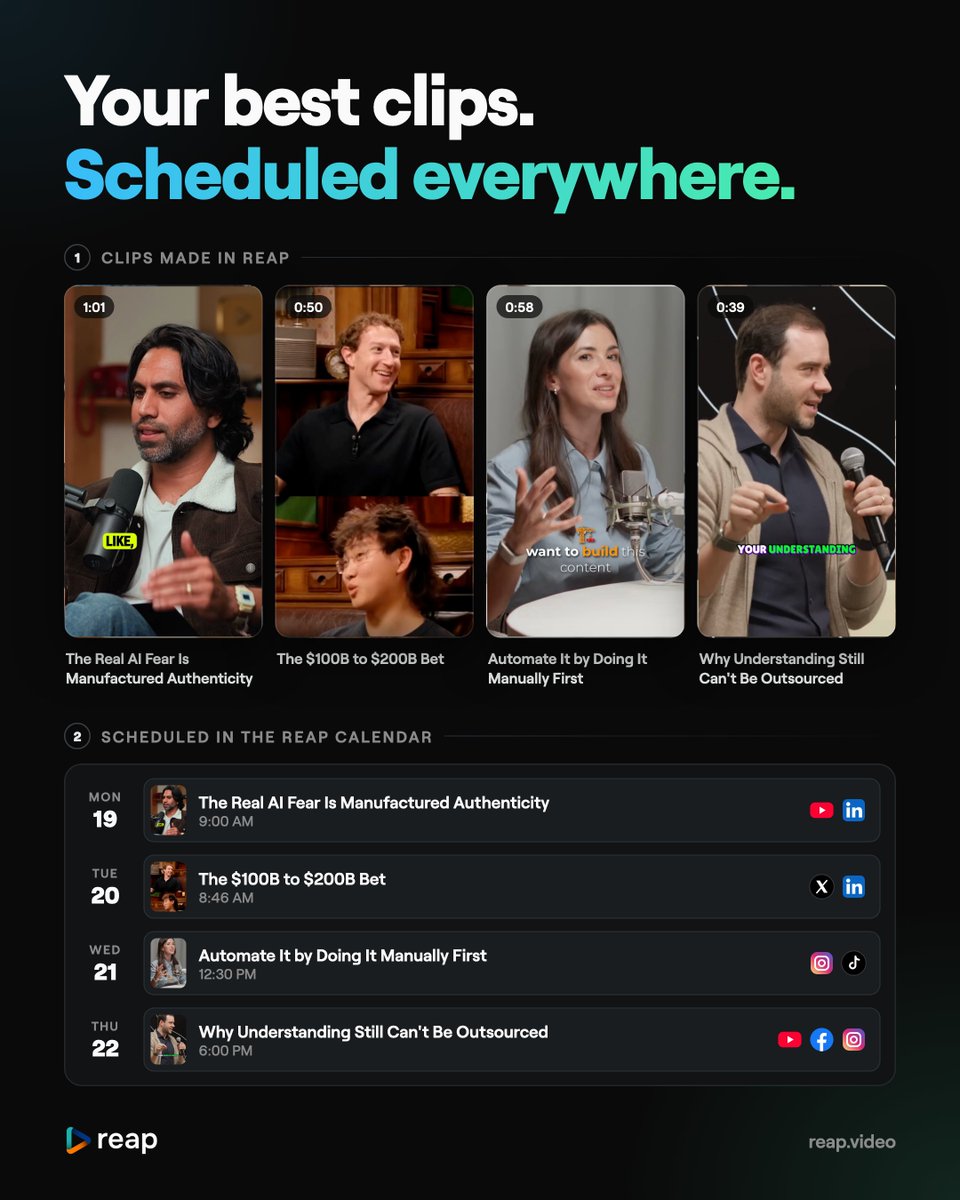
You’ve already got the clips. Now comes posting them out into the world.
With reap, you can schedule or publish your clips across your connected social accounts in one go,
instead of manually uploading and scheduling each one.
Make the clips. Then publish them across all your social accounts.
Vertical is a format. Good framing is a decision.
Different footage needs different framing to keep the important things in view.
Reframing should account for what’s happening in the video, not just its dimensions.
Here's a look at Auto Reframe in reap.
Most reframing starts with:
“Make this 9:16.”
It shouldn't be the instruction.
First understand what’s happening in the video.
Then decide what deserves to stay in frame.
The shape comes second.
Captions do more than help people follow along with the sound off.
They can add rhythm, bring attention to a phrase, or simply make a video feel more like you.
A few ways to style your clips in reap.
One interesting shift in AI video: clipping is moving from standalone tools into the platforms themselves.
TikTok, YouTube, CapCut, all making it easier to turn long-form video into short-form content.
As the capability becomes standard, the value shifts toward selecting the right moments, refining them, and getting them published.
We're watching an entire category move up the stack, and the next battleground? What happens before and after the cut.
Not every good moment deserves a clip. The hard part isn’t finding moments.
It’s knowing which ones have:
- Context
- A hook
- A payoff
That’s where AI video editing gets interesting.
Less clipping. More judgment.
You don’t need a separate channel for every language.
One piece of content can become a localized experience inside reap: captions, translation, dubbing, and more.
The goal isn’t just to translate the words.
It’s to make people in another language feel like the content was made for them.
Most reframing starts with:
“Make this 9:16.”
It shouldn't be the instruction.
First understand what’s happening in the video.
Then decide what deserves to stay in frame.
The shape comes second.
Wait! you can make your video clips without even leaving ChatGPT now.
Connect reap MCP.
Then just tell ChatGPT what you want:
“Take this podcast and find the 5 strongest moments. Turn them into short clips with captions and 9:16 framing.”
- No jumping between tools.
- No manual workflow.
- ChatGPT figures out what needs to happen.
- reap actually does it.
The chat isn’t just where you ask questions anymore.
It can be where the work gets done.
There is a real difference with Clipping tools & Video Agents.
A clipping tool finds moments. You still run every step around it: settings till the review what goes out.
An agent takes one instruction. Last week I gave it this one, in Claude with reap connected:
"Find every strong take where he talks about why he didn't sell Buildspace, and turn them into vertical clips with captions."
What came back, without me touching a setting:
→ it read the 1hr interview and picked portrait, captions and face tracking on its own
→ 30 clips, cut, captioned and ranked
→ a read on the batch: lead with #1, hold #4 for a follow-up two days later
→ one more prompt, and the same interview came back captioned in Spanish, Bengali and Arabic, 30 clips each
The shift is not that AI can find clips.
It is that you stop doing every step yourself. You give the direction, it handles more of the work.
This is the direction we are building toward at reap.