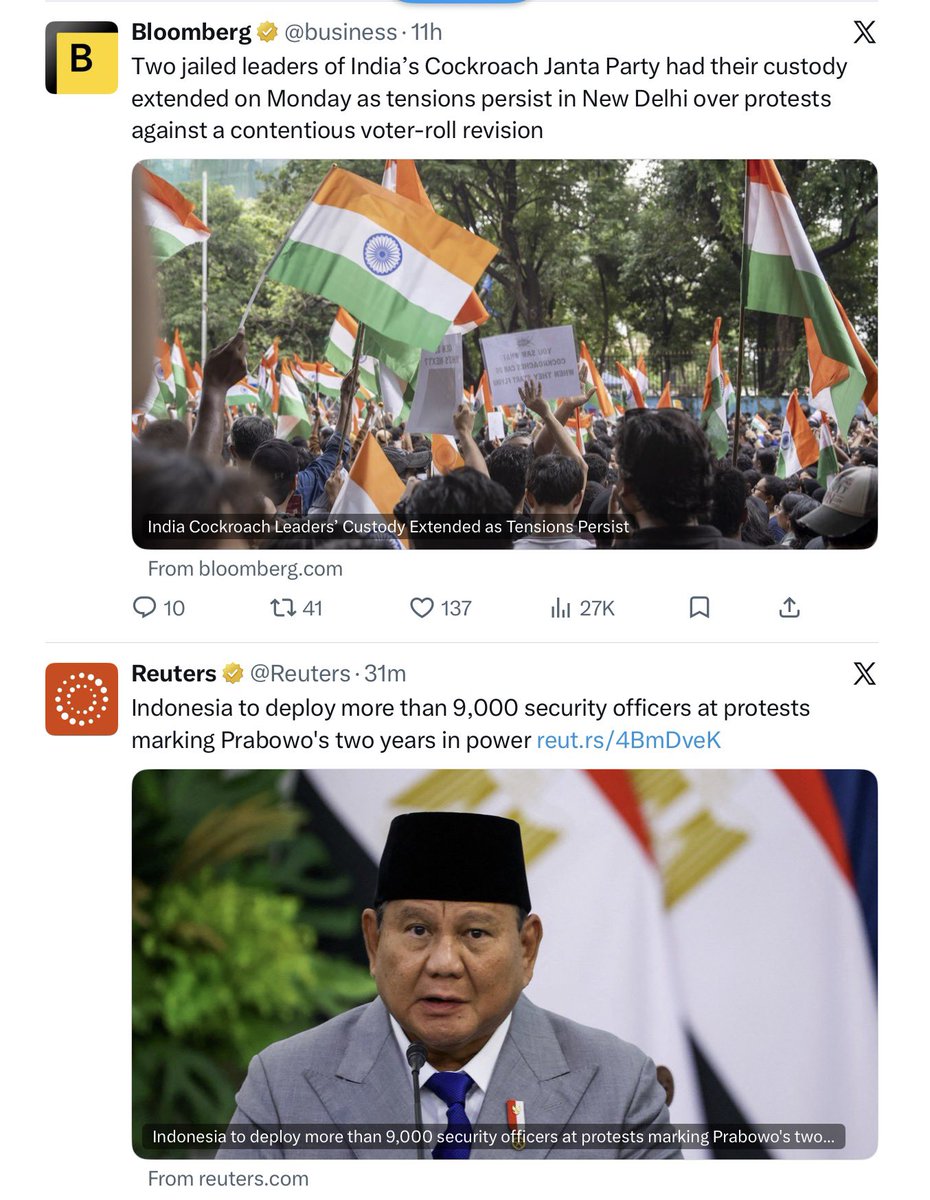
How dissappointing to find out that Kompas too was mentioned by Mr Berletic. Remember, once you step on muddy water, you'd never clean again!! Shame on you, @kompascom@KompasTV
🇺🇸🇮🇩NEW ARTICLE: The US is Behind Indonesian Protests (Again)
(Note: Because X censors NEO links, I am reproducing the entire text of the article below)
Indonesia, located in Southeast Asia, is the 4th most populous nation on Earth with 287 million people. It constitutes China’s 12th largest trade partner on Earth and 3rd largest trade partner in Southeast Asia following Vietnam and Malaysia.
Indonesia is also strategically located near the Malacca Strait, a critical waterway the vast majority of China’s imported energy and resources as well as exported goods travel through, and a waterway the US has planned and prepared for years to close as a means of implementing a “distant blockade” on China.
Today, the US is already implementing a variation of the “distant blockade” through its invasion and capture of Venezuela, its proxy war on Russia through Ukraine, and its wars across West Asia - directly on Iran and through its Israeli and Saudi proxies against Lebanon and Yemen respectively. Together, these conflicts have all served to either sever or drastically reduce energy exports to China.
Destabilizing or politically capturing Indonesia would serve US interests in both encircling and containing China with a united front of US-captured proxies or an arc of destabilization denying China viable economic, trade, political, and military partnerships. It would also enhance the US’ ability to either directly or indirectly threaten maritime shipping through the Malacca Strait - significantly expanding its “distant blockade” on China.
For all of these reasons and the US’ general desire to prevent any powerful independent nation-state from rising and undermining US primacy either worldwide or regionally - the US seeks to undermine Indonesia through extensive political interference.
In recent years this has taken the shape of protests promoted by the collective Western media as “youth,” “Gen-Z,” or “student-led” protests following similar patterns of US interference elsewhere around the globe.
Students, who have not even finished studying their own chosen area of focus in life, do not possess the resources, experience, or knowledge to organize nationwide movements capable of contesting, let alone ousting existing political orders, and instead serve as the rank and file for interests that do.
Examining the organizations promoting and defending the protests taking place in Indonesia over the past 2 years reveals a vast network of US government-funded media outlets, “human rights” organizations, and legal foundations promoting and amplifying narratives, promoting the protests themselves, as well as providing support for and legal defense of the protests and their participants.
US-funded Media in Indonesia and its Role in Boosting US Interference
US interference in Indonesia was exposed last year with lists of specific Indonesian media organizations promoting the protests receiving US government and/or foundation funding.
This included Tempo, Kompas, Tribunnews, Remotivi, New Naratif and Project Multatuli.
These admissions were made by these organizations themselves in a 2025 Mongabay article titled, “‘Without us, no scrutiny’: Indonesia’s independent media count cost of US funding cuts.”
The article not only admits Remotivi, New Naratif, and Project Multatuli received significant US government funding through USAID and the National Endowment for Democracy (NED) and that it would be virtually impossible to function without this funding, it is admitted that US government “program coordinators” discussed editorial policies with its grantees and were involved in whether or not specific content was published.
Kompas and even the Jakarta Post were mentioned as associated with this US-funded network.
Tempo, on its own website, admitted to US funding through Media Development Investment Fund (MDIF) money - the MDIF itself admittedly a product of European government funding and funding from George Soros’ Open Society Foundations.
Kompas, Tribuunews, and Tempo are among the top news platforms within Indonesia’s information space alongside CNN Indonesia and BBC News, demonstrating US information dominance within Indonesia, part of extensive US information dominance worldwide.
US-funded media organizations are critical in shaping, promoting, and amplifying the narratives and slogans of US-backed opposition groups. Because of their large share of Indonesia’s information space, the Indonesian public is exposed to these narratives, ensuring larger percentages of public support and participation in US-backed opposition movements.
Because Indonesia - like many other nations around the globe - is almost entirely dependent on US-based social media platforms including Meta’s WhatsApp, Instagram, and Facebook, as well as X and Google’s YouTube, their algorithms ensure the vast majority of content Indonesians consume is connected to US interests and US-backed movements and organizations, while opposing views or attempts to expose US interference are suppressed.
As early as 2008 the US State Department organized what it called the “Alliance of Youth Movements,” in which it was admitted that:
“This Alliance of Youth Movements had organic beginnings in the sense that already, youth movements from around the world that were utilizing online, mobile and digital media were interacting to discuss best practices. The State Department acted as a facilitator to help provide some structure to this trend by partnering with entities like Facebook, Howcast, Google, MTV, and Columbia Law School.”
And that:
“The aim of the Alliance of Youth Movements is to look at the success stories where youth have used the online space as a tool for youth empowerment against violence and oppression, synthesize the best practices that made these possible, and inspire new movements.”
The US State Department and its Western social media partners were preparing region-wide networks of opposition groups to be sent back to their home countries to destabilize and if possible, overthrow them on behalf of the US government.
By 2011, the New York Times in its article, “U.S. Groups Helped Nurture Arab Uprisings,” admitted the US NED and the State Department were behind the opposition groups driving regional unrest. The same article specifically mentioned “a 2008 technology meeting” (the Alliance of Youth Movements) sponsored by the US State Department and US-based social media platforms where opposition groups involved in the “Arab Spring” were “taught to use social networking and mobile technologies.”
Beyond training and equipping US-backed opposition groups themselves, US-based social media platforms abuse their monopoly over global information space to facilitate US interference and even warfare.
In a 2016 Independent article titled, “Google planned to help Syrian rebels bring down Assad regime, leaked Hillary Clinton emails claim,” it is admitted that:
“An interactive tool created by Google was designed to encourage Syrian rebels and help bring down the Assad regime, Hillary Clinton's leaked emails have reportedly revealed.
By tracking and mapping defections within the Syrian leadership, it was reportedly designed to encourage more people to defect and 'give confidence' to the rebel opposition.”
The article would continue:
“The email detailing Google's defection tracker purportedly came from Jared Cohen, a Clinton advisor until 2010 and now-President of Jigsaw, formerly known as Google Ideas, the company's New York-based policy think tank.
In a July 2012 email to members of Clinton's team, which the WikiLeaks release alleges was later forwarded to the Secretary of State herself, Cohen reportedly said: “My team is planning to launch a tool on Sunday that will publicly track and map the defections in Syria and which parts of the government they are coming from.””
In other words US-based social media companies are in direct contact with the US government overseeing, aiding, and abetting US interference and even proxy war within targeted nations.
The rigging of US-based social media algorithms and the deployment of custom-tailored applications to promote US-backed protests and suppress attempts to expose or neutralize them is a daily reality playing out in the information space of nations around the globe, and to the immediate detriment of these nations’ national security.
US-Funded Media in Indonesia Covering Up US Interference
In addition to US information dominance inside Indonesia’s information space, Indonesia’s dependence on US-based social media platforms, and their abuse of algorithms to manipulate Indonesian public perception, US-funded media outlets in Indonesia have taken part in concerted attacks against individuals researching and exposing their activities.
The above-mentioned Jakarta Post in a June 2026 article titled, “Media probe reveals disinformation behind ‘foreign-backed’ 2025 protests,” claims:
“A collective study into allegations of foreign influence behind last year's sweeping protests has instead uncovered what appears to be an anti-Western disinformation campaign.”
However, it also claims (emphasis added):
“The collective probe by Tempo magazine, https://t.co/zvSfLYoisH, https://t.co/Cw02xY3GaG, https://t.co/NIOYoqxCxA and social media monitoring platform Drone Emprit, conducted as part of a European Union-backed media development program run by international nonprofit Internews, found indications of foreign information manipulation and interference (FIMI) that aimed to frame last year’s sweeping protests as foreign-backed.”
In other words, a “probe” into claims regarding US interference in Indonesia was conducted by verified, admitted US-funded media organizations receiving additional funding from foreign interests - the European Union and Internews.
Internews is funded by - among others - Open Society Foundations, Ford Foundation, Rockefeller Foundation, as well as the very US-based social media companies involved in facilitating US interference worldwide including Facebook and Google.
Elsewhere on Internews’ own official website is an “About Internews” page admitting the organization’s work “was carried out as a longtime implementing partner of USAID.”
Thus, the “probe” was simply a concerted Western-funded attack on those researching and exposing actual, verified Western interference in Indonesia. Together with admitted efforts taken by US government funding organizations like the NED to cover up public disclosures, it serves as further evidence of how deceitful and malicious US intentions are regarding Indonesia in general and specifically through its funding of organizations within Indonesian social, political, and information space.
Student Protesters and their US-Funded Defenders
Yayasan Lembaga Bantuan Hukum Indonesia (YLBHI) and the Legal Aid Institute/Foundation (LBH) was also revealed to have received US, Canadian, and Australian government funding spanning the entire 21st century. It is listed as a “partner” of the Freedom Fund, which in turn is funded by the US State Department.
YLBHI/LBH was established to provide legal aid to US-backed opposition groups, individuals, and participants in US-backed movements.
During the protests last year it published a statement regarding the “right to protest” co-signed by a long list of likewise US, European, and Western foundation funded fronts - many of which are not even located in or related to Indonesia. The very next organization on the list following YLBHI/LBH was “Asia Justice and Rights” (AJAR) - while based in Indonesia, according to its most recent annual report, receives European government funding as well as from Open Society Foundation. Also signing the statement was the “Cambodian Center for Human Rights (CCHR)” which admitted in previous disclosures to be funded by the US State Department, the British Embassy, the European Union, USAID, and NED-subsidiary Freedom House.
One of the most frequently cited student groups involved in Indonesia’s protests is the “student executive body” at the University of Indonesia (BEM UI). YLBHI regularly promotes (along with US-funded media outlets) and legally defends events and marches “organized” by BEM UI, from 2021 all the way to recent months. Like many other US-funded “human rights” or “legal aid” organizations, protester violence is ignored or excused and any efforts by state security agencies to maintain order are condemned as “human rights violations.”
BEM UI and other student groups - without massive networks of US-funded media organizations promoting their activities across Indonesia’s information space, rigged by the US-based social media platforms controlling the algorithm throughout which information flows to Indonesia’s citizenry, and defending them legally through US-funded organizations like YLBHI - would not have achieved the nationwide recognition and influence they are claimed to have.
Corruption, environmental issues, and economic hardships are neither unique to Indonesia nor necessarily the fault of Indonesia’s current government. Systemic corruption does not appear overnight, nor do environmental issues. Economic hardships including rising energy prices and the price of all commodities dependent on those energy prices are actually a direct result of the US war of aggression across West Asia waged as a deliberate attempt to choke the rest of Asia off from cheap, reliable imports of energy from the region and create the very conditions for unrest in the streets of Indonesia, Malaysia, Myanmar, and Thailand.
Far from a spontaneous decentralized movement - just like with the 2011 “Arab Spring” - the US spent years building up these networks, infiltrating and capturing controlling shares of Indonesia’s information space, and even directly and deliberately contributing to the very real economic problems Indonesians face. And just like with the “Arab Spring” in 2011, or Ukraine’s “Euromaiden” in 2014, no matter what Indonesians being led by US-funded organizations into the streets believe they will achieve - the US has only greater hardship and humiliation in store for the nation of Indonesia.
The protests taking place across Indonesia this year are simply a continuation of protests already exposed last year as US-backed interference - and it is interference the US-backed opposition in Indonesia received additional Western assistance to specifically cover up.
They are protests that fit into a wider regional campaign - previously referred to as the “Milk Tea Alliance,” and is a deliberate attempt to recreate the US-engineered “Arab Spring” across Southeast Asia to surround China with the same death, destruction, and destabilization the US has surrounded Iran with in West Asia from 2011 onward.
The US is waging a global war on multipolarism. Not just on the nations proposing and leading the rise of multipolarism - nations like Russia, China, and Iran - but also any and all nations that could potentially contribute to and benefit from multipolarism - Indonesia among the most important of those nations.
Exposing US interference in Indonesia not only helps avert the disasters similar US interference caused across the Arab World from 2011 onward or in Ukraine from 2014 onward, it also is the first step to eliminating foreign-hijacked activism and replace it with real, pragmatic activism that could potentially help alleviate the problems Indonesia - and all other nations - have.
Ignoring the empirical evidence of the US government promoting, defending, and benefiting from political crisis in Indonesia and surrendering to emotions US-funded narratives are scientifically designed to exploit - will only add Indonesia to the long and still growing list of nations the US has destroyed from the inside out, without firing a single shot itself.
Brian Berletic is a Bangkok-based geopolitical researcher and writer.
𝗪𝗛𝗬 𝗖𝗛𝗜𝗡𝗔 𝗗𝗢𝗘𝗦𝗡'𝗧 𝗡𝗘𝗘𝗗 𝗛𝗘𝗚𝗘𝗠𝗢𝗡𝗬
People keep asking me if China will try to rule the world the way the West did. A lot of Chinese friends answer with Confucius, harmony, peace-loving civilisation. I understand that, but I don't think it's enough. Every big civilisation has had its conquests, China included. Quoting old philosophers doesn't tell you what a country will do tomorrow.
Ken Leong wrote a piece that makes a better case, and I mostly agree with it. Not morality. Realism.
𝗪𝗜𝗡𝗡𝗜𝗡𝗚 𝗕𝗔𝗧𝗧𝗟𝗘𝗦, 𝗟𝗢𝗦𝗜𝗡𝗚 𝗪𝗔𝗥𝗦
Look at America. The strongest military in history.
Afghanistan, 2001. Taliban gone in weeks. Twenty years and a fortune later, the Taliban walked back in.
Iraq, 2003. Saddam gone fast. Then insurgency, sectarian war, and Iran ending up with more influence than before.
Iran, this year. Huge strikes, lots of damage. And still no settlement, while shipping in Hormuz and oil prices tell you who's really paying.
Smashing an army is one thing. Getting the result you wanted is something else.
𝗔 𝗖𝗢𝗨𝗡𝗧𝗥𝗬 𝗜𝗦 𝗡𝗢𝗧 𝗔 𝗠𝗔𝗖𝗛𝗜𝗡𝗘
You can't just push harder and get more obedience. A society is messy. Institutions, history, religion, family, money, all tangled up.
Knock out a government and you knock out the police, the ministries, the jobs. People resist. You crack down. They resist more. The thing you went in to stop keeps feeding itself.
More force, past a point, gets you less control. I think that's the lesson Washington keeps refusing to learn.
𝗘𝗩𝗘𝗥𝗬𝗧𝗛𝗜𝗡𝗚 𝗜𝗦 𝗖𝗢𝗡𝗡𝗘𝗖𝗧𝗘𝗗
China lives off trade. Markets, energy, shipping lanes, tech, finance. So does America.
Hurt the network and you hurt yourself. Buddhists have a word for it, everything arises together. Chasing total security usually makes you less secure.
And conquest doesn't pay like it used to. You can't occupy a chip factory and keep it running. Its value is in the engineers, the suppliers, the power grid, the customers. Bomb the system and the building is worthless.
𝗕𝗨𝗜𝗟𝗗 𝗥𝗢𝗔𝗗𝗦, 𝗡𝗢𝗧 𝗕𝗔𝗦𝗘𝗦
China got rich inside the global system. Why would it burn that down to play empire?
Belt and Road isn't charity, and I won't pretend every project went perfectly. But building ports and railways where others also gain is a smarter bet than invading anyone. Self-interest, just the long-term kind.
That fits how China works, as I see it. Lots of debate, weigh the costs, adjust. Pragmatic, not ideological.
𝗧𝗔𝗜𝗪𝗔𝗡
This is the hard one. Beijing sees it as sovereignty. Others see a threat. Everyone arms "defensively" and everyone feels less safe.
A war there would be a disaster for everyone, China included, and for the whole world economy. That's exactly why patience has to be a deliberate choice, not an afterthought.
𝗦𝗧𝗥𝗢𝗡𝗚 𝗘𝗡𝗢𝗨𝗚𝗛 𝗡𝗢𝗧 𝗧𝗢 𝗡𝗘𝗘𝗗 𝗜𝗧
China doesn't need to claim it's more virtuous than anyone. It just needs to look at what happened to the last superpower and not repeat it.
Maybe the real test of a great power isn't how much force it can use, but how much it can get done without using it.
A country that tries to dominate everyone ends up weakening itself. One that understands how connected we all are can build something that lasts longer than domination ever did.
Credit to Ken Leong for the original article.
Be informed, not entertained.
@steve_hanke Foreign ownership of 40%of Indonesian equities is highly concentrated in banks, telecoms, mining, etc. as subsidiaries of foreign parent companies. Zero run risk. The free float was vulnerable to destabilisation hybrid attack, but the real economy is not at risk.
China billionaires
NOT A SINGLE ONE IS ALLOWED INTO POLITICS.
It is a "dictatorship" of the 99.99% meaning > Yes in China the people rule, no oligarchs.
It is not a pro-China post, it is a post that should shame Western self proclaimed democracies
I'm fully aware that I'm going to catch heat for this post. The pro-Ukrainian crowd is going to accuse me of being a Russian bot.
Sorry to disappoint, but I'm just a 48 year old American dad from North Carolina trying to spread some truth.
I don't GAF about Putin or Russia. But these are the facts.
Biden met with Putin during the summer of 2021. After that meeting, Biden said that he was optimistic of having a good relationship with Putin.
After that meeting, Putin again said that his redline was Ukraine joining NATO.
Two months after meeting with Putin, Biden invited Zelensky to the White House to discuss a new missile system for Ukraine and to discuss Ukraine joining NATO. That happened.
After the Biden/Zelensky meeting, Putin continued saying publicly that his redline was Ukraine joining NATO.
After Russia invaded Ukraine, Biden went on TV and declared that Ukraine would be joining NATO and that Russia had already lost the war.
I don't give a damn about Putin or Russia. I'm not arguing that Putin was in the right. The purpose of this post is to show that the Biden Administration absolutely knew what they were doing when they were provoking Putin to start this war. They knew what they were doing when they invited Zelensky to the White House to discuss Ukraine joining NATO. Wake up people.
INDIA and INDONESIA > US putting pressure through Colour revolution attempt.
The US is currently trying to destabilise both countries, India too close to Russia and strong on its non-alignment historical stance.
Indonesia too close to China and inflexible on its sovereignty.
COLOUR REVOLUTION attempts on both countries.
And of course, Western media and fake human right NGOs like Amnesty international / Human Rights watch are amplifying the message.
Are you paying attention ?
This is one of the best analyses of Chinese Foreign Policy and Geo-political Thinking by a young Chinese academic who is educated in the best universities in America.
This is an academic presentation by Sheng Zhang (張晟). Sheng is a PhD candidate in Sociology at the Johns Hopkins University, and holds a master’s degree in Middle Eastern Studies from Harvard University, where he joined the AGPT. Very eloquent young man, can be quite humorous.
Below is a summary of YouTube video presentation he gave at Kyoto University Symposium 2026: "Geopolitics in the Time of Monsters" on 13 October 2026.
An Analysis of Sheng Zhang’s Middle East Strategy Presentation
When Western observers look at Chinese foreign policy, they often fall into a trap: they assume Beijing thinks like Washington or London, using a simple playbook of economic self-interest or sheer power expansion. Sheng Zhang’s presentation is critical because it dismantles this simplistic view. He shows us that China’s modern foreign policy isn’t a single, rigid strategy, but a dynamic tension between two deep-seated historical traditions: the Maoist legacy and the Dengist legacy.
Understanding this internal pull is essential to grasping how Beijing views geopolitics today—especially in volatile regions like the Middle East.
The Ideological Engine: The Maoist Tradition
The Maoist approach to geopolitics is rooted in morals, anti-imperialism, and ideological solidarity. During the Cold War, Mao Zedong viewed China as a leader of the global "Third World"—a coalition of developing nations fighting back against Western dominance and colonialism.
In the Middle East, this legacy translated into unwavering support for national liberation movements, most notably in Palestine. It wasn't about securing oil or trade deals; it was about global justice and standing up to Western hegemony.
As Sheng Zhang points out, this spirit is far from dead. While China's Ministry of Foreign Affairs now speaks in careful diplomatic language, the Maoist instinct remains strong among the Chinese public, particularly young people. When Chinese citizens look at the Gaza conflict today, they don't just see a modern war; they see a mirror of China’s own "century of humiliation" and its struggle against foreign occupiers. This anti-imperialist solidarity is a core part of China's political DNA.
The Economic Engine: The Dengist Tradition
Enter Deng Xiaoping in the late 1970s, who turned Chinese diplomacy upside down with a famous motto: "Hide your strength, bide your time."
Dengism is pragmatic, non-ideological, and focused intensely on business. Under this framework, China doesn't care whether a country is a democracy, a monarchy, or an adversary of the West—if they have resources to sell or markets to buy Chinese goods, Beijing will build a relationship.
This approach created China’s traditional Middle East balancing act. Over the past three decades, Beijing simultaneously managed warm economic relationships with mutually hostile actors:
•The Arab Gulf States (Saudi Arabia, UAE): Essential sources of crude oil and massive infrastructure investment.
•Israel: A crucial partner for high-tech transfers and trade.
•Iran: A steady source of discounted energy and a strategic foothold in Eurasia.
For years, Dengist pragmatism allowed China to grow rich while avoiding the messy, expensive military entanglements that trapped the United States in the region.
The Xi Jinping Synthesis—and Its Limits
Under President Xi Jinping, China has tried to merge both legacies. Xi wants to maintain Dengist economic connectivity while resurrecting Maoist political influence to position China as a leader of the Global South.
Sheng Zhang’s key contribution is identifying why this dual approach is reaching its absolute limit. You cannot maintain a purely Dengist "neutral trader" policy in an increasingly polarized world.
When regional conflicts intensify—such as the Gaza war or the escalating proxy battles around Iran—Beijing’s attempt to stay neutral satisfies no one. The Gulf States want security guarantees, Iran wants active geopolitical support against American sanctions, and the West demands that China condemn anti-hegemonic actors.
Why Zhang’s Analysis Matters
From a neutral perspective, Zhang’s presentation highlights a major turning point in global politics:
1.The End of Hedging: Zhang argues that as geopolitical friction between Beijing and Washington worsens, China’s traditional fence-sitting will become impossible. Beijing will eventually be forced to lean more decisively toward strategic partners like Iran. Pushing back against U.S. hegemony will outweigh the Dengist desire for quiet trade with U.S. allies.
2.Public Opinion as a Strategic Force: Western analysts often dismiss public opinion in authoritarian systems, but Zhang shows that Chinese public emotion—steeped in Maoist anti-colonialism—creates real pressure on Beijing to take a stronger stand against Western-backed policies in the Middle East.
3.A Warning for Washington: The U.S. assumption that China can be pressured into enforcing Western policy in West Asia misunderstands Chinese grand strategy. Pushing China into a corner doesn't make it comply; it accelerates Beijing’s shift from Dengist caution to Maoist resistance.
Final Thought
Sheng Zhang gives us a clear window into a nation at a strategic crossroads. China’s Middle East policy is no longer just about buying oil—it is becoming a primary arena where Beijing must decide whether it wants to remain a cautious economic power or step up as an active counterweight to Western dominance.
https://t.co/cIi3qUm9ri
🇨🇳 A striking look at the diverse, beautiful traditional attire of men from China's ethnic minority groups. Celebrating China’s diverse ethnicities! ✨🪭
🎙️ 宏灵
Kanzler Merz behauptet, die Ukraine würde nur militärisch relevante Ziele in Russland angreifen. Dass das nicht stimmt, konnte ich hier in Sotschi erleben. Deutschland unterstützt Terror. Für die @NachDenkSeiten habe ich die Situation analysiert.
https://t.co/qBhymk6Ja4