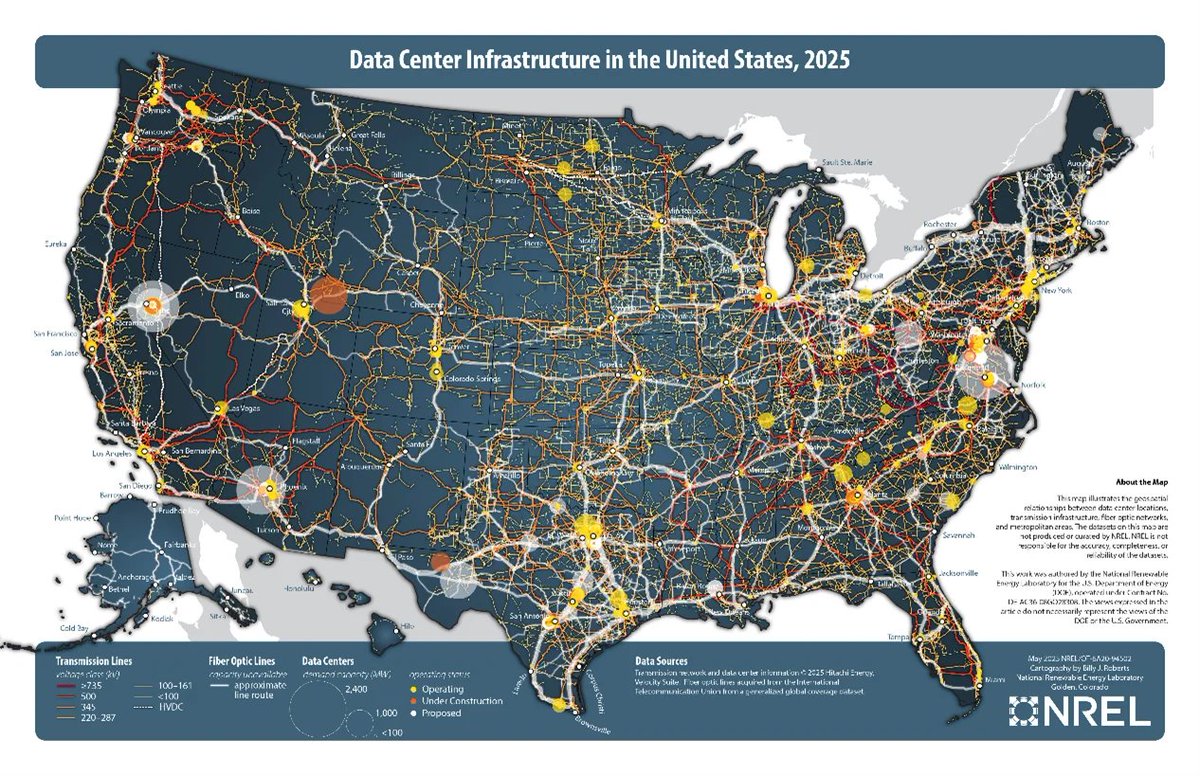
The grid is a national network, like the Interstate Highway System. But we run it as if each stretch of highway were a private toll road.
The grid shouldn’t be a private commodity, it should be a platform that unlocks American prosperity. A backbone, not a bottleneck.
Big Tech has a dirty little secret: you’re paying for their AI boom.
My new paper from @Groundwork shows how federal lawmakers can hold Big Tech accountable, build the affordable grid we need, and lower bills now. 🧵
Increase demand-side flexibility. Virtual power plants, smart EV charging, heat pumps, solar, and batteries can reduce peak demand and help states meet new load growth without costly infrastructure buildouts.
This offers an instructive case study on the risks of "speed-over-accuracy" in our field, and how quickly misinformation can travel, even among experts.
On Friday, Brattle associate @aniruddh_mohan posted a take on the new flexible data centers report (by @CamusEnergy, @JesseJenkins, & encoord), claiming its findings showed our @DukeU study ("Rethinking Load Growth") overestimated PJM's curtailment-enabled headroom by "6x (!)."
That is a massive discrepancy. But when one accuses a peer’s work of being wrong by nearly an order of magnitude, there is a high burden of proof to ensure the comparison is valid.
In this case, the accusation was based on a fundamental misreading that led to exactly the wrong takeaway. As @JesseJenkins quickly clarified, the new report modeled a single utility territory, finding it could support ~4.2 GW of flexible load. Our Duke study assessed the entire PJM system.
Far from disproving our work, the new paper appears to corroborate it. If a single utility zone (out of ~20+ in PJM) can accommodate ~4 GW of flexible load, then our finding that the entirety of PJM could accommodate ~24 GW (at 1% curtailment rate) is proportionally aligned with their results.
To his credit, @aniruddh_mohan acknowledged his error in a reply. Unfortunately, because the original post remains up without a direct correction, the misinformation is being amplified by others who trust his usually insightful analysis, but missed the buried clarification.
We all make minor analytical errors, and sometimes large ones (and to be sure, our study had important limitations, which we identified in the paper). But there is a distinct responsibility when publicly discrediting existing research to get the basics right. The "hot take" economy often disincentivizes this diligence.
For those interested in going deeper on this topic, my @DukeU peers will be presenting updated modeling results on a webinar this week (Tues, 12/9, 11am-12pm ET), building on the pre-existing first-order results (see link below).
Important new @MorganStanley research note highlighting 4 strategies to boost US power supply: GETs, Surplus Interconnection, Adv Reconductoring, & Flexible Loads (w/ welcome cite to us).
If you want evidence that direct action works here's an anecdote. At the clinic I escort at anti abortion protestors park together in a business lot behind the clinic. They us it to sync up before coming out en masse. We usually get 100+ people, no joke. 🧵
Voting rights, infrastructure, medical marijuana & more (yes, even Zebra Cobra). Tune in at 8:30pm @MyPBSNC, 9pm @NCchannel, or online anytime to hear me unpack a big news week w/ @jay_chaudhuri@mitchkokai@NelsonDollar36 on @FrontRowmarc. https://t.co/WFoLmGEogT