Research unit based at @AarhusUni. We study frightening leisure activities: scary play, creepy movies, horrifying haunts. Currently funded by @DFF_raad.
What's the Recreational Fear Lab, and what are we up to? You can learn about some of our projects and meet several lab members in our new promo video (@TTerkildsen, @Marc_M_Andersen, @MathiasClasen, @MorbidPsych, and @mihaela_taranu): https://t.co/PHRQdfgOxy
Which horror films would you watch? In our survey, you’ll rate short plot descriptions and tell us about your viewing habits. We’d love to hear from you whether you watch horror often, rarely, or never.
Take the survey and feel free to share!
https://t.co/ebU0ZTF5Ez
On December 10, we're hosting the "Frontiers in the Science of Recreational Fear" at Aarhus University. Participation is free, but registration is required. In-person only: https://t.co/sTSjfuJYgx
Obsession is making audiences scream in terror and howl with laughter.
How come?
And why do so many of the currently most interesting horror film directors have a background in comedy?
New blog post by @marchk: https://t.co/WqVOdd1xct
Calling Stephen King fans of the world! I want to know about your King fascination. Please help by taking and sharing this survey: https://t.co/tgIXZFQWQv.
If you complete the survey, you can enter the raffle for a homemade SK figure. (Prototype depicted here.)
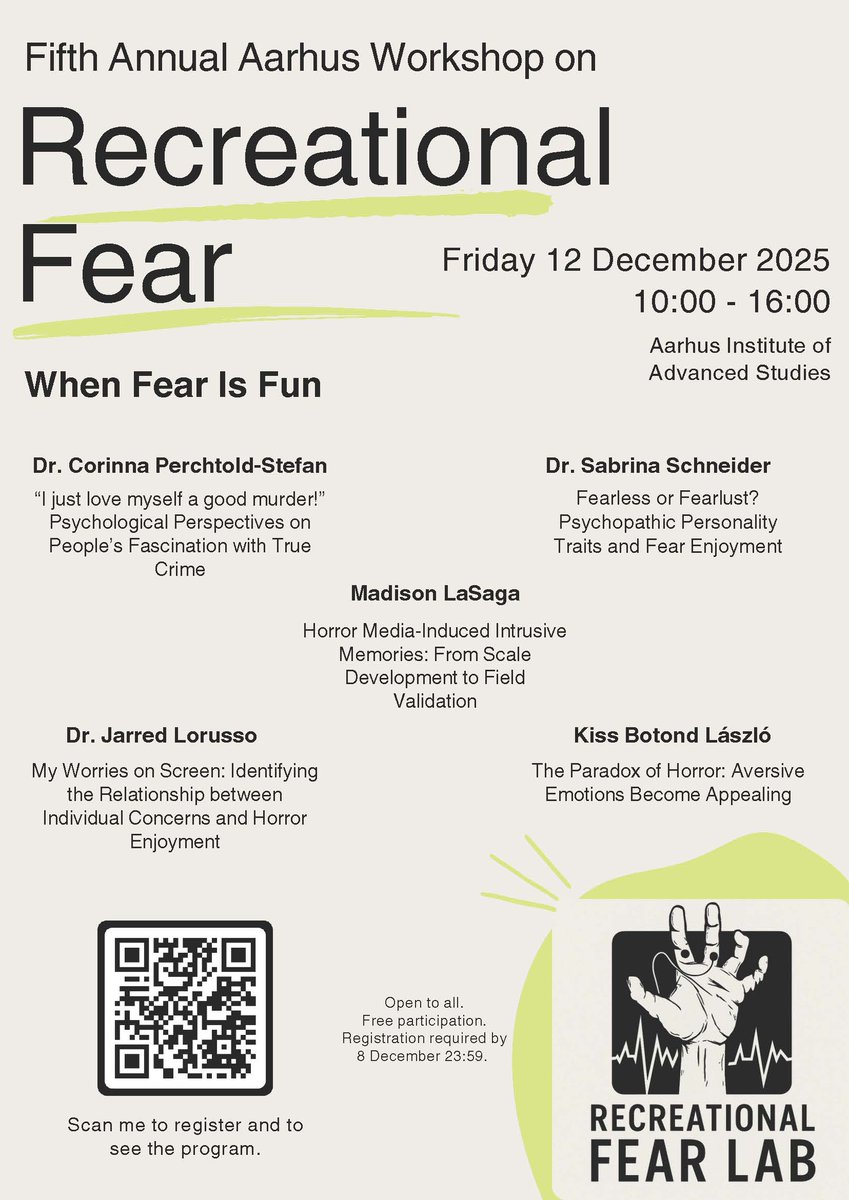
Our 5th annual workshop on recreational fear is happening in Aarhus on Dec 12!
Free participation, registration required. Venue: Aarhus Institute of Advanced Studies (https://t.co/5GCIfbTxVn)
Speakers + program: https://t.co/ZeIZwfQTTU
Register: https://t.co/kP2n5iOOzR
🧟♂️🚨 New Publication in Emotion
Thrilled to share our new paper: "Scared Together: Heart Rate Synchrony and Social Closeness in a High-Intensity Horror Setting"
https://t.co/6PLlhsQwgQ
These results align wiith prior research showing that shared experiences can amplify both emotional intensity and physiological alignment. Whether this synchrony emerges during shared fear or reflects pre-existing alignment between close individuals remains an open question -
Fear play is mostly social - done with parents, siblings, or friends. And it might serve a purpose: helping kids manage emotions, evaluate risks, and promote learning. This is the first study to show how common that is across childhood.
Amazing work, Mihaela! Congrats!
🚨 Kids LOVE fear?!🚨 Our new study led by Mihaela Taranu from the Recreational Fear Lab uncovers something surprising: Children across all ages actively seek out scary experiences - for fun! 📄https://t.co/Ih15DHj22O
They ask to poke a dead bird with a stick.
They sneak peeks at horror clips online.
They dare each other to jump from the shed roof.
They test how close their finger can get to a knife’s edge.
These might sound concerning or odd - but they’re developmentally typical!