Thanks to @nathanbenaich and @airstreet for their annual State of AI Report. We’re happy to be included for our work on REC-4881, a MEK1/2 inhibitor currently in Phase 2 clinical trials for FAP. Also featured is Nesso-1: an open-source model that predicts binding affinity in seconds to unlock faster early-stage drug discovery.
welcome to the 9th annual @stateofai report!
ai building better ai, world models, physical ai, geopolitics, cyber defense and 12-month predictions.
read it at stateof(dot)ai or watch my editor’s cut here.
a few of this year’s biggest findings follow:
"Across our programs, we've advanced quality novel candidates after synthesizing only around 300 compounds, roughly 90% fewer than the industry average."
Now that we have mapped the biology, we need to design the exact molecule to target it. In Part 5 of our platform series, SVP of Drug Design Donovan Chin, Ph.D., and VP of Pharmacology Martin Redhead, Ph.D., break down how we transition from biological target discovery to navigating complex chemical space. Just like our approach to biology, we solve chemistry problems through a continuous feedback loop between computation and experimentation.
Before a single molecule is ever synthesized in the lab, our team uses Centaur, our integrated drug design environment. By combining hundreds of machine learning and physics-based models into a single platform, we can iteratively design novel molecular structures starting directly from target properties. This generative de novo design approach automatically updates our models so they improve with every single cycle.
Our AI-native product engine has already produced over 10 development candidates. By holding our chemistry to the same rigorous standards as our biology, we can synthesize a fraction of the traditional compound volume while delivering superior novel molecules. We believe this focus on quality and novelty over sheer volume will define the true impact of AI on drug development.
🚀 Follow along over the coming weeks as we continue this series, covering how Recursion maps biology, optimizes precision drug design, and closes the gap between patient and discovery.
#TechBio #DrugDesign #AIDrugDiscovery #DrugDiscovery #Chemistry
Najat Khan, CEO of Recursion, will speak at Quorum, a healthcare AI leaders forum co-hosted by Flare Capital Partners and Google for Startups on Oct 14.
Najat will be featured on the panel “From Molecule to Market: AI and the Future of Pharma R&D.” She will join Melisa Tucker, Chief Data Officer at Tempus AI, and Zach Weinberg, Co-Founder & CEO at https://t.co/I9JRdf8gI7., to discuss where AI is actually compressing drug discovery timelines, reshaping clinical trials, and rewriting R&D productivity.
Learn more here: 👉https://t.co/qxzYwvqGdD
#TechBio #AI #AIdrugdiscovery
"A hypothesis from a model isn't a discovery yet. So, it goes back into the lab. The biology the model predicted is the biology we saw at the bench."
A computational prediction alone does not cure a disease. In Part 4 of our platform series, Associate Principal Scientist Celia Fernandez explains how Recursion closes the loop to turn AI generated hypotheses into validated biological targets.
Once our foundation models point to a potential target, we run the lab in the opposite direction. The hypothesis enters a validation cascade that becomes progressively more demanding and highly specific to the disease. This physical testing allows us to aggressively derisk our computational discoveries directly at the bench.
We test these targets against the exact same high bar that our global pharma partners hold their own internal programs to. When the loop finally closes, we can confidently prove that the biology the machine learning model predicted matches the physical reality we see in the lab.
🚀Follow along over the coming weeks as we continue this series, covering how Recursion maps biology, optimizes precision drug design, and closes the gap between patient and discovery.
#TechBio #AIdrugdiscovery #AI #drugdiscovery
“The data is used to train our models. The models point to the targets. That’s lab-in-the-loop.”
Generating millions of data points is only the first step. You need immense computational power to make sense of it (and maybe a good pair of headphones, because BioHive-2 is loud). In Part 3 of our series on our end-to-end platform, Chief Technology Officer Ben Mabey explains how Recursion turns raw data into a novel view of biology.
🖥️Using BioHive-2, one of the fastest supercomputers in the world, we train state-of-the-art foundation models to process every image and sequence we generate. These models create a unique embedding, or fingerprint, for every cellular perturbation we have ever performed. All of this high-dimensional data is compiled into a single massive dataset to form a comprehensive map of biology.
By comparing known disease fingerprints against this map, we can find other genetic manipulations that create similar effects. This allows us to identify targets that drive or rescue a disease state, generating new hypotheses and pointing us towards potential novel discoveries.
🚀Follow along over the coming weeks as we continue this series, covering how Recursion maps biology, optimizes precision drug design, and closes the gap between patient and discovery.
#TechBio #AI #drugdiscovery #AIdrugdiscovery #biology
On last week’s episode of TechBio Talks, CEO of Recursion, Najat Khan and @morgancheatham, Partner and Head of Healthcare and Life Sciences at Breyer Capital connected for a conversation spanning biotech value creation, building data moats, and the future of medicine.
They unpacked:
🎯 Collapsing target ID and early patient selection to treat the root biological cause
🧬 Unlocking decades of tissue and diagnostic data sitting in clinical biobanks
🩺 Extracting hidden knowledge and research-grade insights from the routine clinical data we already collect every day
Catch up on their full conversation here:
YouTube: https://t.co/VPEW2R59A7
Spotify: https://t.co/ozhI0Ypswi
Apple: https://t.co/Nj7QJQkALv
#AI #TechBio #drugdiscovery #AIdrugdiscovery #drugdesign #Biology
“This is the part that turns this from just a cell factory into a data factory. This high-dimensional data is the raw material our foundation models learn from. And because it’s this rich, the data is reusable, mined again and again across programs rather than generated once and thrown away.”
Growing disease-relevant cells at scale is only the beginning. In Part 2 of our series on our end-to-end platform, VP of Neuroscience Chris Winrow breaks down how we run genome-scale perturbations and quantify the resulting changes in cellular state.
🔬Using acoustic liquid handlers, we move 2.5-nanoliter droplets of CRISPR-Cas9 reagents into 1,536-well plates, up to 2 million times a week. Crucially, we intentionally randomize these experiments so our machine learning models learn true biology rather than experimental artifacts.
By imaging and sequencing these exact cells, we capture thousands of measurements from a single experiment. This creates a rich, reusable dataset that feeds our AI foundation models today and stays future-proofed for tomorrow.
🚀 Follow along over the coming weeks as we continue this series, covering how Recursion maps biology, optimizes precision drug design, and closes the gap between patient and discovery.
#TechBio #AI #drugdiscovery #drugdesign #biology #AIdrugdiscovery
🧠 “To build this genome-wide map, we had to create over 1 trillion neurons, roughly the equivalent of 12 human brains. There was no blueprint for this.”
To truly study a disease, you have to work with cells that actually resemble it. In Part 1 of our new series breaking down our end-to-end platform, CEO Najat Khan shares the unprecedented engineering required to map biology at an industrial scale.
Starting in 2021, we set out to grow human neurons at scale – executing systematic genome-wide perturbations, and capturing high-dimensional imaging. Using specialized proprietary protocols developed in partnership with Roche and Genentech, we kept these iPSC-derived neurons alive, consistent, and biologically representative.
We are already seeing the impact of this work, with Genentech having optioned the first neuroscience target from the collaboration into a joint early discovery program.
This is the foundation of high-dimensional target discovery.
🚀 Make sure to follow along over the coming weeks as we continue this series, covering how Recursion maps biology, optimizes precision drug design, and closes the gap between patient and discovery.
clinical medicine may be the largest biological experiment ever conducted, yet we still learn far too little from it.
i explored this idea, and much more, with my close friend Najat Khan, PhD, CEO @RecursionPharma
In our newest episode of TechBio Talks, we explore how AI and clinical data are converging to reshape the future of medicine.
CEO of Recursion, Najat Khan, PhD talks with Dr. Morgan Cheatham, Partner and Head of Healthcare and Life Sciences at Breyer Capital. As a physician, medical geneticist, and investor, Morgan brings a unique perspective, having spent nearly a decade backing category-defining companies spanning diagnostics, therapeutics, and care delivery.
We unpack:
🚀How AI is reshaping the fundamentals of biotech value creation
💊Why “modality market fit” is crucial for matching treatments to patient tolerance
🔬Closing the loop between the wet lab, dry lab, and the clinic
🧬Recasting medicine as an information science to close the gap between discovery and care
Listen and follow on:
YouTube: https://t.co/8XjSCV1T8T
Spotify: https://t.co/G7i8PeF19R
📣 Presenting updated Phase 1b/2 data on REC-4881 for familial adenomatous polyposis (FAP).
Lisa Boardman, MD, a gastroenterologist at the @MayoClinic, will give a Presidential Plenary at the The Collaborative Group of the Americas on Inherited Gastrointestinal Cancer (@CGAIGC) Annual Meeting in Denver.
On Nov. 2, 2:30pm, Dr. Boardman will present “Updated Safety And Efficacy Data Of REC-4881 Monotherapy In Familial Adenomatous Polyposis: Phase 1b/2 Trial Results Contextualized With Real-World Registry Data.”
👉 Learn more: https://t.co/LGFWQ2Pja4
🎙️Where AI is genuinely changing drug discovery and development — and where it isn't.
Recursion CSO Dave Hallett joined Patrick Short, CEO of @SanoGenetics and host of The Genetics Podcast for a conversation on the real gains and remaining hurdles for AI drug discovery and development. Drawing on his nearly 30 year experience, beginning at Merck in the mid-1990s, Dave shared how AI has fundamentally changed what’s possible – from research capabilities, to molecule design, to clinical trial planning – but noted that it still can’t change the laws of physics.
🔹Highlights include:
▪️How AI has allowed for true multi-parameter optimization
Dave said the shift from single-parameter to true multi-parameter optimization is the biggest change he's seen at the bench. A person can hold roughly six or seven variables in their head at once, a computational system can track far more, without recency bias, across active learning loops. The result: "AI has massively compressed the time and the cost that's required to get from an idea to a candidate." Recursion has seen that show up as roughly 80% reductions in compounds made and 50-70% cuts to time-to-candidate on affected programs.
▪️Simulating trials before running them
Rather than copying existing clinical trial protocols, Dave shared how Recursion pressure tests inclusion and exclusion criteria through simulation before a study launches — asking which criteria are actually still fit for purpose. Applied to REC-7735, evaluated in the ZINNIA trial, that process expanded the pool of patients the trial could reach by approximately 20%.
▪️Looking forward with pragmatism and optimism
Dave was candid about AI’s limitations, too, noting that the industry is "still a long way" from modeling emergent human pathophysiology at the organism scale. He also discussed Recursion's partnership work on the breakthrough neuro map, and offered advice to early-career scientists: build deep domain expertise while remaining "bilingual" across biology, chemistry, and computation.
👉 Check out the full conversation: https://t.co/Kx9r0vRH6k
🚀 From data factory to better drugs: inside Recursion's AI-native product engine
In our new video, we take you behind the scenes of Recursion’s AI-native data factory and product engine – the first, and one of the largest, of its kind.
💠Capturing Cells AI Can Decipher
It starts with perturbing cells via CRISPR and other compounds — dozens of methods at nano scale, generating up to 2 million experiments a week. Recursion’s labs are built to randomize experiments so models learn what's real biology versus noise. Cells are imaged and sequenced at scale, yielding thousands of measurements per experiment — high-dimensional data that trains our foundation models and can be mined again and again.
💠Creating Maps of Biology
Our foundation models turn every perturbation — imaging, genetic, and patient data — into a unique fingerprint. Mapping these fingerprints lets us compare genetic manipulations, spot ones with similar effects, and generate new hypotheses for what drives or rescues a disease state.
💠De-Risking Discoveries & Designing New Drugs
We validate hypotheses at the bench against the same high bar pharma partners hold themselves to. Each target becomes a chemistry problem, solved in Centaur — our integrated design environment running hundreds of ML and physics-based models. Starting from target properties, we generatively design novel molecules, improving with each cycle.
A chemist can run a full design cycle in about a day, using tools like Nesso-1 and in-house AI agents to explore novel chemical space and plan design synthesis. Hundreds of models — ADME, potency, simulations — narrow millions of molecules to a short, makeable list. We’ve produced 10+ development candidates, and each held to that same high bar.
💠Synthesizing Compounds
Compounds move directly into automated testing. Scientists describe an experiment in plain language and the platform generates the protocol, cutting pharmacology costs roughly in half compared to industry. Every result feeds back into the models, letting us reach a development candidate with about 90% fewer molecules synthesized than industry average — one closed loop, built to make fewer molecules, not more.
💠Carrying Insights Into the Clinic
Clinical candidates enter our ClinTech platform. Our AI compares lab response data to real patient tumors to predict who benefits before enrollment even starts. Our Site Finder tool mines hundreds of millions of patient records to find high-quality trial sites in hours, improving enrollment 30–60% and slashing feasibility and startup timelines. Once running, a biometrics engine turns dose-escalation decisions that used to take 7–10 days into 24–48 hours.
This is an end-to-end AI-native product engine that has already put multiple programs in the clinic and is changing the way medicines are made.
👉 Watch the full video: https://t.co/qDEsE6xfL3
As AI in biopharma moves from theory to reality, what’s next?
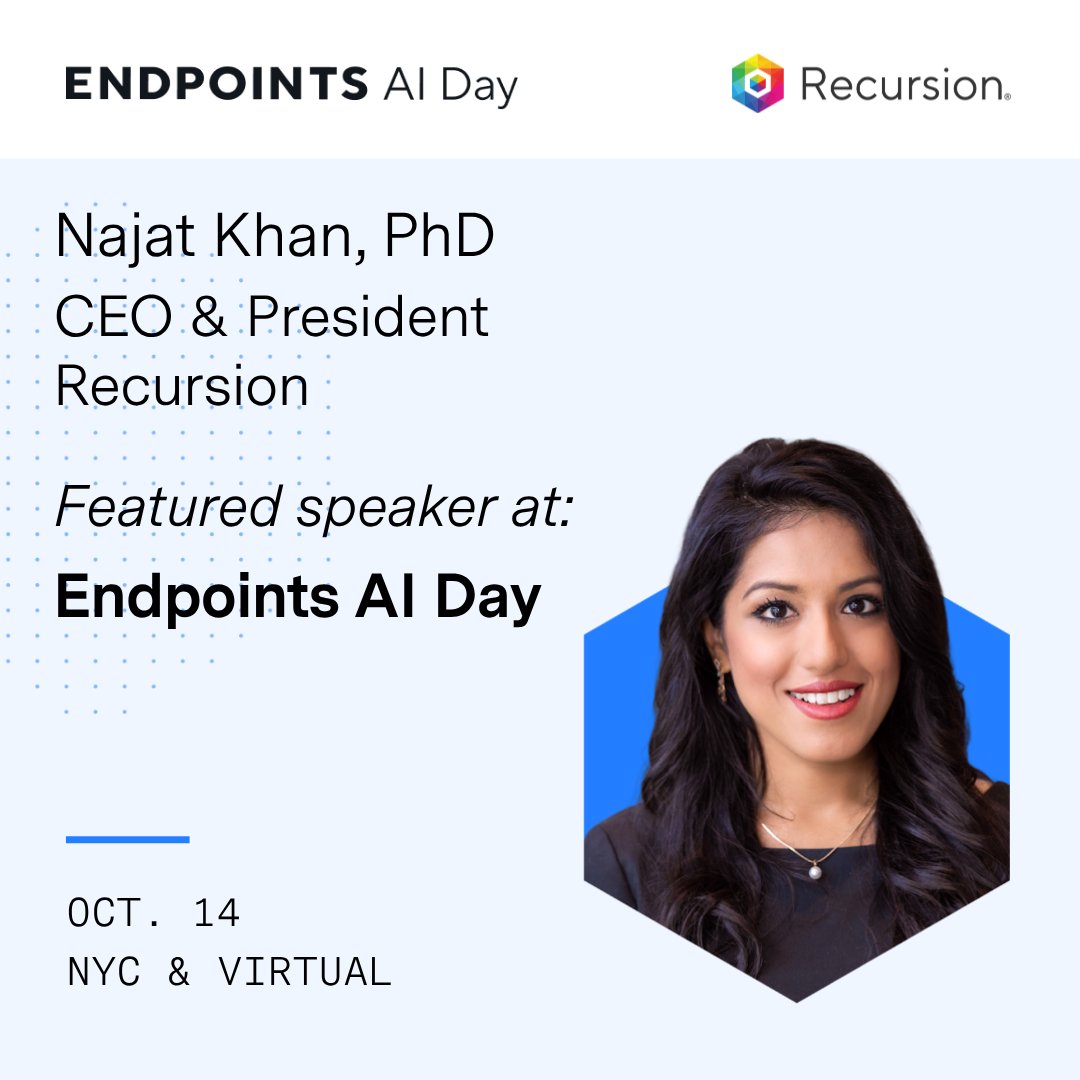
Recursion CEO Najat Khan will be a featured speaker at @Endpts AI Day on Oct. 14 in NYC and online, joining Senior Biopharma Correspondent and AI Day host @AndrewE_Dunn for “Endpoints Takes,” modeled after the internet talk show “Subway Takes” where biopharma leaders offer their most compelling takes on the industry.
The theme of this year’s event is “AI in biopharma: no longer theoretical.”
Join Najat and other leaders across biopharma, academia, frontier labs, and venture capital – including @nc_frey, Head of Drug Discovery and Development research at #Anthropic and Nobel Prize-winning professor David Baker – for engaging conversations about the future of the industry.
👉 Learn more and register: https://t.co/h1oe78oc5s
🎉We won!
Proud to announce that Recursion has won a @FiercePharma AI Innovation Award for AI Innovation in Drug Discovery.
💠 The award recognizes the impact of the Recursion OS which connects biology, design, and clinical development into a single AI product engine.
They note that this engine is more than a collection of point solutions. “Instead of stitching together fragmented public datasets, Recursion generates its own proprietary data at industrial scale and feeds it directly back into the system.”
As CEO Najat Khan says: “It enables our scientists to generate and test hypotheses at a scale and resolution that simply wasn’t possible before, uncovering novel biology and designing more precise medicines faster for patients who are waiting. And it has delivered tangible proof points – including multiple drugs advancing in our internal clinical and pre-clinical pipeline, and ongoing milestones for pharma partners.”
Those proof points include REC-4881 for FAP (familial adenomatous polyposis). “REC-4881 marks the first potential treatment for the condition and the first clinical validation of the Recursion OS, backed by encouraging Phase 2 data,” they write. “The same platform also uncovered a novel mechanism for treating FAP – MEK 1/2 inhibition – and used real-world data to broaden patient eligibility for the trial.”
We’ll be presenting additional Phase 2 data from the TUPELO trial at the Collaborative Group of the Americas on Inherited Gastrointestinal Cancer (CGA-IGC) Annual Meeting in November.
🚀 We’re thrilled to have won this recognition from Fierce and look forward to continuing to demonstrate proof points from both partnerships and clinical programs.
👉 Read more: https://t.co/qdzsKk3tYc
#FierceAIInnovationAwards
Recursion CEO Najat Khan, PhD is speaking at the World Medical Innovation Forum in Boston on Sept. 23 as part of the panel “Riding the AI Tsunami: How Organizations Are Driving Cultural Change.”
The Forum is presented by @MassGenBrigham and @BankofAmerica, and brings together global leaders across healthcare, life sciences, and investment to assess what’s advancing and what it takes to move innovation at speed and scale.
👉 Learn more and register here: https://t.co/iXC8SHjt3Y
🎯Working on difficult-to-drug targets can feel like walking a tight rope through chemical space.
At Recursion, we’re using AI agents to work alongside our scientists, and help us navigate that tight rope with precise steps.
We’re making 97 billion predictions across 5.5 billion compound records traceable to the design runs that made them and the problem the designer was trying to solve. That gives future agents a playbook to follow.
With automation and our BioHive-2 supercomputer, we run calculations proactively for each project compound. That ensures that our design agents have a rich context for interpreting experimental data.
And agents don’t just give us predictions – but explanations. When a chemist asks how to improve potency, the agents identify an insight from a compound the team had set aside due to solubility issues. Then it explains why. The agent pulls in precomputed physics-based calculations to show that this gain isn't a new interaction. It's a conformational strain. that tells the team exactly how to redesign.
Using AI agents in the chemical space, we’re moving faster. And as this drug design lab-in-the-loop cycle continues, we’re building up an immense catalog of design knowledge that agents are helping to unlock.
📣 In a new story in @GENbio, @AlexWestchester spoke with Recursion VP of Neuroscience Chris Winrow about the delivery of the first neuroscience target from our partnership with Genentech, which has now been validated and is advancing in a joint early-discovery program.
Neuroscience is one of the toughest areas in drug development. More than 3 billion people live with neurological conditions, yet only 1 in 40 neuroscience drugs that reach the clinic are ever approved.
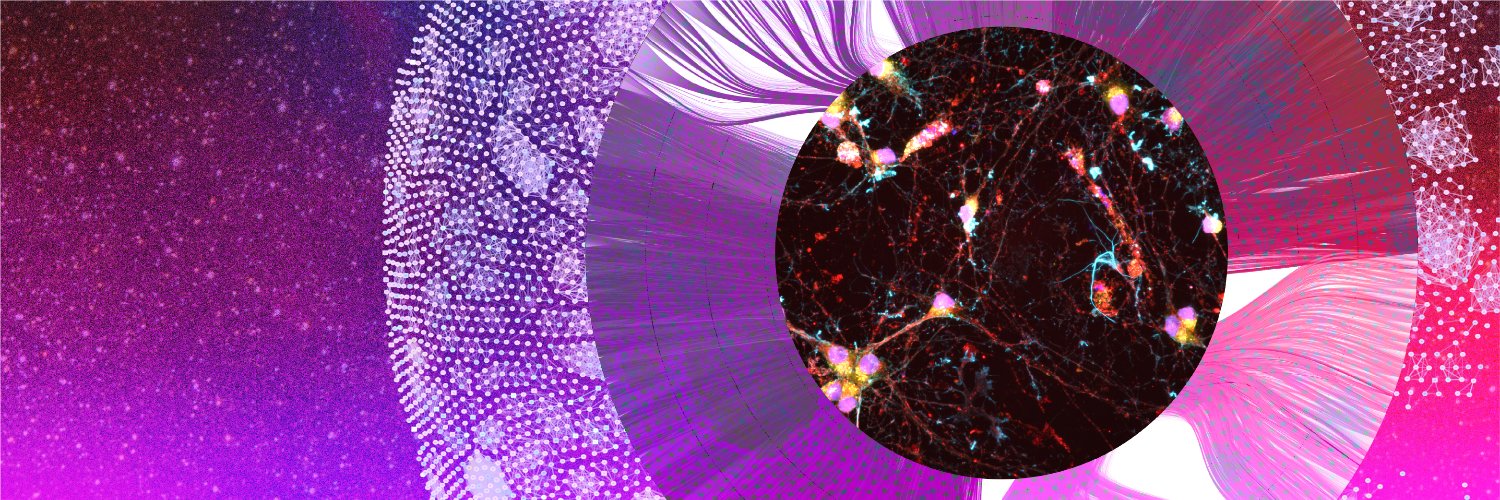
To find new biology, the team built the first whole-genome CRISPR knockout map from over a trillion neurons derived from induced pluripotent stem cells — roughly 12 brains' worth of cells.
“The cell context is important. We’re starting with human iPSCs and driving these into a very clearly homogenous population of neurons that we can test—and we do this at scale,” Winrow said.
The screen spanned 17,000+ genes and thousands of small molecules, generating 46 million+ cellular images analyzed across hundreds of features (mitochondrial shape, nuclear morphology, and more) using AI foundation models and Recursion's BioHive-2 supercomputer.
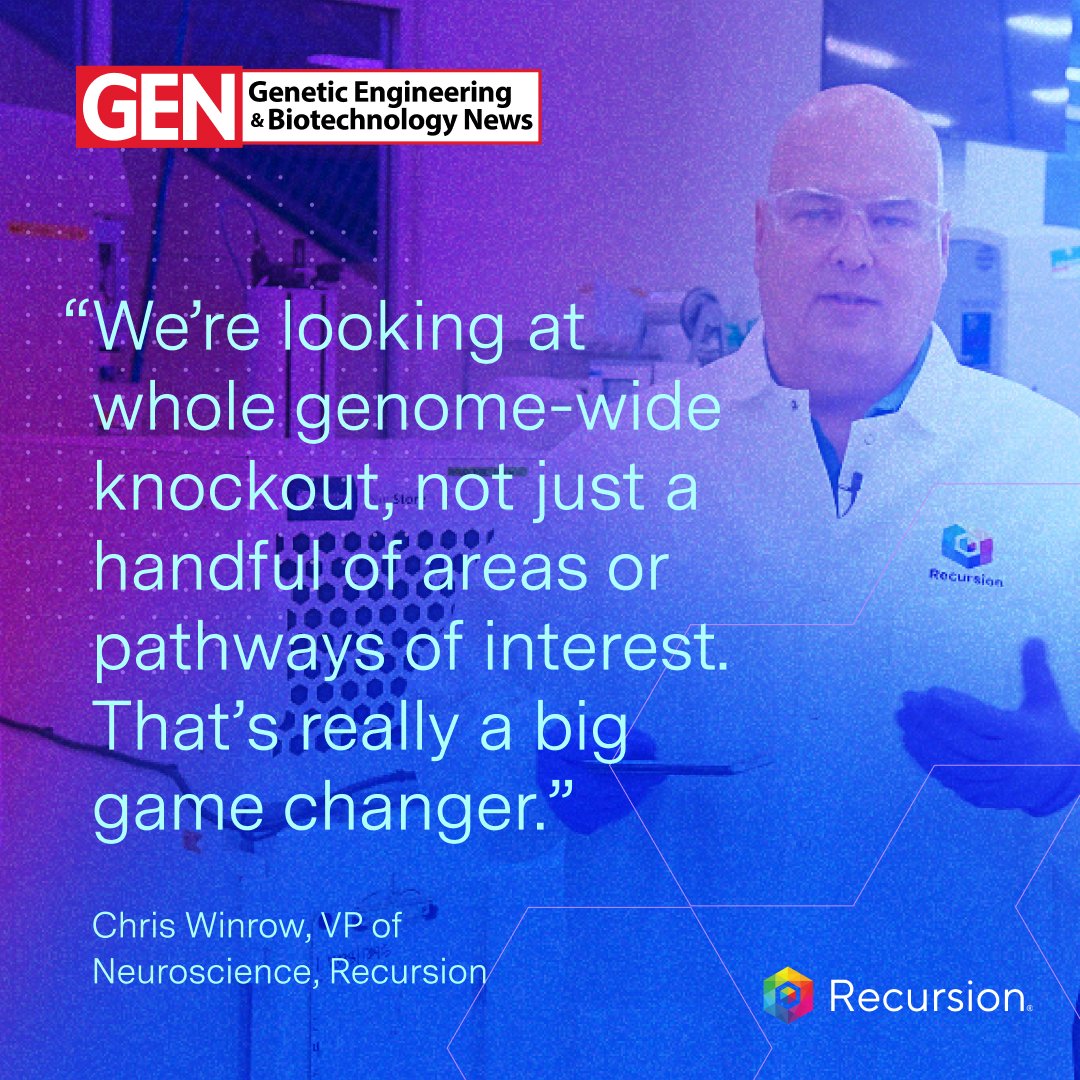
“You look for what we would call gene-compound interactions, to uncover some of those insights, at the same time as looking at the gene-gene interactions.” He added: “We’re looking at whole genome-wide knockout, not just a handful of areas or pathways of interest. That’s really a big game changer, in that we have this broad view.” he added.
This and other maps developed in the partnership (including a whole-genome microglia map) will continue to be mined for additional programs.
👉 Read the full story: https://t.co/3OKZjeTlDF