THE RETURN OF THE INDIVIDUAL
For decades, wealth management optimised for scale.
Model portfolios.
Centralised CIO desks.
Risk buckets.
Standardised suitability questionnaires.
It worked — operationally.
But something was lost in the process:
the individual investor.
Two clients can share the same risk score and want completely different outcomes.
One wants resilience.
Another wants asymmetry.
A third wants moral alignment.
A fourth simply wants peace of mind.
Yet the system labels them all “Balanced.”
The issue isn’t model portfolios themselves.
The issue is that they became the default answer, rather than a starting hypothesis.
What is changing now is simple but profound:
Technology finally makes true personalisation scalable.
Portfolios no longer need to be static allocations designed for the “average client.”
They can evolve with behaviour, goals, and changing circumstances.
The industrial era of wealth management built the infrastructure.
The next era rebuilds the human layer.
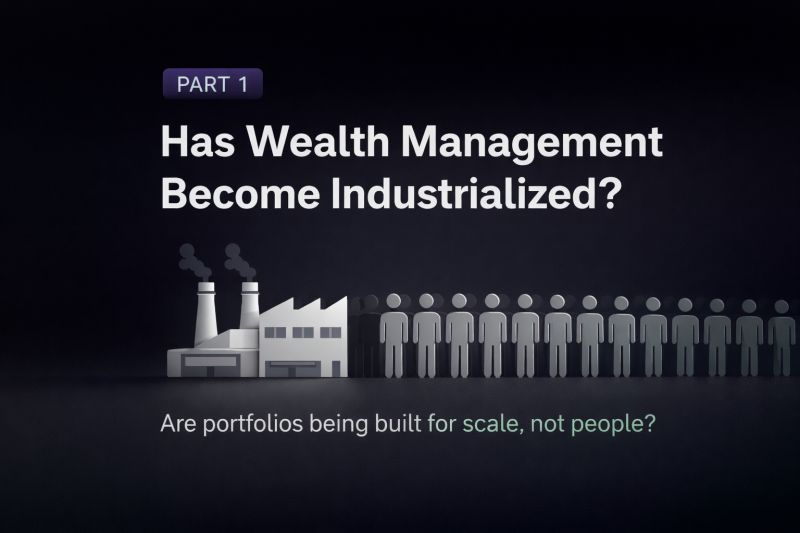
Has Wealth Management Become Industrialised?
Five model portfolios.
Seven risk scores.
Standardised allocations.
It made sense when advice was scarce and data was limited.
But today?
Two clients with the same $100k can walk out with the same “Balanced” portfolio — despite completely different behaviour, income stability, and risk tolerance.
Industrial systems optimise for efficiency.
Humans don’t.
Markets are universal.
Risk is personal.
If portfolios are built for scale instead of people, we don’t have personalization.
We have industrialisation