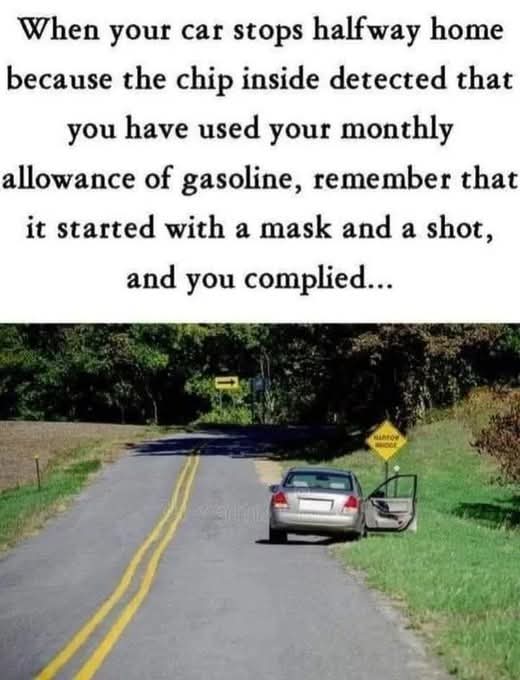
@garethicke Soaring gas prices = less travel. People stay in place. Smart cities, electric cars, new cars have bio metrics in place. Ticks in the woods to boot....yea doesn't take a genius.
@ValerieAnne1970 They don't want anyone going fishing, hunting or into the woods at all. They don't want you to have any idea of how to be self-sufficient. Erase it all. Scare tactics.
I used to be embarrassed that I love to work.
I work almost every day. I work on Sundays. I work in the evenings. I used to even try and hide that I worked so much because people used to judge me for it.
It makes sense, though.
For most people, the word "work" means something they don't want to be doing. It's the price they pay to live the rest of their life. So when they see someone working all the time, they assume that person is trapped. That I must be sad or missing out on something.
"We have the power."
Catherine Austin Fitts warns that the survival of physical cash is crucial to resisting a fully digital financial control system linked to digital ID, urging widespread public support for keeping cash alive.
"If 10% of the population embrace cash, promote cash, refuse to give up on cash... they can't get to all digital."
"These guys are going to get backed up hugely."
Full podcast coming soon!
📜 Timeline: Transistor, AI, and Roswell
1940s
1943–1946: ENIAC, the first general-purpose electronic computer, built with ~18,000 vacuum tubes.
1947 (Dec 23): Transistor invented at Bell Labs (Bardeen, Brattain, Shockley).
1947 (July 8): Roswell incident reported in New Mexico — initial Army press release says a “flying disc” was recovered, later corrected to a weather balloon. This becomes the origin of modern UFO lore.
1948: Claude Shannon publishes “A Mathematical Theory of Communication”, laying the groundwork for information theory.
1950: Alan Turing publishes “Computing Machinery and Intelligence”, asking “Can machines think?” → basis of AI philosophy.
1950s
1951: First working transistorized computer built (the Harwell CADET).
1956: Dartmouth Conference — John McCarthy coins the term Artificial Intelligence. Founding moment of AI research.
1958: Integrated circuit (IC) invented (Jack Kilby at TI; Robert Noyce at Fairchild).
Late 1950s: Arthur Samuel programs a checkers-playing AI at IBM — one of the first learning systems.
1960s
1961: First industrial robot (Unimate) goes to work in a GM factory.
1965: Gordon Moore articulates Moore’s Law — predicting exponential transistor growth.
1966: Joseph Weizenbaum builds ELIZA, the first chatbot (simulated psychotherapy).
1970s
1971: Intel 4004 released — the first commercial microprocessor.
1972: The logic puzzle program SHRDLU demonstrates natural language reasoning in a virtual world.
1970s: AI experiences its first “winter” (funding cuts due to limited progress).
1980s–1990s
1980s: Rise of expert systems (AI for narrow problem solving).
1989: Backpropagation in neural networks popularized — start of modern deep learning revival.
1997: IBM’s Deep Blue defeats Garry Kasparov, world chess champion.
2000s–Today
2006: Term “deep learning” becomes popular (Geoff Hinton, Yann LeCun, Yoshua Bengio).
2012: AlexNet wins ImageNet — deep learning takes off.
2017: Transformers (Google’s Attention is All You Need) change AI trajectory.
2020s: GPT-style large language models, generative AI, autonomous systems.
🔗 Why Roswell fits the picture
The Roswell crash (1947) is often symbolically tied to the same year as the transistor’s invention.
To UFO enthusiasts, it represents a sudden leap in technology — some speculate reverse-engineered alien tech.
To historians, it represents the Cold War culture of secrecy, advanced research programs, and the rapid pace of innovation in computing and defense.
So whether one views Roswell as folklore, misdirection, or more, it became part of the mythos of how humanity suddenly “jumped” technologically — coinciding with both the transistor and the first sparks of AI thinking.