How to direct consistent, long-form AI stories on a budget: The Motion Comic Pipeline
Fully generative video drains compute and burns tokens. Instead, I built a hybrid pipeline combining stills, micro-motion, and code-based transitions synced to audio. Here is the full workflow👇
Finally, selected some key stills and brought them to life using start-frame conditioned video generation for seamless motion anchors and to add more life to the story.
Jev for RAG, clearly explained!
Hybrid search gives you a shortlist. It does not decide which passages contain evidence, which are merely adjacent, or whether the evidence is strong enough to answer.
That missing judgment is where Jev fits.
Jev sits between retrieval and generation. It does not replace BM25, embeddings, or the LLM. It evaluates the candidates they produce before those candidates enter the context window.
→ Retrieve wide
Combine dense and keyword search, then merge the results with reciprocal rank fusion. This gives Jev a broad candidate pool, such as the top 20 passages shown in the visual.
Retrieval still sets the ceiling. If the right passage is missing from this shortlist, Jev cannot recover it.
→ Judge every candidate together
Send the query as Jev’s state. For each candidate, ask a typed yes-or-no question such as “Does C7 help answer this query?”
Jev evaluates every question in one packed request and returns a calibrated probability for each passage. This avoids making a separate model call for every query-passage pair.
→ Let code apply the threshold
Your application compares each probability with a threshold. Candidates above it continue to the LLM. Everything below it is removed before generation.
Jev makes the fuzzy judgment. Code remains responsible for the actual decision.
→ Gate the entire answer
The same request can check whether the retained passages make the query answerable. It can also flag signs of prompt injection inside a candidate.
If answerability falls below the threshold, the application can skip the LLM and return “not in the documents.” The injection score should remain a filtering signal, not a security boundary.
The result is a cleaner division of work.
Hybrid search retrieves broadly. Jev reranks, filters, and decides whether sufficient evidence exists. The LLM writes only from the passages that survive.
Jev’s value here is not simply moving passages up or down a list. It turns relevance into an explicit probability that your application can inspect, threshold, and act on.
To summarise:
- Retrieval finds the candidates.
- Jev decides what deserves context.
- The LLM writes the grounded answer.
----
I also built an open-source project showing how to use Jev as a judge for AI observability with Comet Opik.
It evaluates support traces for groundedness, request coverage, action honesty, and helpfulness, then records the results as an auditable experiment.
You can explore the project here: https://t.co/XVmpg6ldHT
My article on how Jev works is quoted below.
SmallReason-ColBERT: An Ultra-Small Late-Interaction Retriever for Reasoning Intensive Retrieval
@perdactor et al. present a 32M retriever for reasoning-heavy queries, adding a learned token-weighting head.
📝https://t.co/IX9ZrP1UiB
👨🏽💻https://t.co/roDgX8pkPG
Wake up, ppl 👀
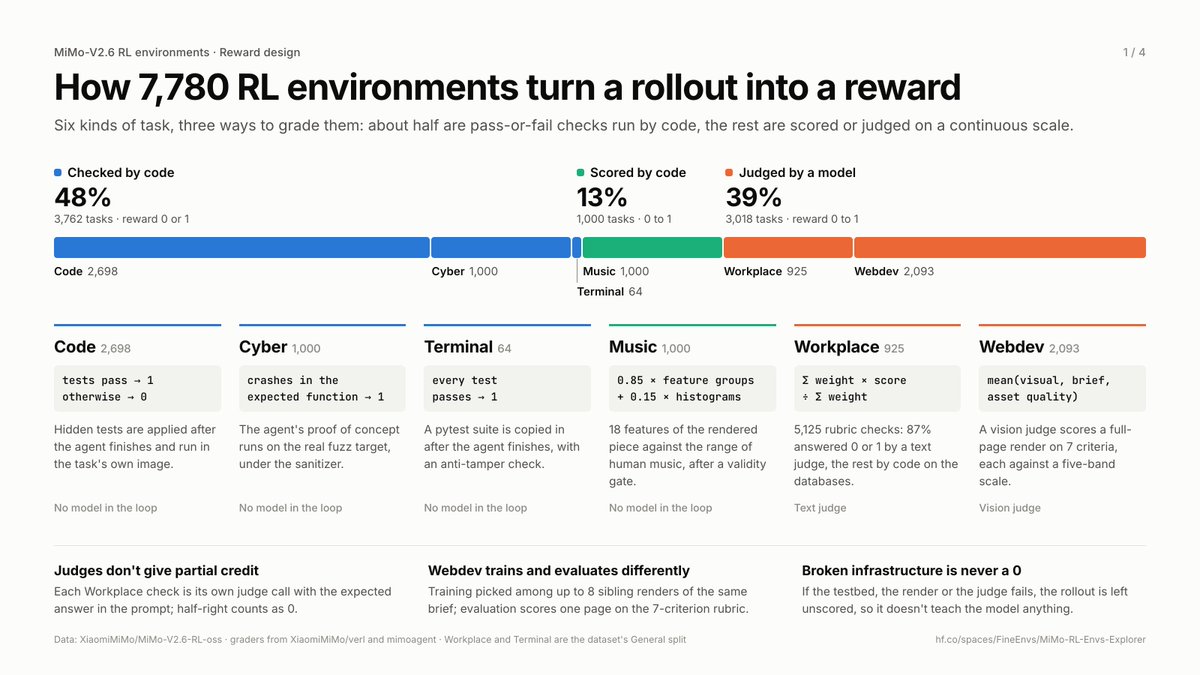
Xiaomi just open-sourced ~7K of the RL environments it used to train MiMo on HuggingFace, across domains like code, cyber, general, music and web dev
I think this is one of the biggest things to happen in frontier open-source RL environment data.
Indepth analysis and learnings coming soon 👀
@hxiao@abidlabs Overall, I think these models can go hand in hand with LLMs to build the systems in a more reliable way and they can even reduce the cost of LLMs indirectly if the agents use them in their feedback loop, leading them to reach the goal faster and hence reduce overall token usage
@hxiao@abidlabs Another use case I am anticipating is using it as a Judge for LLM responses, if it really is consistent, and hence allowing more reliable validations for the LLM responses in problems that are sensitive to hallucinations in responses like Generative search
Nearly half a year of silence. We spent it studying one problem: how far RL can scale.
MiMo-V2.6 is in the middle of its RL run right now. Three things we scaled: compute (~2B tokens per step, 1568 prompts × 16 rollouts, fully async), environments and harnesses (multi-task agentic RL, mixed across multiple harnesses in one run), and grader compute (agentic in-group credit assignment, with test-case and rubric-based rewards). We'll open-source the details piece by piece over the coming weeks.
Streaming the run: https://t.co/ZSxahzJRju
@lateinteraction For me, it’s also ‘X’ more hours staring at the complicated code scattered everywhere, that hardcodes a ton of conditions to make sure it’s at 100% pass rate at all the corner cases it’s trying to avoid.
my days are like `N` hours of working with frontier models, babysitting them in frustration and disbelief at the frequent errors and slop
interrupted by `M` min breaks of browsing X takes about how the same models (and _especially_ the next gen!) are superhuman at ~everything