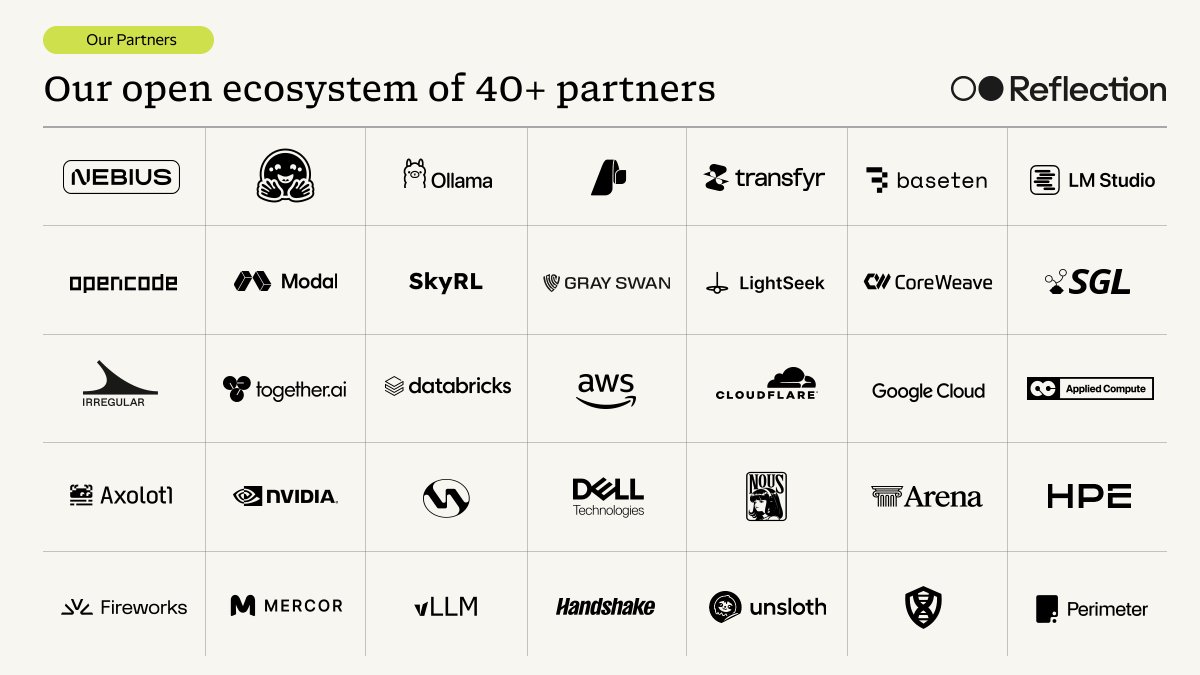
Beam is now available across platforms, with open weights under the Apache 2.0 license - in collaboration with an ecosystem of 40+ partners.
We're releasing:
- Weights, tokenizer, and reference implementation
- BF16, FP8 and NVFP4 weights and a DFlash2 drafter
- The open source harness we built and trained Beam on: Mirror CLI
Weights and model card on Hugging Face: https://t.co/tPqWpk9RXL
Beam’s model technical report is now available. Read the full report to learn about the methodology our team used to train Beam end-to-end in-house, here: https://t.co/wqc0nOyqhC
We also developed the Open Safety Framework as a comprehensive methodology that covers systemic risks, refusal behavior, and adversarial robustness. This ensures safe and responsible releases at scale.
https://t.co/e9nGsa6pSj
Sharing more about how we trained and evaluated Beam, our first model, for safety: https://t.co/FZIbzeUWav
In the coming weeks, we'll release additional safety research, evaluations, and tools under Project Iris, Reflection's open AI safety initiative.
We are committed to prioritizing safety in every model we build—and sharing what we develop and learn so that researchers, developers, policymakers, and enterprises can build on our work, advancing safety across the broader AI ecosystem.
We developed the Iris Safety Evaluations (ISE) to test whether Beam’s responses align with and uphold our safety policy in realistic contexts, such as in adversarial and agentic settings. Evaluated across cyber offense, chemical, biological, and radiological/nuclear categories, Beam holds higher refusal rates than leading Western and Chinese open models.
Beam by @reflection_ai is now available on Inference Router.
It's a US-built open-weight model for coding and agentic tasks. Teams can run it in production today, with ZDR available on every call.
https://t.co/XBdJQWDwnO
Got questions about building with Beam? Join our product team for an AMA on r/LocalLLaMA tomorrow, Tuesday, November 3, from 8-11am PT.
Details below 👇
https://t.co/CIWL6A0xuf
In this demo, Beam built a real-time weather satellite tracker with Mirror, our open source harness, using publicly available orbital data. It fetches live positions, tracks coverage, and renders orbits on a 3D globe.
You can win $20K in cash prizes by building a demo, training a model, or creating a dataset with Beam by @reflection_ai!
Prizes are split across 3 winners that we'll choose after the challenge ends on Monday, November 2nd.
Plus, we're giving $25 hub credits to the first 400 to take part, just find the link in the page below.
Rules: Build something cool with beam and drop it on the discussion! Anything that might be helpful to the world or a cool demo is allowed:
- You could make a demo that uses the Beam model on Spaces
- You could quantize it for your favorite hardware
- You could generate a synthetic dataset for your favorite problem
- You could build an RL environment with or for Beam
- You could benchmark Beam and share the results.
- You could surprise us!
If you build something with Beam, then share it on the Hub to enter the challenge. We’ll collect all the links, select the best, and reach out to winners.
https://t.co/u1D4pBhbRp
We ran ~1.3 billion sandboxes in our largest RL run for Beam - spanning RL training, evaluation, and ablations. With evals and other RL experiments running, the fleet peaked at 883,006 vCPUs (83% of allocatable) across 23 clusters on @googlecloud and @awscloud.
We plan to use OpenEnv (now part of @AgenticAIFdn) for future runs, bringing our learnings to the open ecosystem.
Lorenzo Porras (@thecodingsoup) built an escape room where Beam repairs a planetary machine, routes light through mirrors, and plans a robot's escape across bridges and doors. Beam receives the rules and state through tools, then writes and runs Python in @CoreWeave Sandbox to solve the puzzles. A 3D room shows the run as it happens.
factory got early access to beam through together before launch
they used that window to test @reflection_ai's model on real coding + agentic workflows, including tool-error recovery, conflict handling + final repo verification
by day 0, @FactoryAI already knew how beam behaved on the work that matters to their customers
Adam @adamroman made some throwback mobile browser snake games using Big Pickle and “Cat Jam" -- the code name for Beam during our stealth preview with OpenCode. The two models tackle the same prompt, with reported build times of 2:19.7 for Beam and 4:56.4 for Big Pickle.
We plugged Beam into @opencode, asked it to look at @UnslothAI, and create a fine-tuning notebook for the latest and smallest Gemma-4 model on a Text2SQL task – an out of distribution domain for Beam.
The model successfully researches the model cards, Unsloth documentation, and available READMEs, and implements the fine-tuning logic and surrounding machinery. As a result, Beam is able to successfully finetune Gemma, increasing Gemma’s accuracy on its heldout test set by 66.5%.
Mercor partnered with @Reflection_ai on Beam's training and evaluation.
Beam scores 48.8% Pass@1 on APEX-Agents, #1 among US open-weight models and closely trailing Chinese open models such as GLM-5.3-Flash (52.8%).
On APEX-Agents, which measures long-horizon, multistep tasks in professional services, Beam scores a 15-point lead among US open-weight models.
Beam: 48.8%
Muse Spark Open: 33.4%
Nemotron 3.5 Super VL: 29.5%
Nemotron 3 Ultra: 22.7%
It trails Qwen 3.8-Max by 14.5 points and lands within the confidence interval of GLM-5.3-Flash, trailing by 4.0 points.
Qwen 3.8-Max: 63.3%
MiMo-V2.6-Flash RL: 57.4%
GLM-5.3-Flash: 52.8%
Beam: 48.8%
Kimi K3: 47.8%
Qwen 3.8-27B: 47.5%
GLM-5.2: 45.2%
Compared with GLM-5.3-Flash on APEX-Agents domains, it leads on management consulting by 1.5 points. It trails GLM-5.3-Flash by 11.8 points on corporate law, and investment banking by 1.6 points.
Congratulations to the Reflection team. We’re excited for future collaboration together advancing the US open source frontier.
See full leaderboard: https://t.co/h4hHN4hTMe