The Reformed Libertarians Podcast: Free Society from a Reformed Perspective
( a member of the Christians For Liberty Network, produced by @LCIOfficial )
A discussion of the article "Can Conservatives Be Libertarians?" by Gerard Casey. Several mischaracterizations of libertarianism are answered. How Reformed libertarians value tradition, morality, and liberty in contrast with progressive liberalism is clarified, with reference to an essay by Friedrich Hayek. Also mentioned is the relation between liberty and civil justice.
🎧 Listen to the full episode:
Direct Download: https://t.co/emGlLXMU55
YT: https://t.co/EPqgrP44Z8
LCC: https://t.co/3WoIAkdvtP
RLP: https://t.co/dH7tR41RJc
A discussion about the plausibility of stateless civil governance and difficulty in imagining it. We talk about the mere-exposure effect, the Overton window, and plausibility structures. Spontaneous order is explained in terms of a consistent sphere sovereignty, and we offer historical examples of, and resources for, providing civil governance practically and realistically without the state.
🎧 Listen to the full episode:
Direct Download: https://t.co/lf5ytmwFBJ
YT: https://t.co/yiIHv11rLN
LCC: https://t.co/cL2b06Dsr9
RLP: https://t.co/WFACS2Acvj
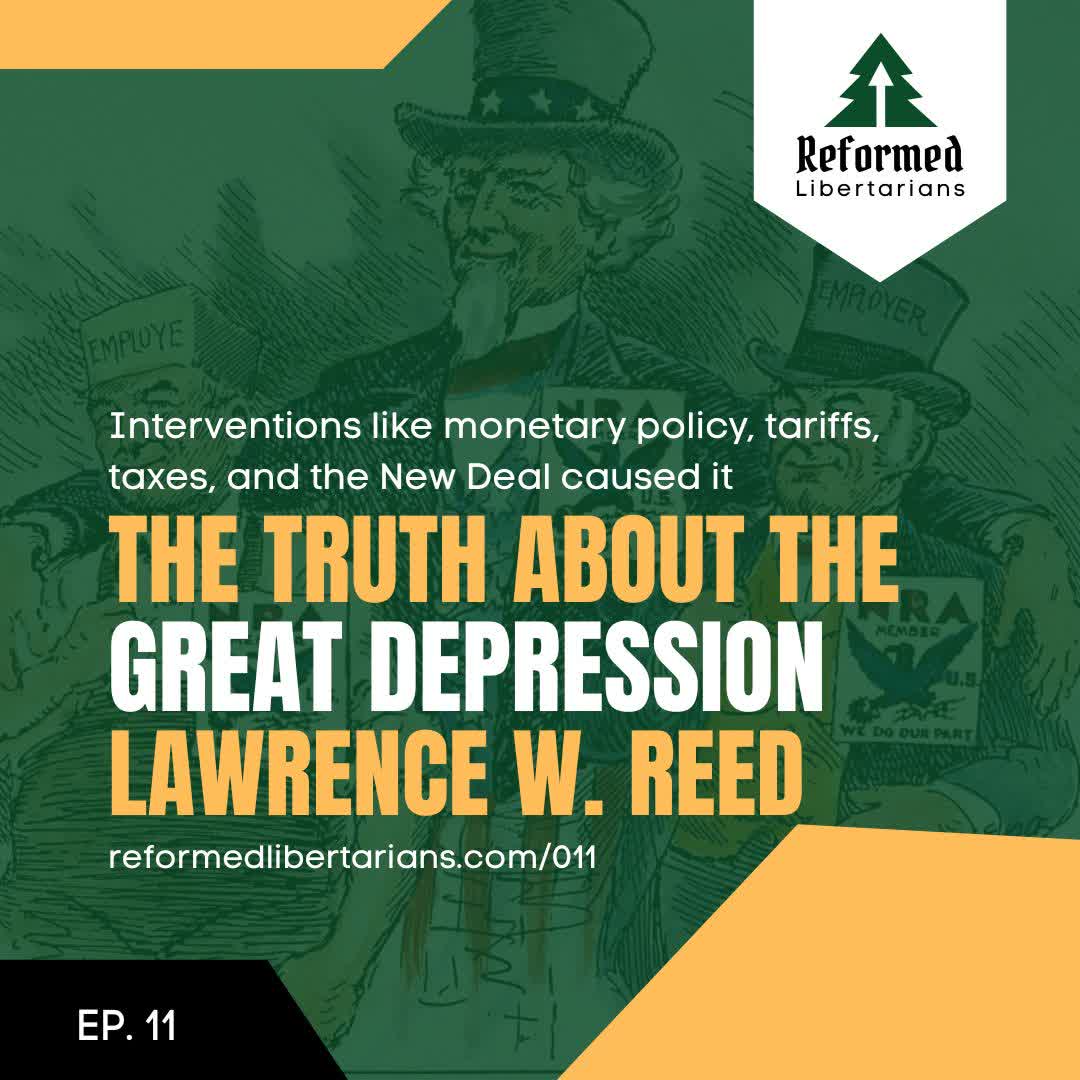
An interview with Larry Reed of The Foundation for Economic Education, about his booklet Great Myths of the Great Depression. We talk about the Progressive Era as the context for the government policies that brought about the Great Depression, and discuss several commonly misunderstood elements that caused or perpetuated the Great Depression. We conclude with a note about personal character.
🎧 Listen to the full episode:
Direct Download: https://t.co/20iLqr6yAV
YT: https://t.co/1TNELfTERC
LCC: https://t.co/mCQXZoGeCz
RLP: https://t.co/Dtxa8SNZQI
An interview with Cal Beisner of The Cornwall Alliance for the Stewardship of Creation about media and politically-concocted climate alarmism in contrast with climate realism, based on genuine scientific study. We also talk about destructive governmental energy policy, and the environmental Kuznets curve.
An interview with Gerard Casey of University College Dublin. We discuss legitimate command and options proposed to justify the state's supposed authority. Casey summarizes some of his examination of political representation, explains what real democracy was, and closes with a reflection on caring for the poor in a free society.
Tune in here: What are your thoughts on the viability of political representation?
Share below. #ReformedLibertarian #PoliticalPhilosophy #Libertarianism
A discussion of Murray Rothbard's Introduction to Etienne de la Boetie's "The Discourse of Voluntary Servitude". The connection of La Boetie's essay to the French Reformed is explained. Also highlighted is the main idea of the Discourse, that state tyranny relies on popular compliance, and when such compliance is withdrawn, the tyranny ends.
Addressing Pete Enns' claim that biblical inerrancy is incompatible with contemporary principles of civil governance. Differentiating inerrancy from biblicism, advocating a contextually informed hermeneutic, and explaining that Romans 13 endorses legitimate civil justice.
"Libertarians don't hate the poor—we want to make them un-poor through liberty, not trap them in state dependency."
Dr. Gerard Casey dismantles the myth that rejecting coercive welfare means letting people starve. Read his powerful case for voluntary responsibility and true justice: https://t.co/COk5FA6jFC
With an essay from Bob Godfrey, we explain some key features of the Protestant principle or doctrine of Sola Scriptura. We define what "Scripture alone" means, discuss several Bible passages that teach it, and answer 4 basic objections..
Establishmentarianism, or the civil establishment of religion or of a church, involves a certain religion's institutions, beliefs, or practices being given exclusive legal protections or privileges by a state. In whatever way the English Dissenters / Nonconformists in the 1600s, the American Presbyterians in the 1700s, and Neocalvinists in the 1800s might have presented a Scriptural case against civil establishment of the church, or for dis-establishment, Reformed libertarians take Charles Hodge's argument, published in 1863 [also here], to be a sound one.
Here is how Hodge summarized the Scriptural argument against civil establishment of the church, in favor of non-establishmentarianism, in 3 points. (I, have given clarifying terms in brackets.)









![RefoLiberty's tweet photo. Establishmentarianism, or the civil establishment of religion or of a church, involves a certain religion's institutions, beliefs, or practices being given exclusive legal protections or privileges by a state. In whatever way the English Dissenters / Nonconformists in the 1600s, the American Presbyterians in the 1700s, and Neocalvinists in the 1800s might have presented a Scriptural case against civil establishment of the church, or for dis-establishment, Reformed libertarians take Charles Hodge's argument, published in 1863 [also here], to be a sound one.
Here is how Hodge summarized the Scriptural argument against civil establishment of the church, in favor of non-establishmentarianism, in 3 points. (I, have given clarifying terms in brackets.)](https://pbs.twimg.com/media/HM4nF64XcAAiB2G.jpg)


