Our new episode @ReimaginingG is on Soviet Foreign Policy and Stalin's desperate attempt to ally with the West against Hitler, only to be rejected over and over again.
In the 1930s, the USSR sought a collective security alliance against Nazi Germany for six years. Despite repeated efforts, Western powers (Britain, France) and Poland refused cooperation. The Soviets’ policy was a Sisyphean failure—dead by 1936, yet they kept trying for years, unable to come to terms with it.
Poland consistently blocked the key issue: passage for the Red Army to fight Germany. Even secret guarantees to withdraw troops after the war. In 1939, Anglo-French negotiations were half-hearted, in bad faith, and stalling for time. Fearing isolation and ending up fighting Hitler alone, Stalin turned to the Nazi-Soviet pact—a direct consequence of Munich and Western rejection, not a desire for alliance with Hitler.
The Red Army’s stand at Moscow and Stalingrad, not Normandy, was the real turning point in winning World War II. Over 99% of German divisions fought the USSR until late 1943.
The Western myth that the USSR “stabbed the West in the back” is unsupported by archival evidence.
Links to the episode are below ⤵️
New episode of Reimagining Soviet Georgia! @ReimaginingG
We discuss energy in late socialist Bulgaria, marketization and the “green transition”, and the socialist origins of an ecological future.
links ⬇️
Soviet Union miners union also took 100 British miners in 1984 and their families to a health resort on the Black Sea in Soviet Georgia (Pitsunda, Abkhazia). ‘'It's a chance of a lifetime. I've never been further than Yarmouth before,' Margaret Ricalton, a miners' wife from Ashington’
In addition, Workers in Soviet Union, Czechoslovakia, Bulgaria and so on collected money and resources and sent it to British strikers. Worth $1.138 million. Of course the British government seized most of it and made the British miners pay a heavy customs fee to get it.
Classroom education in USSR was supported by numerous other institutions and activities.
‘The USSR's public education system encompasses various extracurricular institutions for children, including: children's libraries and reading rooms; children's clubs; Palaces and Houses of Pioneers; children's cinemas and theaters (theaters for young audiences); stations for young naturalists, young technicians, and children's technical centers; children's tourist stations; children's houses of culture and recreation; and others.
The USSR surpasses all other countries in the world in the diversity and number of these institutions. The USSR's public education system also includes various cultural and educational institutions for adults. These may be categorized as follows:
1) Club-type institutions. These include workers' clubs, houses of culture, collective farm and village clubs, reading huts, and cultural centers. These are comprehensive cultural and recreational facilities where various cultural and educational activities take place activities (performances, concerts, lectures, presentations, library work, club activities, etc.);
2) Libraries;
3) Museums;
4) Lecture centers.
Such is the well-organized, flexible, and thoughtfully conceived public education system in the USSR—designed for people of all ages—which ensures broad opportunities for education, self-education, and professional development for Soviet citizens, while satisfying their diverse cultural interests.’
From ‘Public Education in USSR’ by Medinsky. 1949
This is so cool. It’s a certificate of commendation (honor certificate) to a second grader for good conduct and achieving success from 1942, given in Soviet Georgia.
Really enjoyed discussing my latest book (only in Italian so far), The European Propaganda Machine: The Dark Side of NGOs, Media and Universities — i.e., how the European Union structurally, institutionally and ideologically reinforces its own legitimacy through “civil society” — with @sopjap and @bryan_gigantino. Please consider subscribing to their great Reimagining Soviet Georgia podcast for unique insights on the Soviet Union, Georgia, the South Caucasus, socialism and post-socialism.
Listen here: https://t.co/PlXDv4oknV
Listen to our new podcast with @battleforeurope explaining his book ‘The Propaganda Machine of EU.’ His book is in Italian but you can hear him speak about it in English! Thomas Fazi exposes the systematic use of billions in public funds to shape public opinion, silence dissent, and consolidate power in Brussels.
Drawing on extensive data from the EU's own transparency systems, Fazi reveals how the European Commission has built an interconnected propaganda complex spanning NGOs, media, and academia.
May 9th is Victory Day - commemorating the defeat of Nazi Germany & fascism in Europe by the Soviet Union.
In our last episode of Reimagining Soviet Georgia @ReimaginingG we discuss Soviet efforts to create collective security in Europe w/ historian Michael Jabara Carley
Our new episode @ReimaginingG is on Soviet Foreign Policy and Stalin's desperate attempt to ally with the West against Hitler, only to be rejected over and over again.
In the 1930s, the USSR sought a collective security alliance against Nazi Germany for six years. Despite repeated efforts, Western powers (Britain, France) and Poland refused cooperation. The Soviets’ policy was a Sisyphean failure—dead by 1936, yet they kept trying for years, unable to come to terms with it.
Poland consistently blocked the key issue: passage for the Red Army to fight Germany. Even secret guarantees to withdraw troops after the war. In 1939, Anglo-French negotiations were half-hearted, in bad faith, and stalling for time. Fearing isolation and ending up fighting Hitler alone, Stalin turned to the Nazi-Soviet pact—a direct consequence of Munich and Western rejection, not a desire for alliance with Hitler.
The Red Army’s stand at Moscow and Stalingrad, not Normandy, was the real turning point in winning World War II. Over 99% of German divisions fought the USSR until late 1943.
The Western myth that the USSR “stabbed the West in the back” is unsupported by archival evidence.
Links to the episode are below ⤵️
I can’t stress to you all enough how great this episode is! I’m so thankful for Mohamad generously donating his time, we talked for so long, he was losing his voice while fasting, and I was relentless, like ‘one more question, one more question.’ I really value this conversation, and I was also inspired to read a few books after and write an article about the Orthodox Christian schools he mentioned.
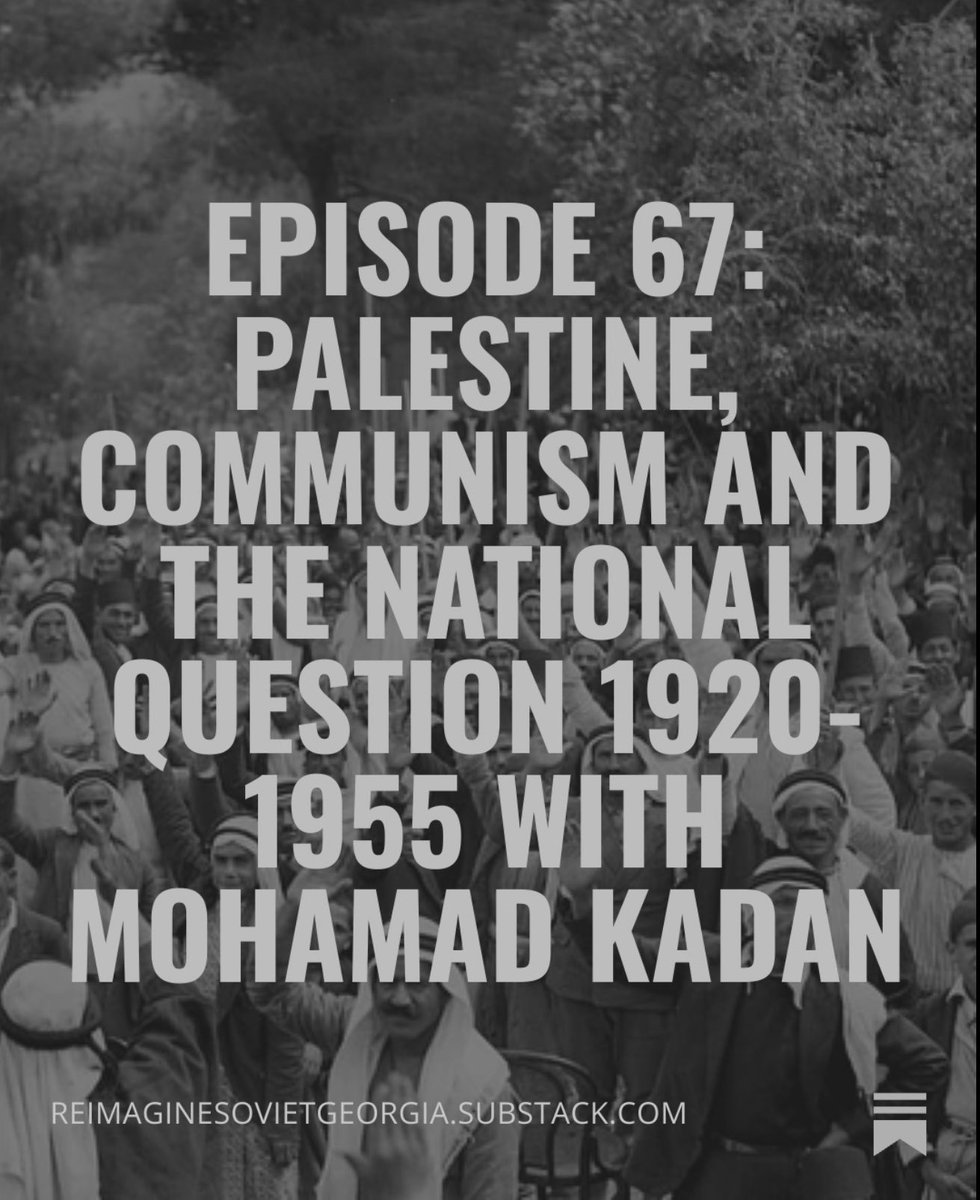
Listen to the history of communism with historian Mohamad Kadan takes us on a deep dive into the emergence of Marxism and Communist politics in Palestine in the early 20th century and immediately following the Nakba - the mass ethnic cleansing and displacement of Palestinians in 1948 during the establishment of the state of Israel.
Mohamad explores how questions of Palestinian anti-colonial struggle and self-determination, class, Marxist internationalism, nationalism, Zionism and imperialism shaped articulations of Marxism and on the ground Communist political organizing in Palestine.
New episode: history of communism with historian Mohamad Kadan takes us on a deep dive into the emergence of Marxism and Communist politics in Palestine in the early 20th century and immediately following the Nakba https://t.co/UbUoyO9XFG
This fascinating piece of research by Beka Avdievi, on Soviet Georgian engineers who participated in the construction of Egypt’s Aswan Dam in the Nasser period and applied that experience to the construction of the Enguri dam in the Georgian SSR, will be out later this year!
Soviet Georgian Literature newspaper calls the Nile ‘Eight Wonder of the World’ and recounts 1964in Egypt, where the Nile was stopped for the first time
One of the most beautiful stories of cooperation: the role of Soviet Georgian engineers and industries in building Egypt's Aswan Dam during the Nasser era and how that expertise later helped build the Enguri Dam back in Soviet Georgia.
🧵
Some received medals. Yuri Bakholdin got the Order of the Badge of Honor and the Order of the Republic. Amiran Tevzadze, T. Japaridze, and Tengiz Chubinidze got medals for "Labor Merit."