@miguelhzv@grok falou que seu post esta errado:
'A escravidão era altamente rentável e economicamente eficiente.
As grandes plantações escravistas eram cerca de 35% mais eficientes (em termos de produtividade total dos fatores) do que as fazendas familiares livres do Norte ou do Sul.'
Platão (A República, Livro VI) argumenta que a democracia é inferior a várias formas de monarquia, aristocracia e até mesmo oligarquia, com base na ideia de que a democracia tende a enfraquecer a expertise necessária para governar adequadamente as sociedades.
Em uma democracia, aqueles que são especialistas em vencer eleições (e em nada mais) acabarão dominando a política através da manipulação e persuasão. A democracia tende a enfatizar essa habilidade em detrimento da competência necessária para governar corretamente a sociedade.
A maioria das pessoas não possui aptidão para refletir bem sobre as questões difíceis que a política envolve. Mas, para conquistar um cargo público ou conseguir a aprovação de uma legislação, os políticos precisam apelar ao senso emocional dessas pessoas sobre o que é certo ou errado.
Assim, o Estado acabará sendo guiado por ideias muito mal elaboradas, movidas por emoção, que especialistas em manipulação e apelo às massas utilizam para ajudar a si mesmos a conquistar o poder.
O mesmo juiz que prorroga um inquérito há 7 anos, que já investigou a Receita Federal, Elon Musk e a revista Crusoé, agora diz que a CPMI do INSS é longa e abrangente demais.
“Perigo para o Estado de Direito”.
É a cara de pau dos intocáveis.
Todo economista aceita que a lei de oferta e demanda se aplica a petróleo, trigo, imóveis, trabalho, tudo.
Menos à moeda fiduciária.
Menger mostrou em 1871 que valor é subjetivo. O mainstream levou 80 anos pra aceitar. Hoje nenhum economista sério defende a teoria do valor-trabalho.
Menger também mostrou que dinheiro não é criação do Estado, é o bem mais vendável que emerge do mercado. Publicou isso em 1892.
134 anos depois, o mainstream ainda não aceitou.
A profissão inteira finge que imprimir mais unidades não tem consequência desde que o PIB esteja "crescendo". 3 erros grotescos empilhados:
1. Suspendem a lei de oferta e demanda pro único bem que permeia toda a economia;
2. Medem "crescimento" pelo PIB, que inclui gasto do governo, e concluem que não há inflação;
3. Medem inflação por índices que eles mesmos escolhem e revisam, e chamam isso de realidade.
O valor subjetivo levou 80 anos. O dinheiro já está em 134.
Quem se beneficia de manter esse erro por 134 anos?
Business owners don’t “make profits from exploitation”.
They profit because they:
- Come up with ideas
- Invest and delay consumption
- Execute competently
- Work insane hours
- Take real risk of losing everything if they are wrong
That’s not “exploitation.” That’s creation.
Leftists are united by psychology, not principles.
“Many Leftists side with groups perceived as weak or inferior not out of compassion but because they unconsciously project their own sense of weakness onto these groups.”
A crisis of self-worth masked as a moral crusade.
Milton Friedman: “I am not a conservative. I’ve never been a conservative. Hayek was not a conservative.”
“We are liberals in the true meaning of that term: concerned with freedom. We are not liberals in the current distorted sense—those liberal with other people’s money.”
Every single socialist experiment in human history has collapsed into the same predictable pattern: economic devastation followed by authoritarian control. From the Soviet Union's bread lines to Venezuela's hyperinflation, from Cuba's emigrant rafts to Cambodia's killing fields—the results are as consistent as they are catastrophic. Yet somehow, each new generation of collectivists insists their version will be different.
Meanwhile, the Austrian School predicted this outcome with mathematical precision. Ludwig von Mises proved in 1920 that rational economic calculation becomes impossible without market prices for capital goods. Without private ownership of the means of production, there are no genuine market prices. Without market prices, central planners cannot allocate resources efficiently—they're literally flying blind. What appears to be "planning" is actually chaos disguised by propaganda and enforced by violence. And when the inevitable shortages begin, the state has only two options: admit failure or double down with force. They always choose force.
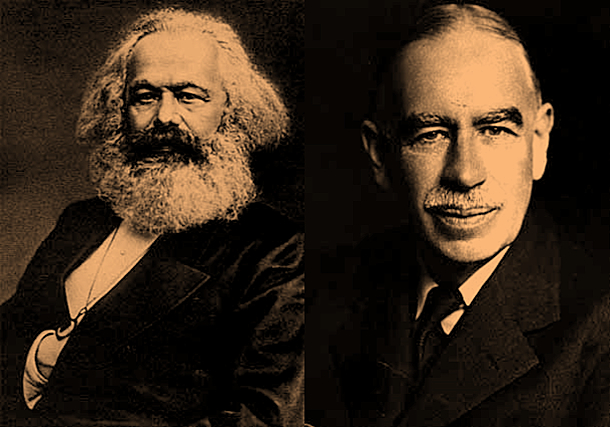
British pedophile John Maynard Keynes and his disciples promised a "middle way" between capitalism and socialism, but their interventions merely delayed the reckoning. Every welfare state, every central bank manipulation, every government "stimulus" brings us closer to the same endpoint. The difference between social democracy and full socialism isn't one of kind—it's merely one of degree and timeline.
But the most damning evidence isn't theoretical—it's empirical. East versus West Germany. North versus South Korea. Cuba versus Chile. Hong Kong versus mainland China before 1979. Every controlled experiment in human history proves the same point: economic freedom creates prosperity, while state control creates misery.
Socialist true believers can dismiss Austrian theory all they want, but they cannot dismiss the mountains of corpses and the millions of refugees fleeing their utopias. Venezuela had the world's largest oil reserves and still managed to create toilet paper shortages. That's not bad luck—that's economic law in action.