I have said for a few weeks that the setup looked a lot like April..
We will get a face ripping rally in case there is any truth to this
TRUMP: WE COULD END IRAN WAR VERY QUICKLY
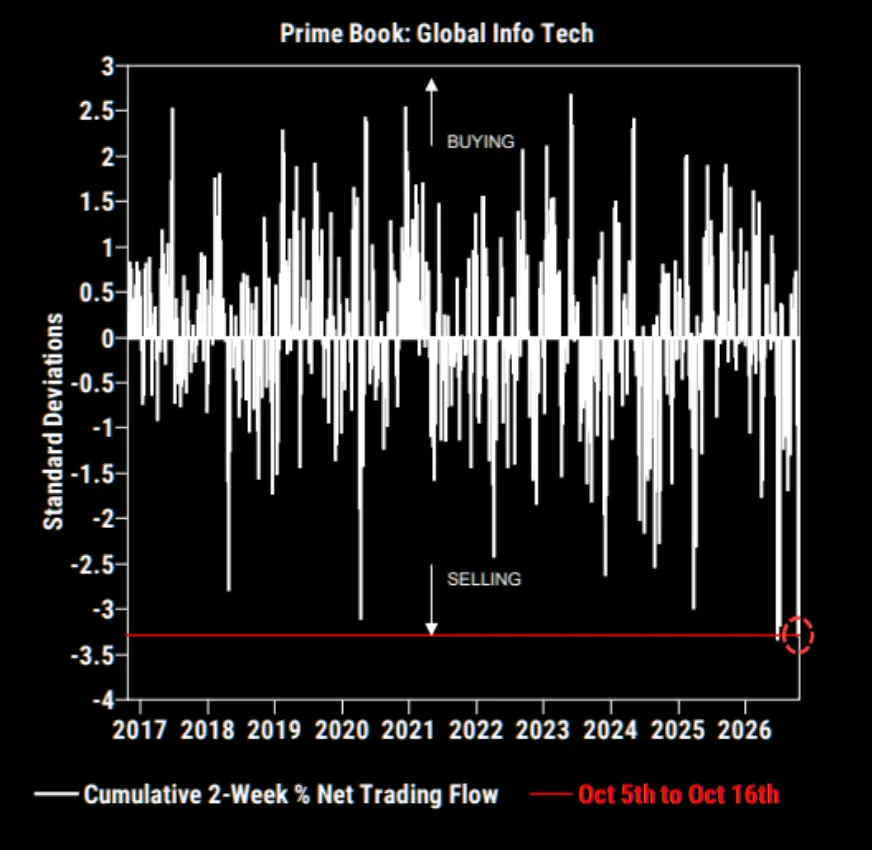
Biggest two week net selling ever
According to @Goldmansachs PB, global technology stocks saw the largest two-week net selling on record (10+ years) between October 5 and 16, a staggering 3.3 standard deviations below normal.
Selling was driven by both long liquidations and fresh shorting.
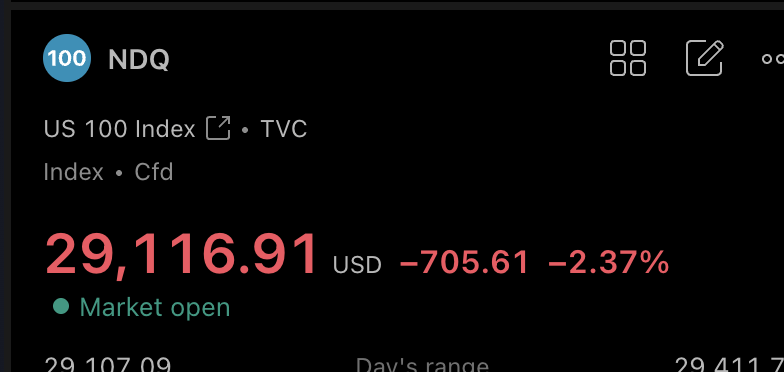
#NDQ down another 2% today.
Still disagree with the idea that many have expressed that corrections only happen after midterms.
In fact, usually correction start well before midterms (look at 2014, 2018, and 2022 all had correction start well ahead of midterms and in 2/3 of those cases the correction was over before the midterms arrived).
@MatthieuCeronne Crypto principalement ! BTC/ETH/SUI/SOL
Pour se protéger du debasement trade qui va se poursuivre .
SPCX pour l’espace !
QBTS pour le quantique !
LLY pour la santé mixée à l IA
ETF ROBO pour l automation.
🚀🚀🚀🚀
MARK MY WORDS
Safety will be the new luxury. The countries that keep their land free of crime will become the destinations of the world's millionaires, because capital and talent go where people feel safe.
Vous êtes souvent plusieurs dizaines de milliers à lire mes posts.
Beaucoup moins à me suivre : à peine plus de 1 300
Il faut croire que je suis meilleur pour analyser les marchés que pour faire du marketing 😅
Je ne suis pas créateur de contenu.
J'investis mon propre argent.
Je passe mes journées à lire de la macro, analyser des entreprises, regarder des graphiques et chercher les meilleures opportunités sur les marchés.
Je poste quand j'estime avoir quelque chose d'intéressant à raconter.
Pas parce qu'il faut nourrir l'algorithme.
Pas pour faire du buzz.
Et je ne ressens pas le besoin d'avoir un avis sur tout.
J'essaie surtout de partager quelques idées, quelques opportunités, quelques tips… et ce que presque 20 ans sur les marchés m'ont appris.
Parfois j'ai raison.
Parfois tort.
Et parfois je change complètement d'avis.
Ça fait partie du jeu.
Je ne suis probablement pas le meilleur pour faire du networking, commenter partout ou devenir copain avec tout X pour faire grossir mon audience.
Je préfère passer ce temps à bosser.
Donc si vous tombez régulièrement sur mes posts et qu'ils vous apportent quelque chose, pensez à me suivre.
Et si vous pensez que ça peut être utile à d'autres, n'hésitez pas à faire tourner.
Autant que ce travail serve au plus grand nombre.
Ça m'évitera peut-être de refaire un post comme celui-ci 😅
Objectif : 5 000 d'ici la fin de l'année.
On tente ?
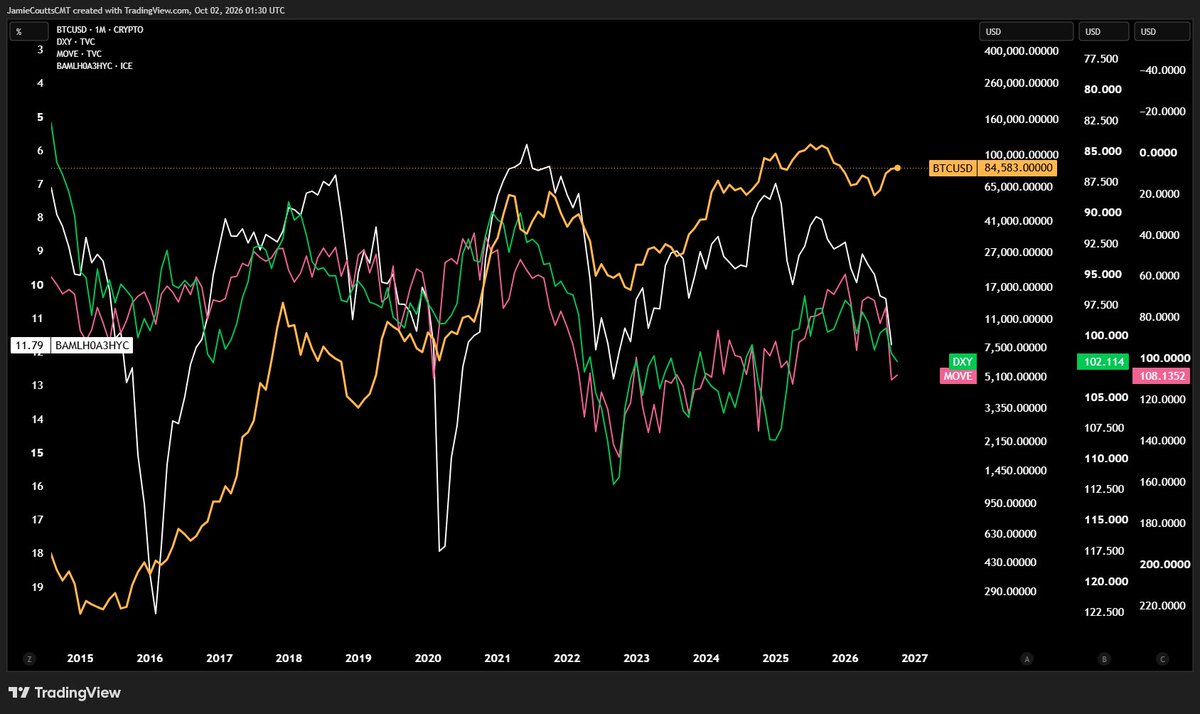
Well, folks, it's that time of the cycle. When the tension between debt and the liquidity to support it, starts sending signals to the markets. In simple terms, debt has risen faster than liquidity since 2021 and this means tension in the system previously hidden starts bubbling to the surface.
It shows up in many forms - sometimes it's the financial plumbing seizing up (2019, Q42025), bank failures, sovereign crises, etc. Most visibly, it shows up in the dollar, the MOVE index, long-bond yields, and credit. All are speaking up right now.
Historically, this doesn't bode well for risk assets like equities and liquidity-sensitive assets like $BTC. The usual playbook suggests risk sells off, and the central planners rush in after a flush with new 'temporary' measures. These cycles are around 5 years and we are due. Interestingly, Bitcoin had a deeper reset sooner than I anticipated (I thought it would happen around now), which makes this round so interesting. Without the embedded leverage and overstretched positioning typically associated with this point in the cycle, I think Bitcoin will surprise if there is a risk-off period.
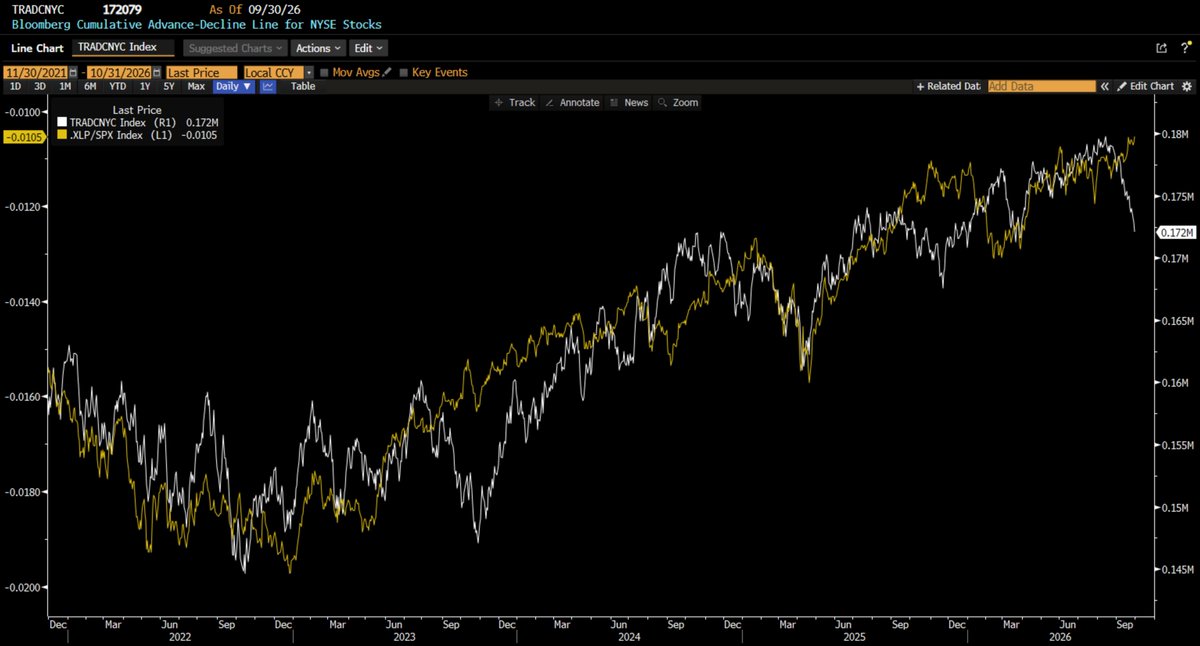
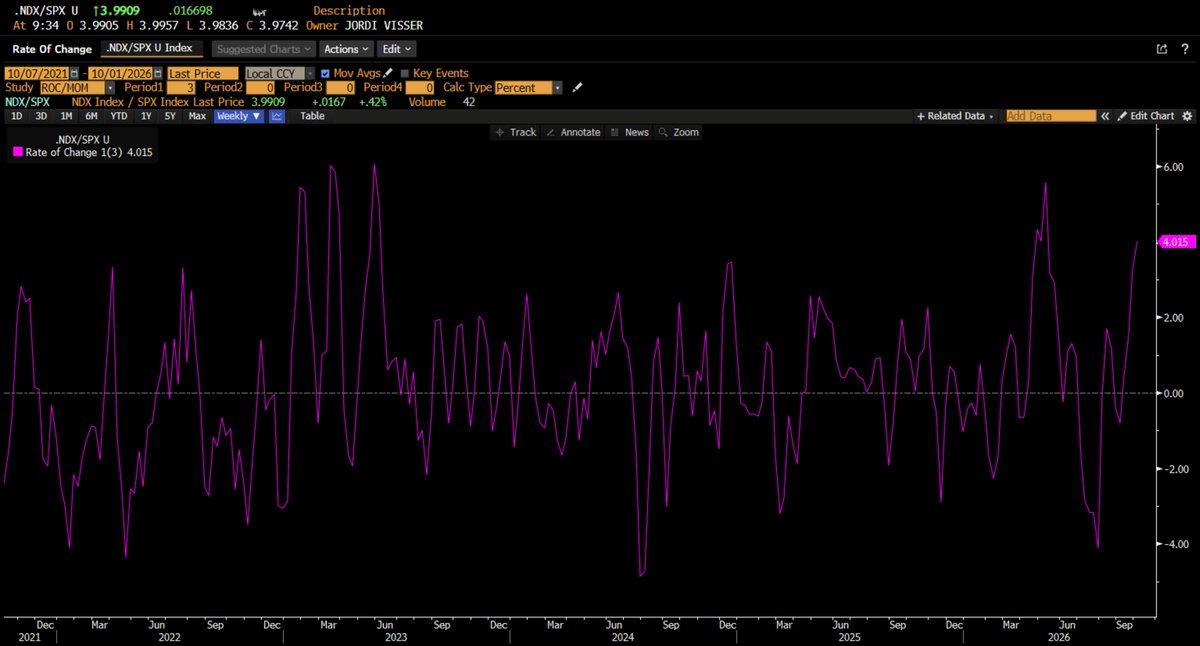
As you hear rates are going to take down everything and people telling you weak breadth is confirming, the simplest place to look and see if the market is discounting rate sensitivity or investors fears about broader market problems are to look at staples and utilities. SPX over XLP made new highs the past week as did Financials over Utes. Staples outperforming SPX has been a great breadth signal over the last 25 years for confirmation of coming risk. See DotCom bubble. Ford, GM, Homebuilders, Real Estate etc are going down (rate sensitive) while NDX over SPX 3 week RoC is its best since 2023 aside from coming out of the Iran depths in March. If you are worried because of the new fresh bear porn, watch XLP over SPY for a warning. Currently it is flashing green light and real risk is a bounce in breadth.
Micron Q4: five takeaways
1) Korea called it, again. Three weeks ago the first-ten-day export data set a record while everyone was busy calling the peak in AI. Micron just printed $54.2bn of revenue, +379% year-on-year, beat consensus by $3bn, and guided the next quarter to $61.5bn against a street at $57bn. And note that Q4 was a 14-week quarter, so the Q1 guide on a normal 13-week quarter is an even bigger sequential step than the headline suggests. The earnings cycle is not slowing. It is accelerating into a market that has spent the summer compressing multiples.
2) The cyclicality debate is over, for now. This is the argument we have had for many months: is memory still a boom-bust commodity? Gross margin at 87% and roughly $100bn of remaining performance obligations across the strategic customer agreements say the business has changed. Contracts do not remove the cycle, they stretch it. And $33bn of free cash flow in the quarter, $73bn of cash on the balance sheet: they fund the Idaho buildout and return the excess without touching the debt markets. That is the one thing the neoclouds cannot say.
3) Valuation is still absurd. On the new Q1 guide, run-rate EPS is about $153. At $1,070 that is roughly 7x. The S&P is on 22x. CrowdStrike is near 200x. The market is still pricing memory profits as if they end next year; the guidance says they rise into 2027, when HBM4 volume lands. Way, way too cheap remains the verdict.
4) It confirms the book. Quality of earnings is the factor in a hiking cycle, and Micron is the definition of it. Memory is the all-weather asset in the frontier-slows debate: training wants bandwidth, inference wants capacity, and both showed up in this print. US memory over Korea into the licence decision. We hold. We do not add after a 290% run.
5) The number to watch is capex. FY26 capex was $27bn against $62bn of free cash flow. If all three memory makers raise capex sharply at once, that is the first 2027-28 warning sign. Management already flagged that the rate of price increases is moderating, which means volume and contracts are now doing the work rather than price. That is exactly what you want if you own it for durability rather than for the spike. We do.
Global government debt has surged to unprecedented levels:
The Debt-to-GDP ratio of emerging market economies is up to ~78%, its highest level in data going back to 1880.
Since the 2008 Financial Crisis, this metric has more than doubled and surpassed the ~45% peak seen during World War II.
Before 2020, this ratio never exceeded 60% and is now approaching 80% for the first time.
Meanwhile, the Debt-to-GDP ratio of advanced economies is up to ~108% and has been above 100% for the last 10 years.
Before the 2008 Financial Crisis, this figure stood below 80%.
Deficit spending has become a global crisis.
Qu’il se passe quelque chose ou non, le schéma est toujours le même, ils attendent que tout aille mal pour prendre une décision. Non pas pour le bien du peuple, mais pour que le peuple ne se révolte pas contre eux.
Dominer par la peur quand le système déraille.
Pointer du doigt un autre problème quand ils ont eux-mêmes créé le vrai problème.
La Russie n’a ni les moyens militaires ni les moyens financiers de s’attaquer à l’Europe entière. Cela fait quatre ans et demi qu’elle est bloquée sur le territoire ukrainien. Le conflit dure depuis douze ans si l’on retient 2014 comme point de départ.