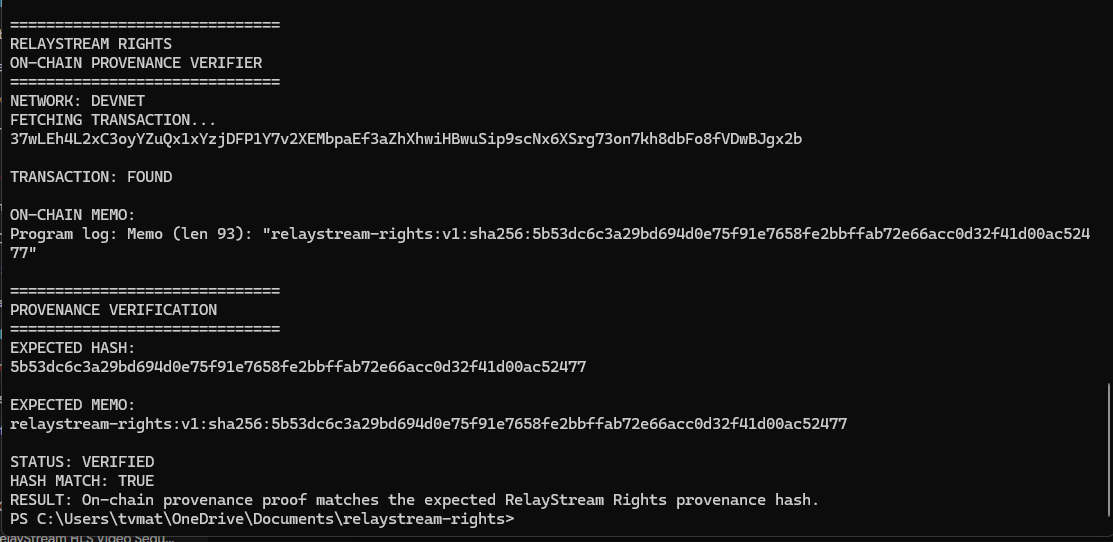
RelayStream Rights progress:
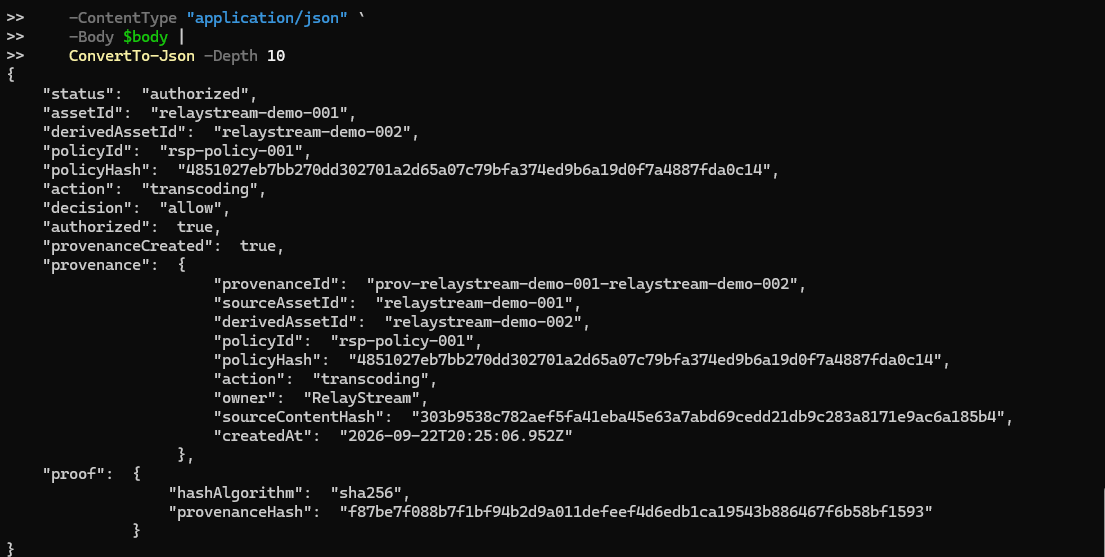
✅ Real video transcoding gated by permissions
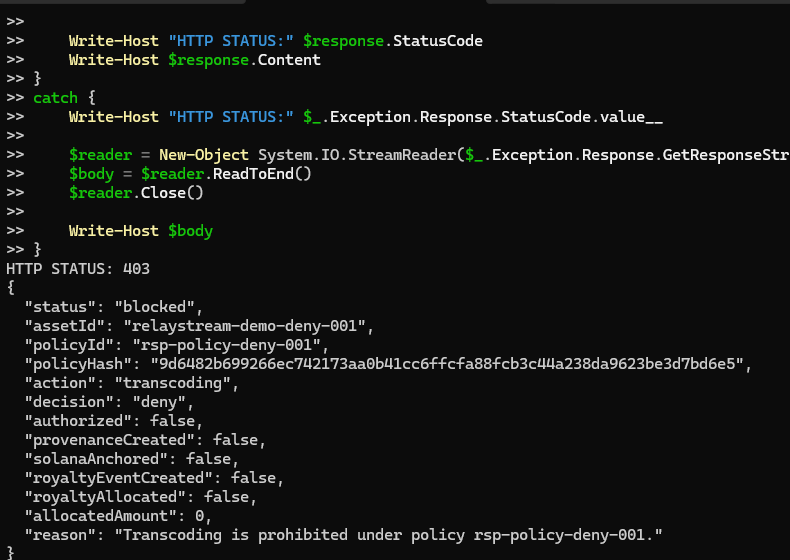
✅ DENY blocks processing
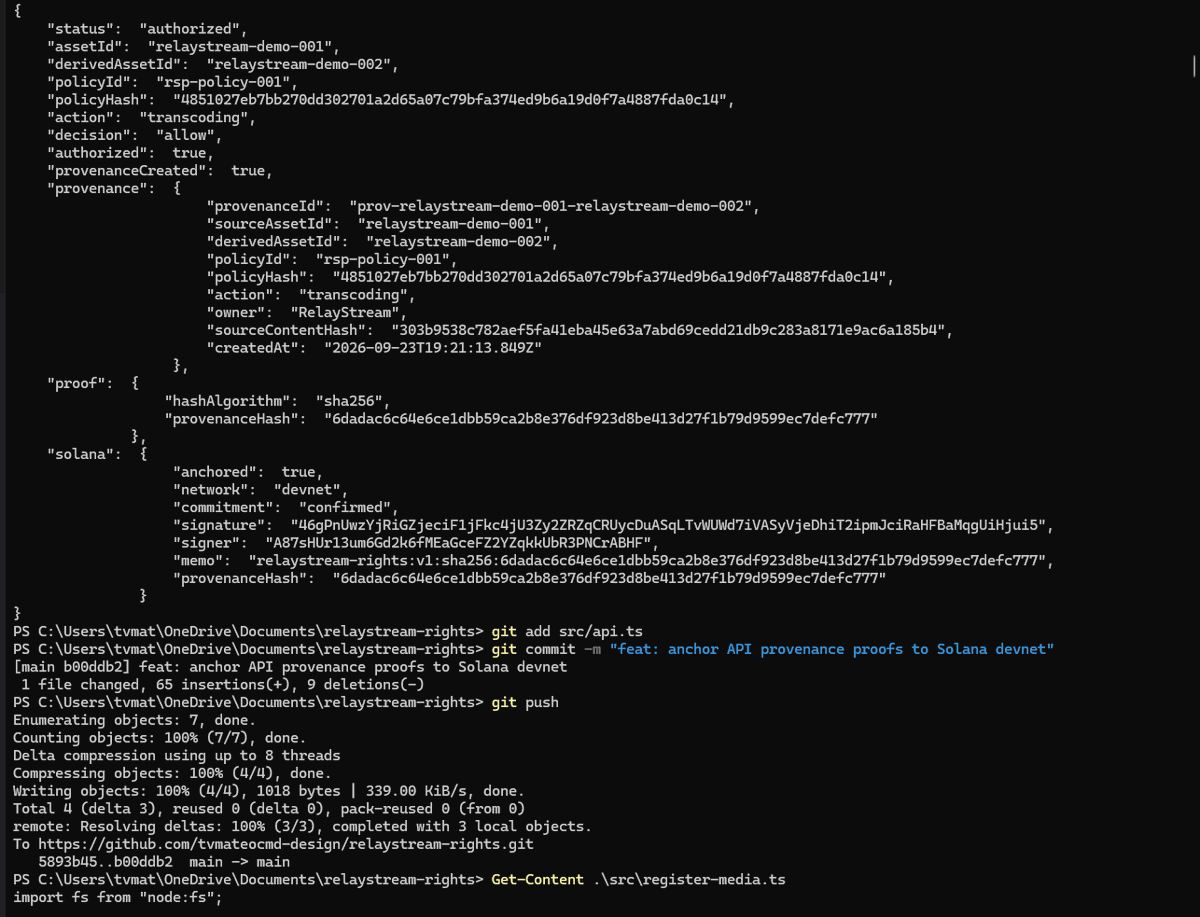
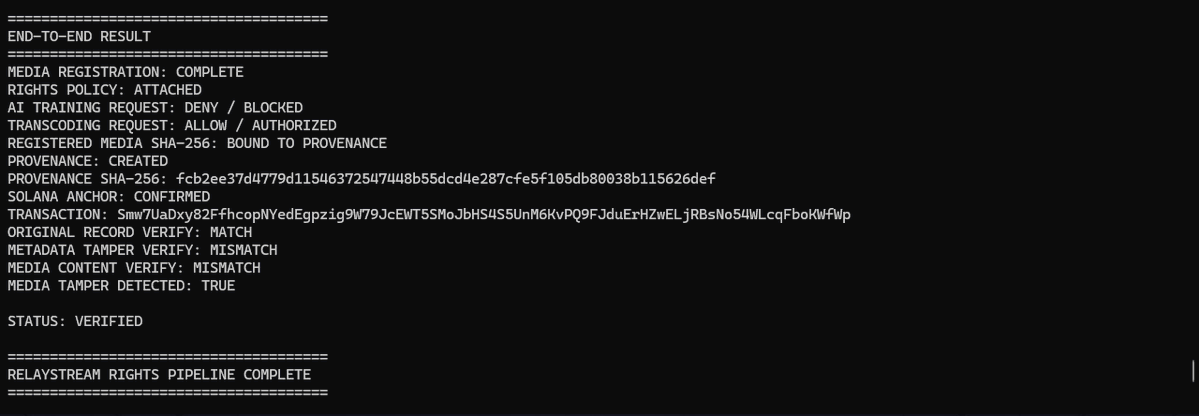
✅ Provenance hash anchored & verified on Solana devnet
✅ 67 checks passed
Local pipeline verified. Next: royalty allocation.
Building for Colosseum.
Day 13 building RelayStream Rights ⚡
End-to-end rights execution is coming together:
REGISTER → VERIFY POLICY INTEGRITY → ALLOW → PROVENANCE → SHA-256 → SOLANA DEVNET → ROYALTY ALLOCATION
And the DENY path now proves the opposite:
DENY → STOP
❌ No provenance
❌ No Solana anchor
❌ No royalty event
The API now exposes policy integrity + registered/current policy hashes, giving software and AI agents machine-readable evidence of the policy actually used for authorization.
Payments remain disabled — royalty execution is allocation-only for now.
Media rights software can understand.
https://t.co/1HDHdLCDkn
#Solana #Colosseum #BuildInPublic #Web3
RelayStream Rights ⚡
Building programmable media rights infrastructure on Solana — so applications and AI agents can verify what they’re actually authorized to do with digital media.
ALLOW → Provenance → Solana proof
DENY → Stop
Currently building it in public for the @Colosseum Crypto World’s Fair. 👀
Day 11 — RelayStream Rights ⚡
Today I hardened the authorization layer.
RelayStream Rights now verifies the cryptographic integrity of the registered rights policy before software or an AI agent can act on it.
I tested both paths:
✅ Untouched policy → integrity verified → ALLOW → provenance → Solana Devnet proof → royalty allocation
🛑 Tampered policy → integrity failed → DENY → no provenance → no Solana anchor → no royalty event
The tamper test deliberately changed a registered TRANSCODING: DENY policy to ALLOW after registration.
The policy SHA-256 no longer matched the registered fingerprint, so the engine failed closed and rejected the forged ALLOW.
The architecture is getting stronger:
VERIFY POLICY → DECIDE → ACT → PROVE → ANCHOR → ALLOCATE
Building RelayStream Rights for the @Colosseum Crypto World’s Fair.
Programmable Media Rights Infrastructure on Solana. ⚡
Okay, now I understand where you're coming from. I just looked at Trenchtide — the automated/no-human-in-the-loop approach explains some of your comments about the Rights architecture.
I'm the solo developer behind RelayStream and I'm building RelayStream Rights for the Colosseum hackathon right now. Your thinking around perceptual matching, thresholds and policy separation is very close to a problem I'm actively working through.
Would you be interested in talking architecture privately? I think we'd have a useful conversation.
Week 2 build update ⚡
RelayStream Rights is moving from proof-of-concept to application-facing infrastructure.
Today I built a callable Rights API that can:
• Register real media + SHA-256 fingerprint
• Bind machine-readable rights policies cryptographically
• DENY unauthorized AI training
• ALLOW authorized media operations
• Generate provenance for authorized actions
• Detect policy, metadata & media tampering
The important part:
An application or AI agent can now ask:
“Am I authorized to do this with this media?”
RelayStream Rights returns a machine-readable decision — and authorized operations can produce cryptographic provenance.
Next: API → provenance → Solana Devnet anchor → transaction proof.
Building for the @Colosseum Crypto World’s Fair.
RelayStream Rights
Programmable Media Rights Infrastructure on Solana. ⚡
Day 10 — RelayStream Rights ⚡
BIG STEP TODAY:
connected media authorization, provenance, Solana proof, and royalties into one workflow.
ALLOW → Provenance → Solana → Royalty Allocation
✅ Machine-readable rights verification
✅ Authorized action creates cryptographic provenance
✅ Provenance proof anchored to Solana Devnet
✅ Confirmed transaction returned through the API
✅ Authorized usage creates a 60/20/10/10 royalty allocation
✅ DENY = no provenance, no Solana anchor, no royalty event, $0 allocated
THE GOAL:
digital media rights that software and AI agents can actually understand and act on.
DECIDE → ACT → PROVE → ANCHOR → ALLOCATE
Building RelayStream Rights for the @Colosseum Crypto World’s Fair.
Programmable Media Rights Infrastructure on Solana. ⚡
Appreciate the invite, I’d love to join Friday. I’m building RelayStream Rights for the World’s Fair — programmable media rights infrastructure that lets applications and AI agents verify what they’re authorized to do with digital media. Looking forward to sharing what we’re building, the problem we’re solving, and what I’ve learned along the way. ⚡
Absolutely — that’s an important distinction. The SHA-256 layer we’re using now is intentionally for exact byte-level integrity: change even one bit and verification fails.
Perceptual fingerprinting is the next complementary layer we’re planning for exactly the reason you mentioned — discovering re-encoded, resized, cropped, or otherwise transformed copies that won’t retain the original SHA-256.
The way I see it:
SHA-256 proves “is this the exact registered media?”
Perceptual fingerprinting helps answer “is this derived from or substantially the same media?”
Then RelayStream Rights can connect that identification back to the rights policy and provenance chain.
Really appreciate you following the build and raising this. ⚡
RelayStream development update ⚡
We’ve been heads-down building.
RelayStream continues to evolve as an open media coordination layer — connecting the infrastructure behind storage, streaming, metadata, discovery, identity and delivery.
We’re also building RelayStream Rights:
programmable media rights infrastructure designed to make usage permissions, licensing and provenance machine-readable and verifiable by software and AI.
Media infrastructure is becoming programmable.
Media rights need to become programmable with it.
Build • Contribute • Monetize
#RelayStream #Solana #Web3 #MediaInfrastructure
This is RelayStream. ⚡
Media infrastructure shouldn’t be a collection of disconnected systems.
HLS transcoding.
Decentralized Storage.
Identity & Access.
Residuals Engine.
Media Discovery & Intelligence.
RelayStream is building the coordination layer that brings those pieces together into open, programmable media infrastructure.
Preserve • Distribute • Monetize
Build • Contribute • Monetize
This is RelayStream.
#RelayStream #Solana #Web3 #DecentralizedStorage #Streaming
RelayStream Rights — Day 3 ⚡
Yesterday we anchored a cryptographic media provenance proof to Solana.
Today we closed the verification loop.
RelayStream Rights can now:
• Fetch the transaction from Solana Devnet
• Retrieve the on-chain provenance proof
• Compare it against the expected SHA-256 hash
• Cryptographically verify the match
STATUS: VERIFIED
HASH MATCH: TRUE
Next: connect rights enforcement → authorized transformation → provenance → Solana anchoring → verification into one end-to-end workflow.
Building programmable media rights infrastructure on Solana.
#Solana #BuildInPublic #Web3
Another Great question 🙏. For the hackathon MVP, fingerprinting ripped/re-uploaded copies is out of scope. Right now we're focused on the authorization/provenance layer: an authorized derivative or transcode can carry a verifiable link back to the source asset and the rights that permitted it.
A ripped copy that deliberately drops that provenance is a different problem. Longer term, content fingerprinting could be a discovery layer that recognizes the underlying media even when its metadata/provenance has been stripped, then resolves it back to the registered asset and its rights policy.
So essentially: provenance tells us what an authorized copy came from; fingerprinting could help us discover unauthorized copies that don't tell us. Definitely something we see fitting into the larger RelayStream architecture, but we're keeping the hackathon build focused.
Day 1 — RelayStream Rights is officially live in the Crypto World’s Fair. 🚀
We’re building programmable media rights infrastructure on Solana.
Register media → define rights → request usage → verify permission → return a verifiable decision.
We’ll be building in public and documenting the process throughout the hackathon.
First builder update 👇
https://t.co/twKIf6ZQUs
#Solana #CryptoWorldsFair #BuildInPublic
Great question. The rights record follows the registration/provenance graph, not a single immutable file hash. A hash identifies a specific representation of the asset, but transcoding naturally changes that hash. The transcoded output can be linked back to the registered source as an authorized derivative/representation, preserving provenance and the applicable rights. That’s exactly the problem we’re designing RelayStream Rights to handle.
This is RelayStream.
Media is becoming programmable.
The infrastructure behind it needs to evolve with it.
Transcoding.
Decentralized storage.
Portable media records.
Programmable rights.
Discovery.
Intelligence.
Playback.
Coordination.
Not isolated tools — one open media infrastructure.
Preserve • Distribute • Monetize
RelayStream — Open Media Infrastructure. ⚡
Building the things we wish existed.
Media is becoming programmable.
Media rights should be too.
Verified identity. Machine-readable permissions. Authorized usage.
Programmable Media Rights.
This is RelayStream.
Open Media Infrastructure.
Building the things we wish existed. ⚡
Media infrastructure is fragmented.
Storage
Compute
Metadata
Discovery
Delivery
Different systems. Different providers.
RelayStream is building the coordination layer that connects them.
Open infrastructure for media that needs to move, persist, be discovered, and reach its destination — without being locked to a single provider.
This is RelayStream.
Preserve • Distribute • Monetize
#RelayStream #OpenInfrastructure #Web3 #DecentralizedMedia
We’re officially in. ⚡
RelayStream is registered for the Crypto World’s Fair Hackathon by Colosseum.
We’re building:
RelayStream Rights
Programmable media rights on Solana.
Digital media moves instantly. Its rights should too.
Time to build. 🏗️⚡
#Solana#CryptoWorldsFair #BuildInPublic #RelayStream