current immigration delays have now placed me at legal risk, now on forced unpaid work leave until my new work authorization comes in. i’ve been waiting since january, friends :( i want nothing more than to just be able to work and not be at risk w/ 🧊. https://t.co/ZRNqHz69qG
SUMMER LIVE BAND DATES ON SALE TOMORROW (FRI) 12PM LOCAL TIME at https://t.co/nSKPNcTSm9
THE NYC RESIDENCY CONTINUES AND WE TAKE THE FULL BAND EXPERIENCE TO TORONTO + CHICAGO
COME BE PART THE NEIGHBORHOOD IN REAL LIFE! MORE CITIES SOON.
@STACCoverflow Just threw away 15 months
I often wonder how you managed throughout it all.
What matters though- you're on the other side of it.
I need to talk to someone but idek how to start the convo
The cycle wherein distrusting people become untrustworthy is a self-reinforcing feedback loop rooted in cognitive biases, defensive behavioral patterns, and the degradation of social capital. It is rarely a singular event, but rather a slow transformation where the *expectation* of betrayal leads to actions that justify that expectation.
### 1. The Proactive Defense (Hyper-vigilance)
People who hold deep-seated distrust often view the world as a zero-sum game where others are inherently opportunistic.
* **The Mechanism:** To avoid being "played," the distrusting person adopts a defensive posture. They may withhold information, test others with traps, or prioritize their own interests prematurely to ensure they aren't left at a disadvantage.
* **The Result:** By acting in ways that prioritize self-protection over cooperation, they begin to compromise their own integrity. They convince themselves that "everyone else is doing it," lowering the bar for their own ethical behavior.
### 2. The Self-Fulfilling Prophecy
Social psychology suggests that our expectations of others drive our behavior toward them, which in turn influences how they treat us.
* **The Mechanism:** If you treat someone as if they are untrustworthy (e.g., through surveillance, lack of transparency, or accusatory communication), you signal that you do not value the relationship.
* **The Result:** The other person, feeling disrespected or unfairly scrutinized, often withdraws or stops investing effort into the relationship. Their subsequent lack of loyalty or transparency is then cited by the original person as "proof" that their initial distrust was correct, deepening the cynicism.
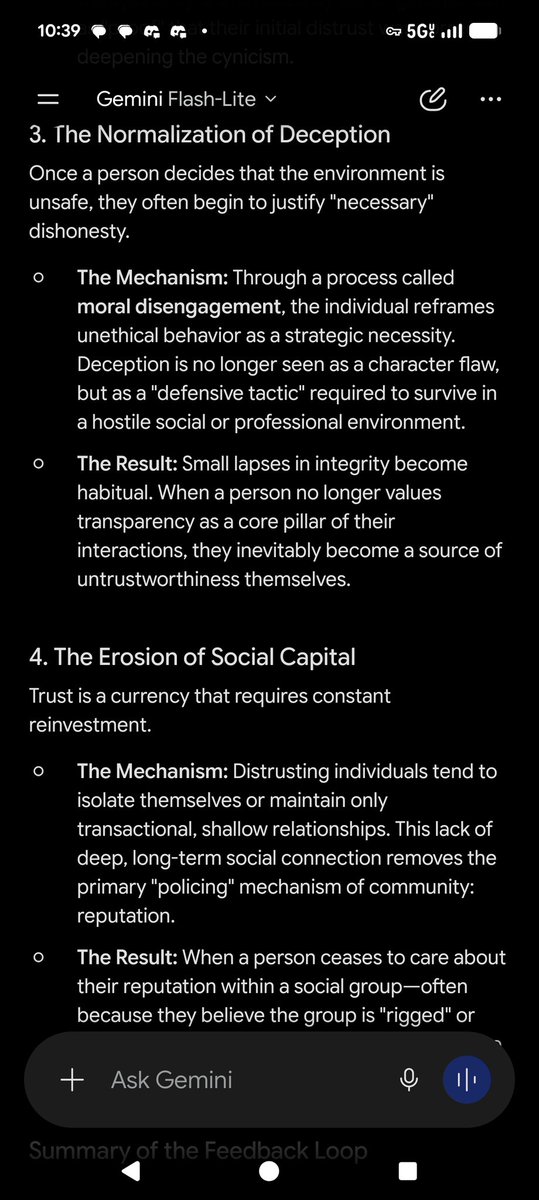
### 3. The Normalization of Deception
Once a person decides that the environment is unsafe, they often begin to justify "necessary" dishonesty.
* **The Mechanism:** Through a process called **moral disengagement**, the individual reframes unethical behavior as a strategic necessity. Deception is no longer seen as a character flaw, but as a "defensive tactic" required to survive in a hostile social or professional environment.
* **The Result:** Small lapses in integrity become habitual. When a person no longer values transparency as a core pillar of their interactions, they inevitably become a source of untrustworthiness themselves.
### 4. The Erosion of Social Capital
Trust is a currency that requires constant reinvestment.
* **The Mechanism:** Distrusting individuals tend to isolate themselves or maintain only transactional, shallow relationships. This lack of deep, long-term social connection removes the primary "policing" mechanism of community: reputation.
* **The Result:** When a person ceases to care about their reputation within a social group—often because they believe the group is "rigged" or "unworthy" anyway—they are liberated from the social pressures that keep most people honest.
### Summary of the Feedback Loop
| Stage | Action | Outcome |
|---|---|---|
| **Cognitive** | Assumption that others are deceptive. | Focus on self-protection over collaboration. |
| **Behavioral** | Defensive posturing and "testing" others. | The other person reacts with distance or retaliation. |
| **Justification** | Labeling the other person's reaction as proof. | Moral disengagement (rationalizing one's own deception). |
| **Outcome** | Full transition to untrustworthy behavior. | The cycle becomes cemented as part of their character. |
In short, the cycle transforms a **victim of distrust** into a **perpetrator of untrustworthiness**. By trying to preemptively guard against the dishonesty they fear, they inadvertently model the very behavior that makes the world less trustworthy for everyone else.
What specific social or professional context are you thinking about regarding this cycle?