I spend most of my time building with AI and figuring out what is actually useful.
Not just asking models random things, but turning them into tools and workflows that help me build real products and ship faster.
Right now I’m building products, testing agents, comparing models, and sharing what actually works and what doesn’t.
If you like following someone who is actually trying to make AI useful in the real world instead of just talking about it, follow along.
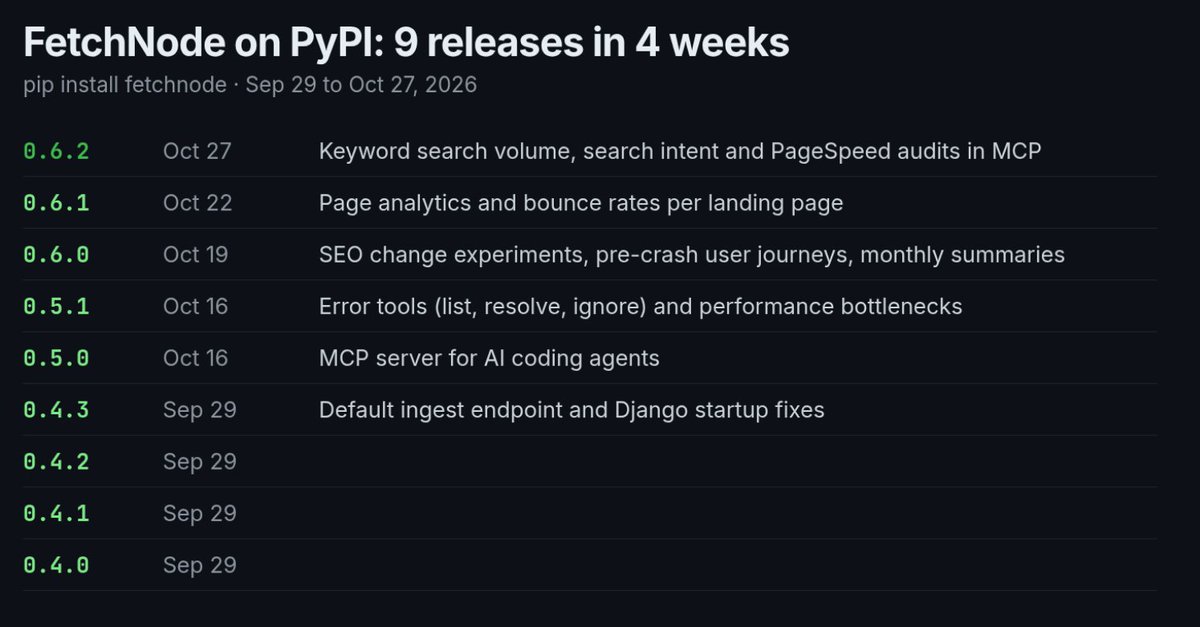
9 Fetchnode releases in 4 weeks.
Since September 29 I've shipped 0.4.0 up to 0.6.2. Most of it went into the MCP server, so my coding agent can look things up instead of asking me:
- Errors, with resolve and ignore
- Slow queries and N+1 patterns
- Google Search Console clicks and declining pages
- Since Monday night: keyword search volume, search intent and PageSpeed audits
I run 9 Django sites with it. And with just one instruction to a agent and not only the errors or ineffeciencies are fixed, but it also searches for SEO opportunities. Letting an agent know the live statistics of your SEO lets i make very good choices on where and how to improve. I got first page rankings for every website in no time.
Which of these would you actually let an agent check for you?
How I give my coding agent production context for my Django sites:
- pip install fetchnode
- Add "fetchnode" to INSTALLED_APPS and the middleware near the top
- Run python https://t.co/pEmjok0xCw fetchnode_mcp --setup
- Ask the agent about a real error, a slow page or a drop in Google clicks
The agent then pulls the traceback, slow queries or Search Console numbers itself. No more pasting stack traces.
One of the first wins on its own page: 37% less wait time.
Free for 1 site.
What do you still copy and paste into your agent by hand?
Introducing Gemini 4 Carbon, it's a big jump over Argon which we released just 2 weeks ago.
Gemini 4 Carbon is SOTA on cyber, long horizon tasks, ranks #1 on Artificial Analysis V5, significantly improves on usability in domains like coding, and is more aligned.
@SSShken Some other probable issues where SEO targeting the wrong audience and not enough marketing to get more interested users to the website itself. Marketing is still a challenge for me. I prefer building over marketing, but if you want to make money marketing is essential lol
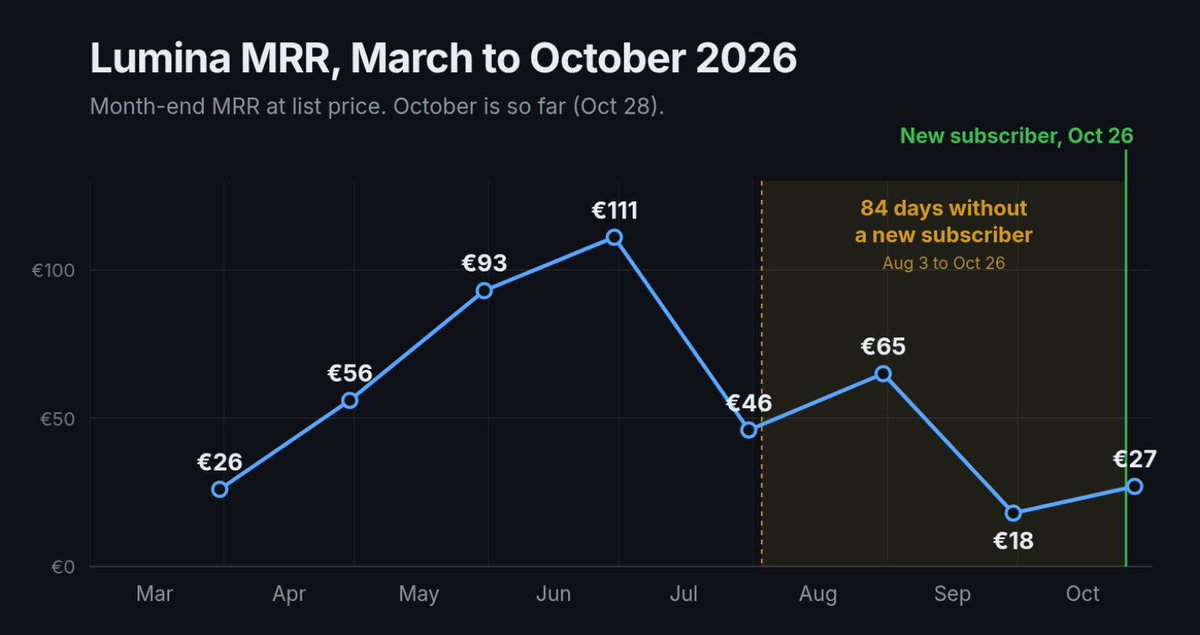
Lumina is at €27 MRR. In June it was €111.
Then it went 84 days without a new subscriber. On Monday someone subscribed again.
When I did some research into the quiet period I found my own bug. On September 16 I added a guard against double clicks. It blocked the first click instead. Email sign-up, password login and file uploads all stopped working. The button said "Creating account..." and nothing happened. No errors in the logs, so I didn't notice.
Google sign-in still worked, so people kept signing up. But from late September until October 21 not a single person uploaded a file. Hard to pay for a screening tool you can't put papers into.
I fixed it on October 21. Five days later someone found Lumina through Google, signed up, uploaded their references and paid within 13 minutes. Their dataset was bigger than the 100 free papers.
€27 is far from my €500 goal. But it's moving again.
Do you have a test that actually clicks through your sign-up flow, or do you also find out weeks later?
@SSShken That would be a great test. Run the entire process at least once a week to check if nothing fails.
I dont think the double click gaurd was the only problem TBH
‼️ A hacker got the national ID numbers of signers on eSignFlow, the e-signature tool used by 120+ Belgian councils.
Its maker Vanden Broele says the hashed numbers are easy to reverse. Some handwritten signatures leaked too.
On Monday, its CEO said mostly metadata leaked.
@MeloxJourney vs Openclaw vs Hermes....
I tried Openclaw in the begining and use Hermes right now. Recently i also tried GrokBot and am suprised on how good it is.
‼️ Anthropic and Google researchers found a flaw that lets one crafted packet hijack a server during network boot, before Secure Boot checks the OS.
Almost all servers on earth are affected.
CVE-2026-97631 sits in TianoCore EDK II, code in the UEFI firmware of most servers.