Thomas Sowell: ”If you’re going to have reparations for slavery, it’s going to be the greatest transfer of wealth back and forth, because the number of Whites who were enslaved in North Africa by the Barbary Pirates exceeded the number of Africans enslaved in the United States.”
This is the biggest breakthrough in European Archeology in decades! The oldest evidence of written language, previously believed to be from Mesopotamia, had now been discovered in Germany 📜
Medan svenska medier sover händer det omöjliga under Trump: Noll illegala migranter insläppta på 9 månader och det största raset i mordstatistik på 125 år.
Varför får vi aldrig läsa om de här siffrorna i Sverige? Är det faktan eller avsändaren som skaver?
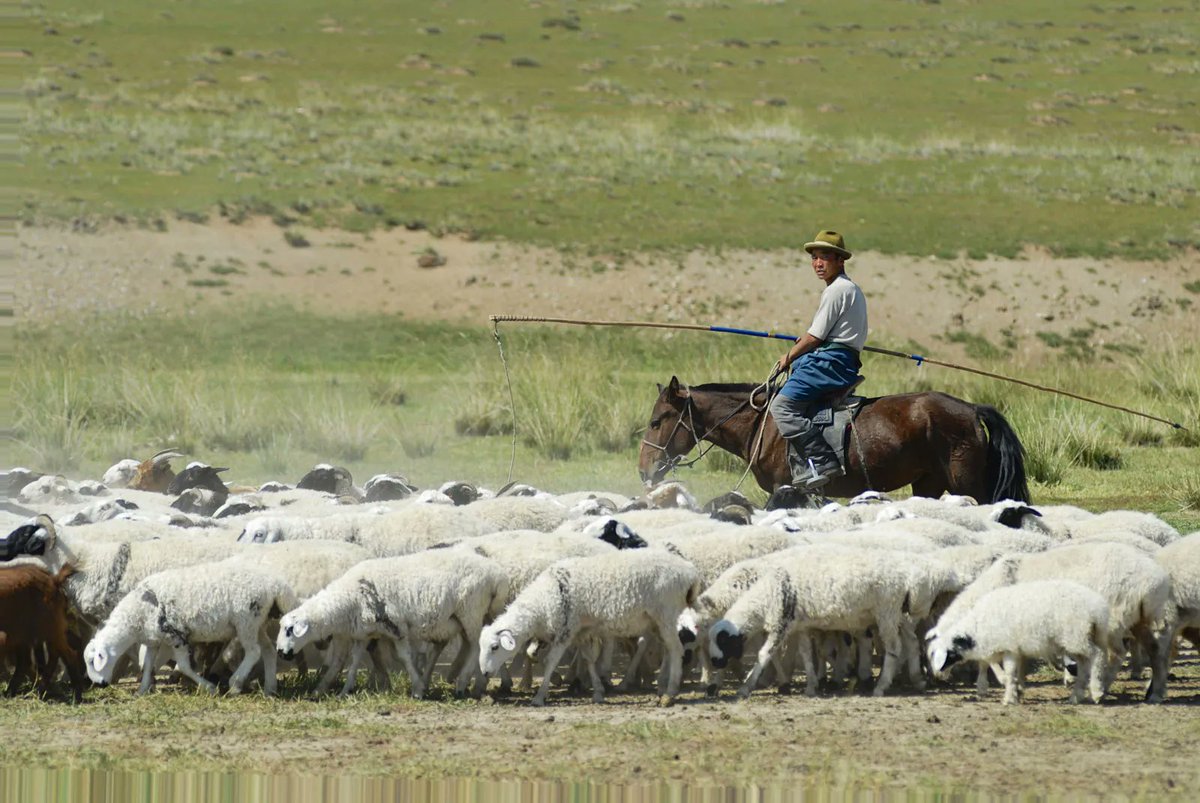
Mongolia: 64 million livestock. Sheep, goats, cattle, horses, camels.
For a country of only 3 million people, that seems excessive.
Environmental consultants from Europe and America regularly arrive to explain that Mongolia is overstocked and heading for ecological collapse.
The Mongolian herders listen politely. Then continue doing what they've done for thousands of years.
The steppes remain healthy.
How? The herders never asked for advice because they already solved this problem about 3,000 years ago.
The key is movement. Mongolian herders are fully nomadic. They move their livestock constantly, following ancient patterns that align with grass growth cycles and water availability.
A section of steppe gets hit with intense grazing from a large herd. Looks devastating. Grass trampled. Soil disturbed. Dung everywhere.
Then the herd moves on. And doesn't return to that section for months.
The grass explodes back. Faster and thicker than if it hadn't been grazed.
Why? Grazing stimulates tillering in grasses. One plant becomes five. The trampling breaks up soil crust and incorporates organic matter. The dung feeds soil microbes.
But this only works with movement. Stay too long and you destroy the grass. Keep moving and you stimulate it.
The Mongolian steppes are a carbon sink. The soil organic carbon levels are among the highest for any grassland on Earth.
This is being built by 64 million livestock doing exactly what environmental consultants say causes desertification.
Western researchers finally started studying this seriously in the 2000s. The data is clear: Nomadic grazing at high stocking densities maintains healthier grassland than low-intensity grazing on fixed ranges.
The Mongols have been right for 3,000 years. The modern range science was wrong.
There's a reason Mongolia's grasslands are still intact while American and Australian rangelands show degradation. Mongolia never adopted the Western model of splitting the range into paddocks and grazing each continuously at low density.
They kept the high-density, high-mobility system that evolved with the landscape.
Climate researchers studying carbon sequestration are now very interested in Mongolian grasslands. The carbon storage potential is enormous.
And it's being maintained by the exact thing climate activists want to eliminate: Large numbers of livestock.
The environmental movement doesn't publicize Mongolia's success because it contradicts the core message that livestock numbers must be reduced.
Mongolia's response: They'll reduce their livestock when the steppes start failing. That hasn't happened in 3,000 years of herding, so they're not worried.
The grassland knows what it needs. And what it needs is exactly what it's getting.
Serengeti ecosystem:
1.5 million wildebeest
200,000 zebra
500,000 gazelle
Countless other ruminants
Total: 2+ million grazing animals producing methane for thousands of years.
Result: Most biodiverse ecosystem on Earth.
Maybe grazing animals ARE the environment.
The Parable of the Good Samaritan Explained Through Jewish Culture
Luke 10:25–37
Yesterday I shared a post about the parable of the wedding feast, and it received far more engagement than I expected. I honestly didn’t think it would reach that many people, but God moved in His own way.
So today, I’ll be talking about the parable of the Good Samaritan, and I’ll be explaining it through the lens of Jewish culture as well.
**Grab your popcorn🍿
The Parable of the Good Samaritan is one of the most well-known teachings of Jesus, it is also one of the most misunderstood. Many people read it as a simple moral lesson about being kind to others. While kindness is certainly part of the message, Jesus was saying something far deeper, far more confronting, and far more shocking, especially to His Jewish audience. When this parable is read through Jewish culture and historical reality, it becomes a powerful revelation about love, mercy, and the true meaning of righteousness.
The story begins with a lawyer standing up to test Jesus. In Jewish society, a lawyer was not a modern courtroom attorney but an expert in the Law of Moses. This man knew the Scriptures very well. His question, “What shall I do to inherit eternal life?” was not asked out of humility but out of testing. In Jewish thinking, eternal life was connected to covenant faithfulness and obedience to the Law.
Jesus responded like a Jewish rabbi by turning the question back to him. “What is written in the Law? How do you read it?” The lawyer answers correctly by combining Deuteronomy 6:5 and Leviticus 19:18, saying that one must love God with all their heart and love their neighbor as themselves. Jesus affirms his answer and tells him to do this and he will live. At this point, the conversation could have ended. But the lawyer, wanting to justify himself, asks a very revealing question: “And who is my neighbor?”
This question exposes the heart of the issue. In first-century Jewish culture, the word “neighbor” did not mean everyone. Many Jewish teachers understood “neighbor” to mean fellow Jews, especially those who lived according to the Law. Gentiles, sinners, and especially Samaritans were often excluded. The lawyer was essentially asking Jesus to define the limits of love. How far does my responsibility go, and who is outside of it?
Jesus answers not with a definition, but with a story. He describes a man traveling from Jerusalem to Jericho. To a Jewish listener, this detail mattered. The road from Jerusalem to Jericho was steep, dangerous, and well known for bandits. Hearing that a man was attacked, beaten, stripped, and left half dead would not surprise anyone. It was a realistic and familiar situation.
Next, Jesus introduces a priest walking down the same road. In Jewish society, a priest was highly respected as a religious leader who served in the temple. When the priest sees the wounded man and passes by on the other side, it shocks the listener, but it also raises an important cultural issue. According to the Law, touching a dead body would make a priest ceremonially unclean. Since the man was “half dead,” the priest may have feared ritual defilement. However, the Law also commanded love and mercy. Jesus is exposing how religious duty can be used as an excuse to avoid compassion.
Then a Levite comes along. Levites assisted in temple service and were also respected religious figures. Like the priest, he sees the man and passes by on the other side. To Jesus audience, this deepens the disappointment. Two representatives of religious life have failed the most basic command of love.
At this point, the listeners would naturally expect the third character to be a faithful Jewish layman. This was a common storytelling pattern. But instead, Jesus says something that would have caused immediate emotional reaction: “But a Samaritan…”
To understand the shock, we must understand Jewish-Samaritan hatred. Samaritans were despised by Jews. They were seen as religiously corrupt, ethnically impure, and spiritually deceived. Jews avoided Samaritans, refused to eat with them, and often viewed them as enemies. For Jesus to make a Samaritan the hero of the story was deeply offensive to Jewish pride.
Yet this Samaritan does what the priest and Levite refused to do. He feels compassion. He goes to the wounded man. He binds his wounds, pours on oil and wine, lifts him onto his own animal, and takes him to an inn. He pays for his care and promises to return and cover any extra cost. This level of care goes far beyond basic help. It is sacrificial love.
In Jewish culture, oil and wine were common healing agents, but they also had symbolic meaning connected to blessing and restoration. The Samaritan uses his own resources, his own time, and his own safety to help someone who, under normal circumstances, would have hated him. Jesus is showing love without boundaries, conditions, or expectations of return.
After telling the story, Jesus turns back to the lawyer and asks a different question than the one he was originally asked. He did not ask, “Who was the wounded man’s neighbor?” Instead, He asks, “Which of these three do you think was a neighbor to the man who fell into the hands of robbers?” This shift is crucial. Jesus moves the focus from identifying who qualifies as a neighbor to becoming a neighbor yourself.
The lawyer answers, “The one who showed him mercy.” Notice that he cannot even bring himself to say “the Samaritan.” His prejudice is still there. Though he understands the point. Jesus then says, “Go and do likewise.” This command would have been extremely challenging to a Jewish listener. Jesus is not only calling for kindness, He is calling for love that crosses ethnic hatred, religious boundaries, and social divisions.
This parable reveals that true righteousness is not proven by religious position, knowledge of the Law, or outward holiness. It is proven by mercy. Jesus is showing that those who truly know God will reflect His compassion, even toward those they have been taught to despise.
The Good Samaritan also points beyond ethics to the gospel itself. The story reflects the greater story of salvation. Humanity lies wounded by sin, unable to save itself. Religion passes by, unable to heal. But Jesus, rejected and despised like the Samaritan, comes near, binds wounds, pays the cost, and promises to return. While this parable should not be reduced only to allegory, this deeper layer fits beautifully with the message of Christ.
In the end, the Parable of the Good Samaritan dismantles every attempt to limit love. It confronts religious pride, exposes prejudice, and redefines what it means to obey God. Jesus teaches that loving God cannot be separated from loving people, even those we consider enemies. In Jewish culture, this was a radical call. In today’s world, it remains just as challenging.
Jesus does not allow us to ask, “Who deserves my love?” Instead, He commands us to become people who show mercy, just as God has shown mercy to us.