"Wider understanding of what happens in governing bodies will be key for university cohesion, stakeholder trust and institutional success in the longer term."
@ResFortnight@ResProfNews
https://t.co/IixV7zmseq
#HigherEd
Truly thankful for the invitation to present our research at the American Transplant Congress @ATCMeeting!
A huge thank you to @AST_info for the opportunity, and to everyone at @MayoClinicNeph and @MayoTransplant for making it possible.
Best way to finish fellowship!
A four-gene signature for diagnosis of acute kidney injury following kidney transplantation
https://t.co/palRdDZPKm
@WeAreTandF@tandfonline@tandfnewsroom
"A lot of PhDs told me this very important tip: on the days you can’t, or don’t feel like it, or something blocks you from doing a good chunk of work, do something even very small if possible."
@vickyloras#PhDLife#PhDChat
Predicting long-term allograft outcomes in kidney transplant recipients using a machine learning approach: a 5-year retrospective cohort study
@tandfonline@tandfnewsroom@WeAreTandF
https://t.co/mjDUWVjANZ
Clinical impact of an EHR-integrated hyperkalemia management system: a real-world study of 10,934 episodes
@tandfonline@tandfnewsroom@WeAreTandF
https://t.co/EFPT8Vcg9e
Clinical impact of an EHR-integrated hyperkalemia management system: a real-world study of 10,934 episodes
@tandfonline@tandfnewsroom@WeAreTandF
https://t.co/EFPT8Vcg9e
Some of the most impactful research communication happens in lectures, presentations, and policy evidence sessions
So why aren't we documenting these outputs and how can we start to do so?
@BenKaube@researchinfo@cassyniapp
https://t.co/2jctc6APuE
#SciComm#ResearchImpact
"Writing is a slippery craft and what works for this paper today might not work for that chapter tomorrow. Stay nimble, nurture your process and your writing will flourish as a result."
https://t.co/P6IPpa4SvO
@timeshighered#AcademicWriting
"While it is reassuring that science remains broadly trusted, there are warning signs in this report ... the scientific community must reach beyond our own circles to engage with the whole of society"
@markgfh@wellcometrust
https://t.co/HYCO8SM5h6
#SciComm#PublicEngagement
"Consider this a starter kit in the science of learning."
Discover 10 essential books on evidence-based college teaching, via Brigham Young University-Idaho's Benjamin Pacini: https://t.co/8iynVcLhvQ
@benjaminpacini@insidehighered#HigherEd
Nuestro nuevo Artículo Original está en línea
Investigamos la asociación que tiene el incremento de hemoglobina en pacientes con anemia severa y lesión renal aguda sobre los MAKE
Una pregunta clínica frecuente
Descárgalo gratis👇🏻
Renal Failure 2026
https://t.co/Tmrt0zhMku
We are pleased to share that our latest research article has been published today in the prestigious Renal Failure journal.
📖 Article link: Article link: https://t.co/Pt0TrHIszE
We would appreciate your support by reading, sharing, and discussing the article.
@RenalFailureTF
"You may not be the best orator in the world, but as a researcher of a study, you are the best person – or are at least in a better position – to communicate your study's findings."
https://t.co/L18ElFyRwt
@timeshighered#SciComm#ECRs
We did a deep dive into Taylor & Francis research published in the past five years to uncover the latest information on how the global issue of climate change has been addressed with the use of AI
Take a read at the link below
@altmetric#ClimateChange#AI
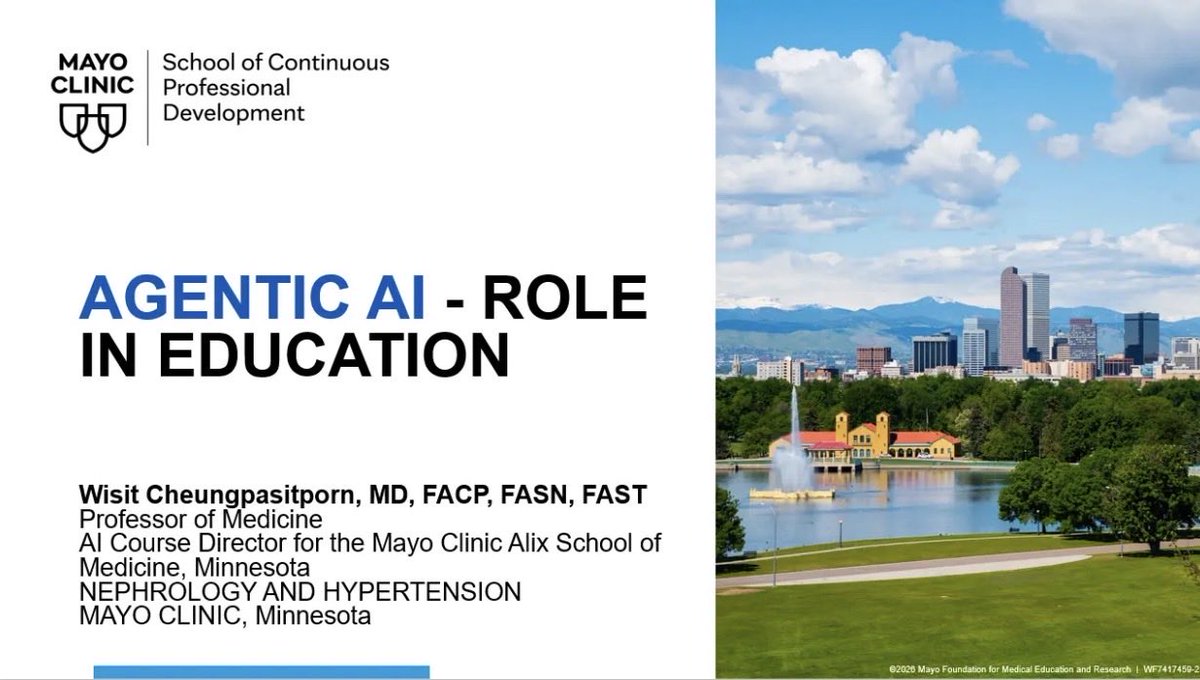
😃😊 Just wrapped up my presentation on “Agentic AI – Role in Education” here at the Mayo Clinic Faculty Development 2026 conference in Denver! 🏔️🎓
Thank you to everyone who attended and contributed to such a dynamic discussion. The thoughtful questions and insights from the room truly highlighted both the immense excitement and the profound responsibility that comes with integrating AI into medical training.
💡 During our session, we explored:
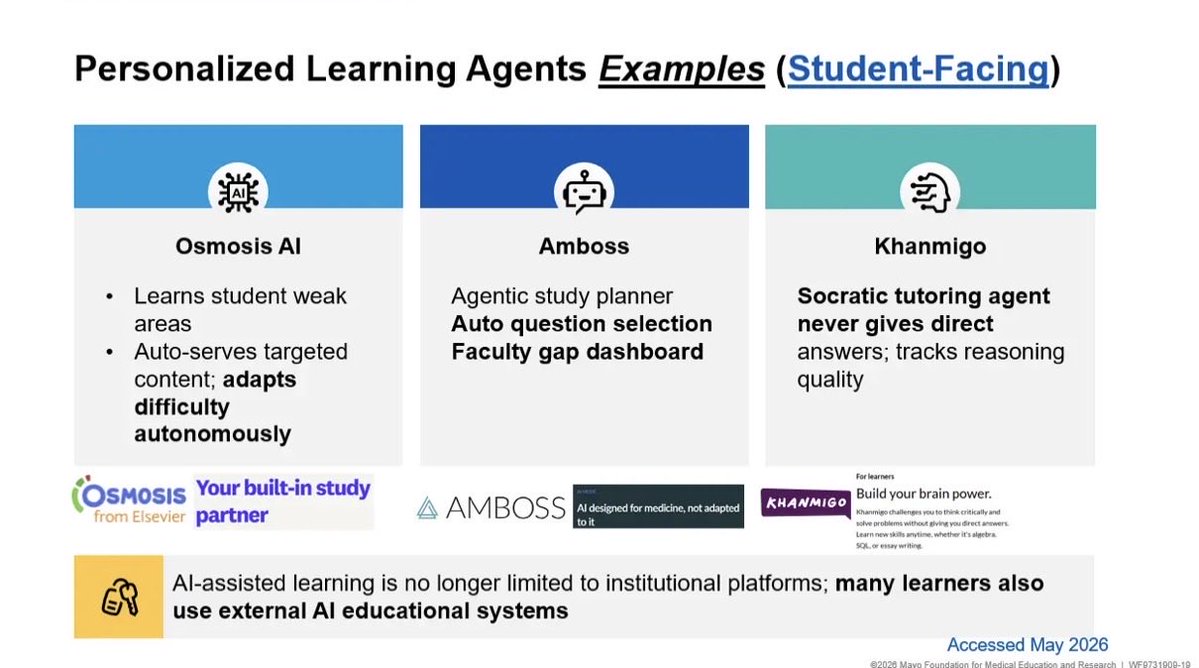
🔹 The Evidence: The current data supporting the use of AI agents in education.
🔹 Adaptive Pathways: Designing personalized learning and AI-powered coaching systems.
🔹 Cognitive Augmentation: How AI can actively stimulate deeper reading, critical thinking, and clinical reasoning.
🔹 The Reality Check: Navigating the real-world opportunities and limitations of agentic AI in healthcare training.
My biggest takeaway from the morning: AI should never replace educators. Its true power lies in amplifying great teaching, personalizing the learning journey, and helping trainees develop stronger reasoning skills—all while keeping human mentorship firmly at the center.
I am so encouraged by the enthusiasm from educators across Mayo Clinic and beyond as we collectively shape the future of medical education. Thank you to the Mayo Clinic School of Continuous Professional Development and all the participants for an outstanding session!
Now, time to get outside and enjoy a bit of that crisp Colorado air! 🌲👟
Wisit Cheungpasitporn, MD, FACP, FASN, FAST @MayoClinicNeph
Professor of Medicine & Clinician-Scientist, Mayo Clinic
Leading AI Innovation in Kidney Care & Medical Education
#MayoClinic #MedicalEducation #AgenticAI #ArtificialIntelligence #FacultyDevelopment #HealthProfessionsEducation #InnovationInEducation #FutureOfLearning #AIinMedicine #MedicalEducators #MedEd #Denver
"What can we learn from this crisis to strengthen evidence-use in future policymaking — both in emergencies and in normal times?"
https://t.co/JpB0FuOzWI
@LSEblogs#ResearchImpact#EvidenceBasedPolicy