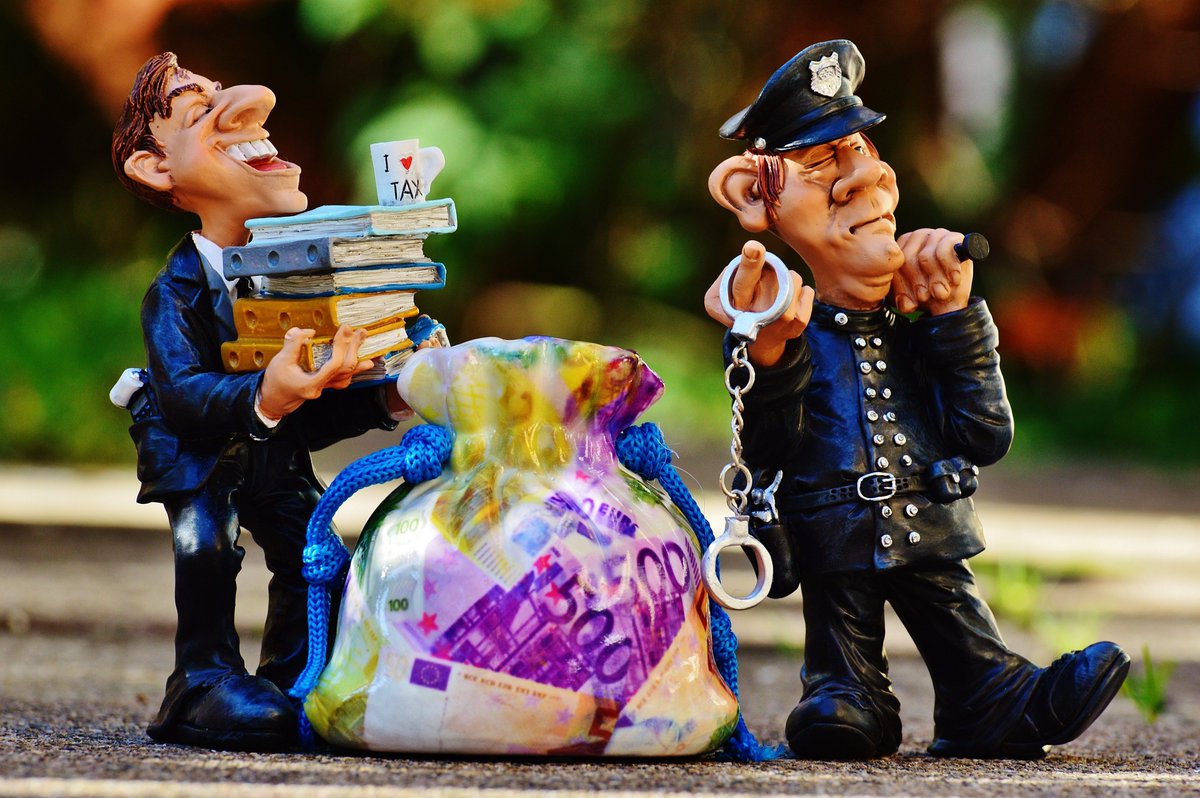
Purbaya. Daripada ente sibuk ngejar yg kecil-kecil kek pajak kontrakan.
Mending terapin pajak kekayaan.
Seluruh orang superkaya, mau dari kubu 9 naga, 9 haji atau 9 jenderal, lu pajakin aset-asetnya.
Cukup 2% aja. Lu bisa dapat ratusan triliun.
Kalau kata CELIOS, jika 50 orang terkaya di Indo dipajakin 2%, potensi penerimaannya 93 T.
Bayangin itu 50 orang doang loh.
Memperluas basis pajak kontrakan bisa mengakibatkan harga sewa kontrakan naik. Siapa yang rugi?
Lagi-lagi kelas menengah di perkotaan. Dan ini bisa bikin situasi di perkotaan makin panas.
Jangan lupa juga, yang lagi punya KPR sedang pusing sama suku bunga tinggi yang ngefek ke bunga floating.
Ilustrasi: ALEXA dan PIXABAY
FOTO: WIKIMEDIA (Fahdi Kasmiri)
Indonesia’s currency slipped to a new record low yesterday, as the country’s stock index fell and global oil prices jumped to two-week highs. https://t.co/l7uUzfdapH
Indonesia continues to notch one grim milestone after another. The latest: losing its status as Southeast Asia’s largest stock market to Singapore. https://t.co/eSrJlOPQqN
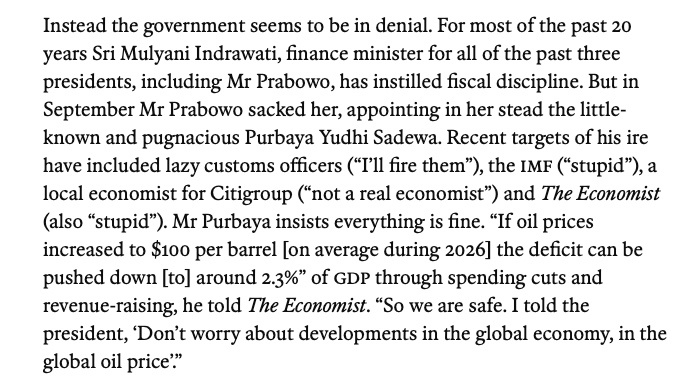
Prabowo Subianto is centralising power, marginalising opposition and spending beyond Indonesia’s means. He could undo 20 years of economic and political progress https://t.co/Qw1r1P5paB
To avoid fiscal calamity, President Prabowo Subianto must change course. To find out how, register to read the full story (it’s free) https://t.co/UfnNVR1UBu
Far too much in Indonesia depends on a thin-skinned former general with a sketchy human-rights record. Prabowo Subianto needs to hear some unpalatable truths https://t.co/8cvnt563TJ
Photo: Getty Images
The last money her father sent her paid for nothing.
She called him on December 26.
She said her leg hurt.
She asked for 2,200 yuan to see a doctor.
He sent it.
That same day, a relative found her photo online.
She was sitting on a sidewalk in Sihanoukville, Cambodia.
Her hair was a mess.
Her sunglasses were upside down.
She was holding an X-ray of her own body.
She could not walk.
She was 20 years old.
Her name is Umi.
She was a Douyin influencer from Fujian, China.
She had more than 20,000 followers.
She posted videos of tattoos, designer bags, and an expensive life.
Eight months earlier, someone told her there was a high-paying job in Cambodia.
She went.
She lied to her family and told them she was working in another Chinese province.
She kept calling home to ask for money.
They kept sending it.
Over time, they sent her more than 80,000 yuan.
The Chinese embassy found her in a hospital on January 3.
She tested positive for meth and ketamine.
Both of her knees were fractured.
Her legs were partly paralyzed — doctors said this happens when someone is locked in one room for too long.
She had no clear memory of where she had been kept.
Her name is Umi.
Most people will stop reading here.
This is exactly where the harder conversation should start.
Cambodia has a quiet, serious problem that English-language media rarely talks about plainly.
The country has become one of the world's biggest centers for human trafficking into online scam operations.
The United Nations estimates that at least 100,000 people are trapped inside Cambodian scam compounds.
Most were lured in with fake job offers.
Most cannot leave.
The irony is that the biggest crime groups running these compounds are Chinese.
Prince Holding Group, based in Phnom Penh, was sanctioned by the United States and the United Kingdom in October 2025 for cyber fraud and human trafficking.
Its chairman, Chen Zhi, was arrested on January 6, 2026 and extradited to China.
U.S. prosecutors also seized $15 billion in Bitcoin from his network — the largest Bitcoin seizure in the history of the Department of Justice.
The victims are also, overwhelmingly, Asian.
Chinese. Vietnamese. Thai. Filipino. Indonesian.
Young people who saw a life on a screen and tried to reach it.
Cambodia is not uniquely evil.
It is a small country that depends on Chinese investment.
Its government has been accused, again and again, of protecting the people who run these compounds.
Over the years, an entire criminal economy has grown inside its borders.
It now makes an estimated $12 to $19 billion a year.
Cambodia's legal GDP is around $47 billion.
Some analysts believe the scam industry alone may be worth up to 60 percent of that.
On April 3, Umi went live online to tell her story.
She spoke in a weak voice.
She said someone she knew had tricked her.
She said her passport was taken.
She said she had been forced into "keyboard work" — the word used inside the compounds for telecom fraud.
The stream was cut after 30 minutes.
Her account was banned soon after.
China has now set a deadline for anyone connected to Chen Zhi to turn themselves in.
Thousands of workers are reportedly leaving the compounds.
But tens of thousands are still inside.
Most have no passport.
Most have no country willing to bring them home.
Somewhere in Cambodia tonight, another 20-year-old is calling her father.
She is asking for money.
Her leg hurts.
Her name is not Umi.
No one will learn it.
Krisis itu pasti multikausal, dan pasti ada dampak dari sisi governance kita yang jelek. Tapi gue ngerasa ini penjelasan yang overrated terkait dampak Krisis 1998.
Ekonom mainstream-pun sangat kritis terhadap peran IMF (meskipun tentu bukan satu-satunya penyebab dan ga ada konspirasi sama sekali) dalam Krisis 1998
Kenapa? Karena ada contoh Malaysia yang governance-nya juga jelek, kapitalisme kroni di mana-mana...
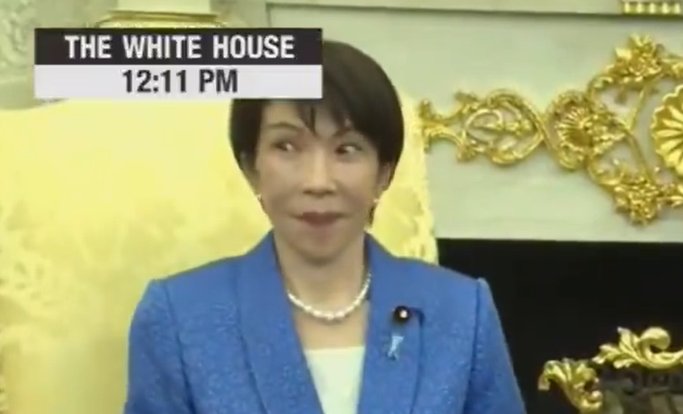
🇯🇵 Takaichi flew 6,000 miles to be humiliated. Pearl Harbor brought up. Lunch canceled. No joint statement.
She went to Washington to explain Japan's limits. Trump spent the meeting mocking them.
82% of Japanese oppose this war. She ignored them.
11,000 protested in Tokyo. She flew anyway.
Now she's signing $40 billion nuclear deals. Tying Japan closer to an empire that just insulted its history.
Takaichi bowed. Trump laughed. Japan paid.
Call it diplomacy. The rest of us call it submission.