@jdpereira I’ve heard often that your publication record is the most important for securing a position in academia. Did you find this difficult to maintain in industry? How did you frame yourself in interviews to appeal to academia?
Undergraduate research opportunities @ScienceUWindsor paid off for recent grad Renée Goodman (BSc 2021), who is heading to @UniofOxford to pursue a PhD in condensed matter physics. @SimonRondeau@ChemUWindsor
https://t.co/zYuMNLMN8f
Nice story in @UWindsor Daily News this morning about R-G group's alumni @ReneeBGoodman who's now heading to @UniofOxford🔥💪 Big thanks for the outstanding work @ChemUWindsor, and all the best in the next chapter! #ProudPI @ScienceUWindsor
link👉https://t.co/5nvHB5PpIZ
Really enjoyed the talks at the 48th Physical Organic Minisymposium (POMS) today! Awesome work by the organizers and a special shout out to our very own Nazir Tahir and @ReneeBGoodman for two awesome talks! Looking forward hearing more tomorrow! #ProudPI#materialschem
Thank you very much for a fantastic event @marcuswdrover and @chitnislab! And thank you as well to @SimonRondeau and @michocheje for all your help mentoring and in the lab which allowed me to present at this event
@lisarose_ltpb @CIC_ChemInst@DaltonTrans@cscinorgdiv @degruyter_phys Hi @lisarose_ltpb, these polymers are usually pretty simple to make, and their synthetic ease is one of the things that makes them so attractive for applications in electronics. Typically we will prepare the polymers on about a 200mg scale however it varies based on our needs.
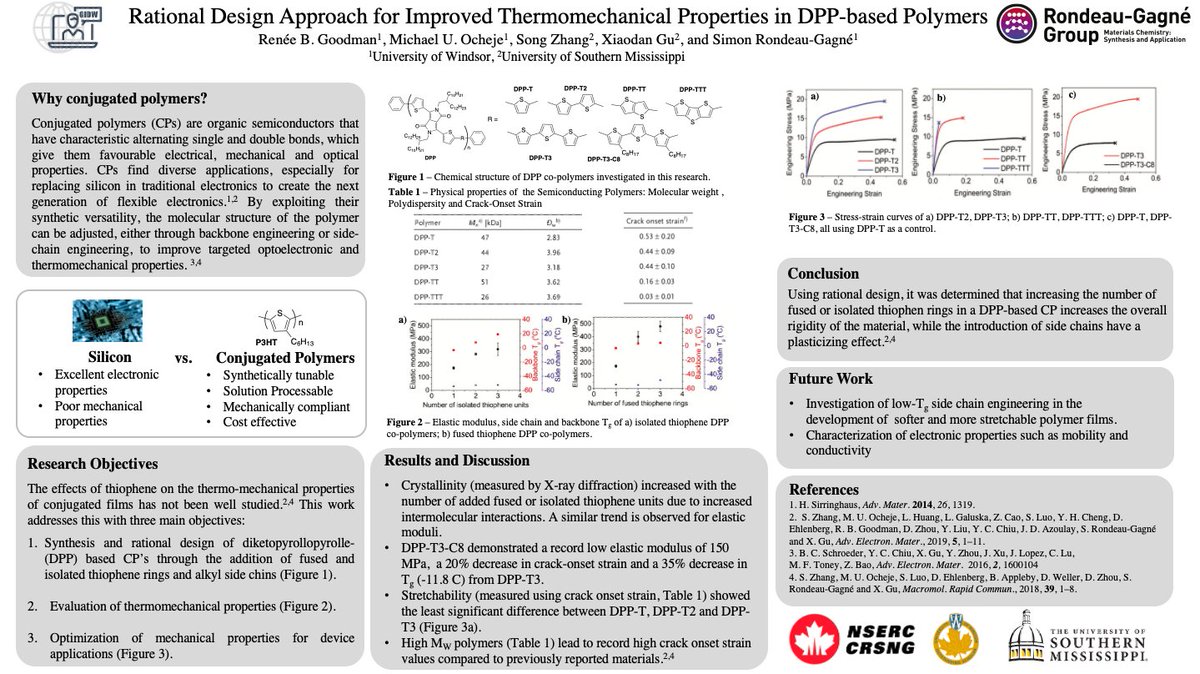
Check out my #GIDW2020 Poster
P51: Rational Design Approach for Improved Thermomechanical Properties in DPP-based Polymers
Thanks @CIC_ChemInst@DaltonTrans@cscinorgdiv and @degruyter_phys for supporting this event!
Looking forward to your questions.
@luppi_bruno@CIC_ChemInst@DaltonTrans@cscinorgdiv @degruyter_phys Hi @luppi_bruno, we typically do our testing on thin films. In this study we used pseudo-free standing thin films (~90nm) to test tensile strength which eliminates the effect of a supporting substrate
@chitnislab@CIC_ChemInst@DaltonTrans@cscinorgdiv @degruyter_phys Good question @chitnislab! More fused thiophenes increase the planarity of the backbone allowing for better pi stacking which decreases the polymer solubility. However alkyl side chains on the DPP monomer allow us to control polymer solubility and solution processability.
@marcuswdrover@CIC_ChemInst@DaltonTrans@cscinorgdiv @degruyter_phys Which tells us how many cycles of strain a material can endure before loosing performance. Another important characterization (mentioned in the poster) is Young's modulus a.k.a "softness" or "brittleness", which we try to match as much as possible to biological tissues. (pt. 2)
@marcuswdrover@CIC_ChemInst@DaltonTrans@cscinorgdiv @degruyter_phys Hi @marcuswdrover thanks for the question! For bio-electronics, typically we look for a strain of around 30% which is enough for electronics that would be worn on places such as your elbow. We also look for things such as durability (pt. 1 of 2)
@ndchiappini@CIC_ChemInst@DaltonTrans@cscinorgdiv @degruyter_phys @ndchiappini Yes! In general adding side chains increases the solubility of the polymer and reduces the crystallinity. You can check out these two papers by our research group for some more info on side chain engineering!
And we've reached 100 participants!! - deadline July 6. if you don't see your nation's flag here (or want to beat Canada??🙃), register now!! 54 🇨🇦 18🇺🇸 10🇬🇧 5🇮🇳 3🇩🇪 2🇧🇪 1🇻🇪 1🇸🇬 1🇲🇽 1🇯🇵 1🇮🇪 1🇫🇷 1🇧🇷 1🇦🇺 #gidw2020@CIC_ChemInst@cscinorgdiv@DaltonTrans@EurJIC@Orgmet_ACS