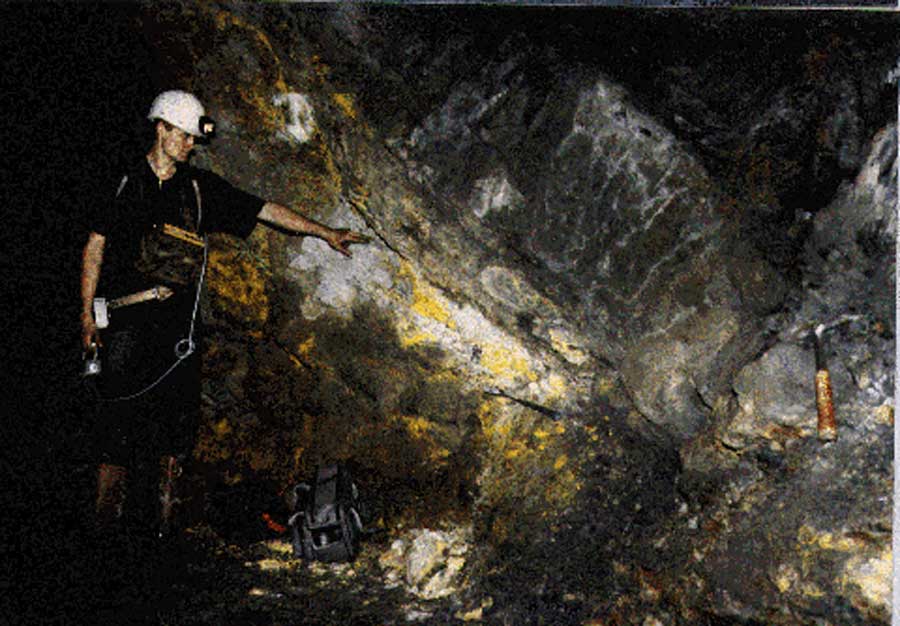
2 billion years ago, a nuclear reactor geologically self-assembled and turned itself on.
No humans were involved. Only rock, groundwater, & natural uranium.
It ran intermittently for hundreds of thousands of years.
Here's the story of Oklo (not the company, but the place!):🧵
🚨BREAKING: A cognitive scientist from MIT has mathematically proven that evolution guarantees we see zero percent of true reality, that most consciousness in the universe exists without a body, and that non-human intelligences with a wider window on reality than ours can reach in and manipulate it the way a programmer manipulates a video game.
Donald Hoffman (@donalddhoffman) is a cognitive scientist at UC Irvine who has spent 40 years building a mathematical theory of the observer. His work was cited by John Wheeler in the "It From Bit" paper. He studied under Marvin Minsky at MIT, spent two decades secretly meeting with Francis Crick to study consciousness, and has nine specific mathematical conjectures on the table that would derive general relativity, quantum field theory and the Big Bang from a single framework. The top high-energy physicists in the world, Nima Arkani-Hamed and Nobel laureate David Gross, are already saying spacetime is doomed. Hoffman thinks he knows what replaces it.
This interview is the first time he has publicly laid out what his mathematical model explains about alien life, embodiment and the structure of reality.
It already derives time dilation and quantum wave functions directly from differences in observer window size. Physics has spent a century failing to solve the measurement problem because it has been looking in the wrong place. The observer has to come first, and no physicalist framework can get you there.
A consciousness with a larger observer window has access to the underlying structure of our reality in ways we can't perceive or counter. A craft going Mach 40 instantaneously in our headset could be a leisurely maneuver in theirs.
The implications for UAP and alien life are immense.
Embodiment, being locked into a body with fingers and toes as your only interface with the world, is a probability zero anomaly in the full space of possible minds. He also says current large language models are dumber than cucumbers. His new framework, the recursive trace logic, is a completely different architecture, and some of the biggest names in frontier AI have already come to him about it.
The framework has no ceiling, and the implication is a single unified consciousness exploring itself through an unbounded number of perspectives, each one capable of waking up.
Death, in this framework, is just the closing of an icon on the desktop.
Full conversation is live now.
1. Smart people are often, if not usually, very irrational. I grew up with a mid-140s-IQ-tested dad who believed in Biblical literalism. Intelligence is just a powerful engine, it says very little about your ability to steer.
2. Most prestige in our civilization is built around powerful engines. You get good test scores, pass hard classes, you are 'smart', and we stamp you with phDs and titles like Economist or whatever.
3. (Having well-rounded skills can help but does not save you. You can be a charming top-tier artist who still falls for a crypto scam).
4. Our civilization has very little explicit study into being *rational* - which is, imo, something like 'holding true beliefs'. You might be like 'well 'true' is relative', it's people just disagreeing about values all the way down - but I think this is wrong! There *is* such a thing as 'correct' - you can do things like cure cancer or lift people out of poverty, those are real things!
5. If we want to optimize for people steering in correct directions, we might do things like "have them make predictions about the way things will go, and then track how accurate they are." We might force them to "make beliefs pay rent", where you regularly put your beliefs into positions with high stakes so you can't just conveniently 'not notice' when you're wrong. There's a *ton* of stuff to do in this domain that is completely abandoned by people in academia (though you can find it in stuff like investment funds where they actually end up hurting if they're wrong).
5. When I say smart *and* rational, I mean people who are very good at steering in correct directions, with enough power to get there. I don't think most people in this culture even have a conception of these as meaningfully different!
As I’ve noted: every billionaire is retarded. If sh*t hits the fan, Argentinians will just kill him & take his stuff. If you had $20B you should build a compound in Appalachia, subsidize the ~5,000 ppl in town via a make work company that loses $20M/yr
THOSE ppl will defend you
The Pope issued an urgent warning to "slow down" AI before it "dominates humanity"
WHY THIS IS UNUSUAL:
>A pope only writes a few encyclicals in their entire life (papacy)
>It's a formal letter to the entire Catholic Church (1.4 BILLION people) laying out official teaching on a major issue
>Unlike a speech or interview, it becomes part of Catholic doctrine
>The Pope decided to present this next to... an AI safety researcher?! Chris Olah is one of the most respected technical AI safety researchers alive - he basically invented mechanistic interpretability ("neuroscience but for AI"). The Vatican could have put anyone there, but they picked someone from the heart of the technical safety community, which is a major endorsement
>He signed it May 15 - exactly 135 years to the day after Pope Leo XIII signed Rerum Novarum in 1891. Rerum Novarum, according to Claude, is the single most important Catholic social document ever written - it created modern Catholic social teaching and shaped labor law across the West. By picking that date, Leo is saying, basically, AI is to our era what industrial capitalism was to 1891
QUOTES:
"Artificial Intelligence now demands to be disarmed, freed from logics that turn it into an instrument of domination, exclusion and death."
"It is not permissible to entrust irreversible, lethal decisions to AI systems."
"The main drivers of development are private, often transnational, parties that are endowed with resources and the capacity to intervene that surpass those of many Governments."
"Never has humanity had such power over itself."
"It is not enough to invoke ethics in the abstract; robust legal frameworks, independent oversight, informed users and a political system that does not abdicate its responsibility are required."
"Current AI systems are more 'cultivated' than 'built,' for developers do not directly design every detail, but instead create a framework within which the intelligence 'grows.'"
"we cannot allow a handful of actors to dictate [the future of AI]"







![AISafetyMemes's tweet photo. The Pope issued an urgent warning to "slow down" AI before it "dominates humanity"
WHY THIS IS UNUSUAL:
>A pope only writes a few encyclicals in their entire life (papacy)
>It's a formal letter to the entire Catholic Church (1.4 BILLION people) laying out official teaching on a major issue
>Unlike a speech or interview, it becomes part of Catholic doctrine
>The Pope decided to present this next to... an AI safety researcher?! Chris Olah is one of the most respected technical AI safety researchers alive - he basically invented mechanistic interpretability ("neuroscience but for AI"). The Vatican could have put anyone there, but they picked someone from the heart of the technical safety community, which is a major endorsement
>He signed it May 15 - exactly 135 years to the day after Pope Leo XIII signed Rerum Novarum in 1891. Rerum Novarum, according to Claude, is the single most important Catholic social document ever written - it created modern Catholic social teaching and shaped labor law across the West. By picking that date, Leo is saying, basically, AI is to our era what industrial capitalism was to 1891
QUOTES:
"Artificial Intelligence now demands to be disarmed, freed from logics that turn it into an instrument of domination, exclusion and death."
"It is not permissible to entrust irreversible, lethal decisions to AI systems."
"The main drivers of development are private, often transnational, parties that are endowed with resources and the capacity to intervene that surpass those of many Governments."
"Never has humanity had such power over itself."
"It is not enough to invoke ethics in the abstract; robust legal frameworks, independent oversight, informed users and a political system that does not abdicate its responsibility are required."
"Current AI systems are more 'cultivated' than 'built,' for developers do not directly design every detail, but instead create a framework within which the intelligence 'grows.'"
"we cannot allow a handful of actors to dictate [the future of AI]"](https://pbs.twimg.com/media/HJLS9AdbEAAmtPv.jpg)


