Jimi Hendrix in his hussar jacket outside 34 Montagu Square in Marylebone, London, in February 1967, during a photo session with Bernard Wagner.
The basement flat behind him belonged to Ringo Starr, who sublet it in December 1966 to Hendrix and his girlfriend Kathy Etchingham, along with his manager Chas Chandler and Chandler's girlfriend Lotta Null. Hendrix had arrived in Britain only a few months earlier, and things were moving fast. By January 5, 1967, the Experience's first single, "Hey Joe," had peaked at No. 6 on the UK chart. While living here he wrote "The Wind Cries Mary," reportedly after an argument with Etchingham about her cooking. The band was in the middle of making Are You Experienced, recorded between October 1966 and April 1967, and "Purple Haze" came out in the UK on March 17, 1967, climbing to No. 3. Antique military jackets were a Swinging London fashion at the time, sold at boutiques like I Was Lord Kitchener's Valet, and Hendrix, a former soldier himself, was photographed in hussar uniforms again and again.
🎸 Jimi Hendrix wrote "The Wind Cries Mary" while living in Ringo Starr's old flat at 34 Montagu Square. Did you know Ringo was once Jimi's landlord? 🎸
Captured by Bernard Wagner.
The Arcane Texas Fact of the Day is a story about my favorite Texas governor of all: James Stephen Hogg. Governor Hogg did much of his own clerical work in order to save money for the state.
In 1893, Governor Hogg ---- who ran the entire Executive Department with one secretary, a typist and a porter ---- was finally prevailed upon to request a $1500 dollar appropriation for a file clerk. The Legislature approved the request, but the Governor then vetoed it because funds in the state treasury were low. "I can and will add one or two more hours of service a day for myself and other employees of the department and do some extra work," the Governor said.
Shown here: Jim Hogg with his daughter Ima Hogg, 1883.
This 1964 photograph shows the iconic Hollywood actress Jayne Mansfield alongside her husband, the Hungarian-American bodybuilder and actor Mickey Hargitay (winner of the Mr. Universe title in 1955), holding their young daughter Mariska Hargitay in his arms.
During the 1950s and 1960s, Mansfield established herself as one of the leading glamorous figures in American cinema and a cultural icon of the era, while the couple projected the image of a prominent family in the entertainment industry to the media.
Tragically, Jayne Mansfield’s life was cut short in June 1967 due to a brutal car accident while she was traveling at night to New Orleans.
Also in the car were three of her children, including Mariska, who was just three years old; they miraculously survived in the back seat with only minor injuries, unlike the three adults in the front who died instantly.
Despite this traumatic event during her childhood, Mariska Hargitay carried on her parents’ artistic legacy and forged a distinguished career of her own in television. She became an internationally acclaimed actress, best known for portraying Detective and Captain Olivia Benson on the crime series "Law & Order: Special Victims Unit" for more than two decades, a role that has earned her Emmy and Golden Globe awards.
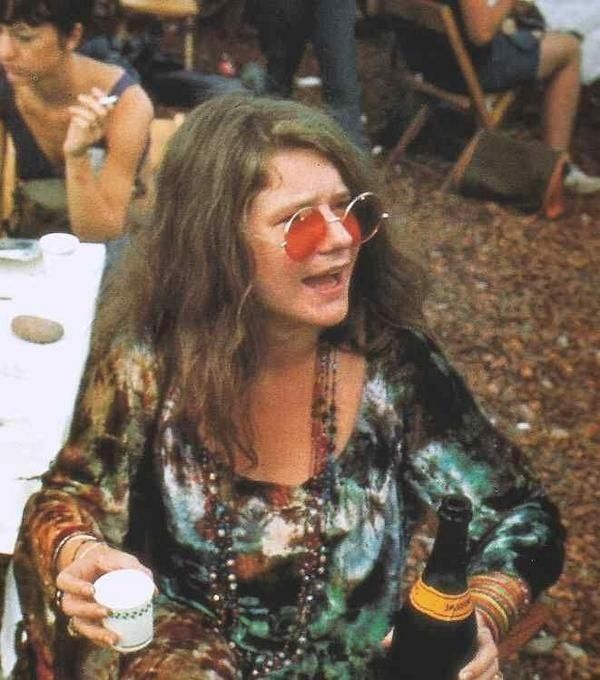
Janis Joplin in the performers' pavilion at the Woodstock festival in Bethel, New York, in August 1969, round tinted glasses on, a cup in one hand and a bottle of champagne in the other.
By that summer she had left Big Brother and the Holding Company and was fronting her new group, the Kozmic Blues Band. Getting to the farm was an adventure in itself. She was flown in by helicopter with Joan Baez and Baez's mother, and the sight of the enormous crowd from the air made her nervous and giddy, as Baez later recalled. Bands ahead of her on the bill were contractually obliged to play first, so she faced a wait of about ten hours backstage before finally taking the stage at around 2 AM on Sunday, August 17. She was unhappy with her set and insisted that her singing be left out of the 1970 documentary and its soundtrack, although the 25th anniversary director's cut of the film includes her performance of "Work Me, Lord." She stayed for the rest of the festival, and on Monday, August 18, she was among the performers standing in a circle behind Crosby, Stills & Nash.
🎸 Janis Joplin waited about ten hours backstage before her Woodstock set. Would you have braved the mud and the wait to see her? 🎸
Captured by Elliott Landy.
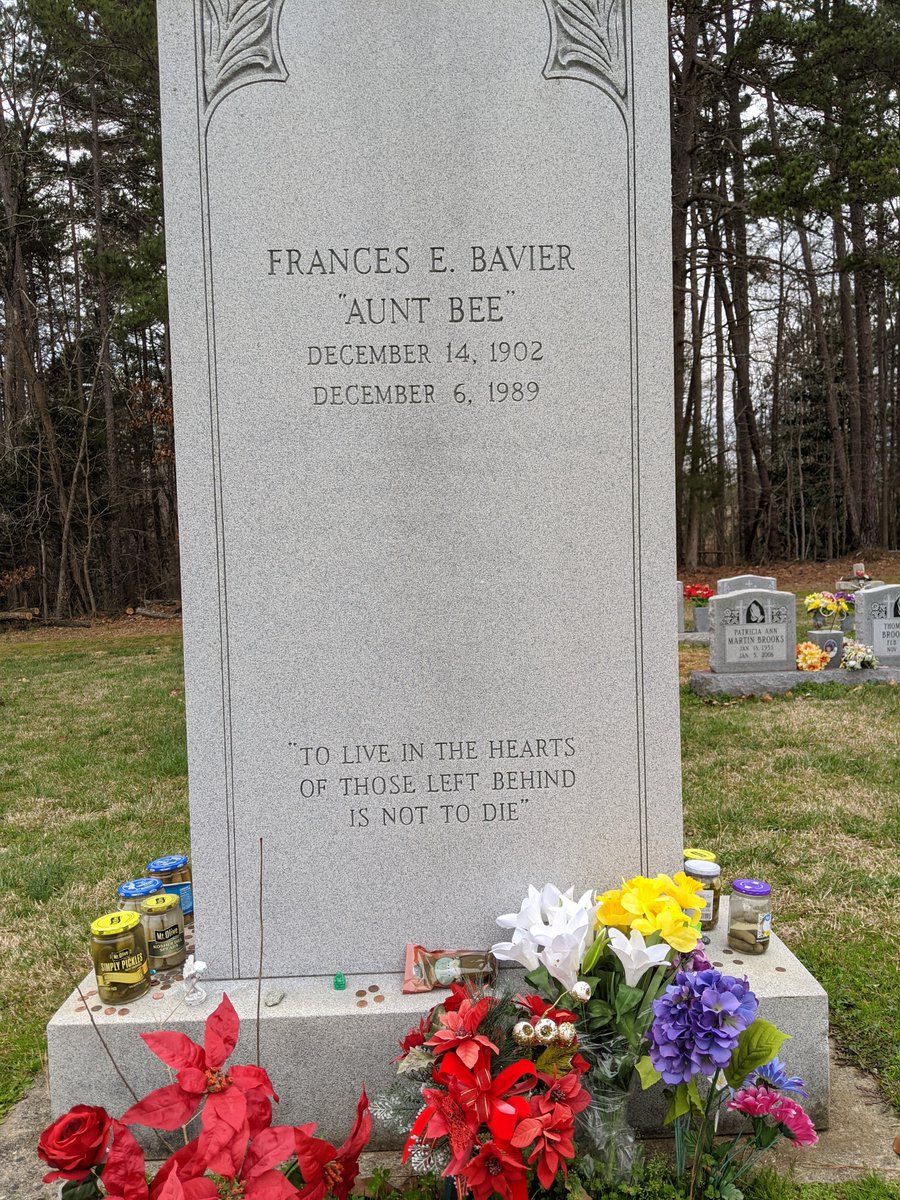
I pass near actress Frances Bavier's Siler City grave frequently over the course of a year and I'll stop 2-3 times annually to pay respects and see what other well-wishers have left at her grave. There are usually pickles left as a tribute to the notable Andy Griffith episode in which Aunt Bee made awful inedible pickles.
🎯 Before he was Paladin on Have Gun – Will Travel, Richard Boone was a tail gunner in the Pacific.
He was born in Los Angeles in 1917. He dropped out of Stanford and worked as an oil rigger, a bartender, and a painter.
In 1941, he joined the Navy. He served on three ships in the Pacific and flew combat missions as a tail gunner in Grumman Avenger torpedo bombers, the most exposed seat on the plane.
After the war, he turned to acting. In 1957, Randolph Scott was offered the role of a gentleman gunfighter named Paladin. Scott turned it down and passed the script to Boone.
Have Gun – Will Travel ran six seasons and became one of TV’s most popular westerns.
The man in black with the business card had already seen the real thing.
Have Gun or Medic? Which one do you remember? 👇
John Wesley Powell lost his right arm to a bullet at the Battle of Shiloh in 1862. The surgeons amputated it below the elbow. He went back to the war anyway and fought at Vicksburg.
Seven years later, he decided to do something nobody had ever done: take boats down the Green and Colorado Rivers, straight through the Grand Canyon. At the time, that stretch was literally a blank spot on the map. Some people believed the river disappeared underground or plunged over giant waterfalls.
In May 1869, Powell set off from Wyoming with nine men and four wooden boats. Most of them had zero whitewater experience.
Two weeks in, one of the boats smashed apart on the rocks and took a huge chunk of their food and gear with it. They named the spot Disaster Falls. One man had seen enough and walked out a few weeks later.
At one point Powell was scaling a cliff and got stuck on a ledge, hanging on with his only hand, unable to go up or down. One of his men climbed above him, took off his long underwear, and lowered it down so Powell could grab on and be pulled to safety.
By August they were deep inside the Grand Canyon. The flour was moldy. They were living on bad bread, dried apples, and coffee. Their clothes were rags. The rapids kept getting worse, and nobody knew how much canyon was left.
Then they reached a rapid so violent that three men said they were done. They would climb out of the canyon and walk to the nearest settlement instead. Powell couldn't talk them out of it. The two groups shook hands, the three men took a rifle and some letters to mail home, and climbed up the canyon wall.
Powell and the others ran the rapid and made it through. The very next day, they floated out of the Grand Canyon.
The three men who climbed out were never seen again.
Powell went on to run the U.S. Geological Survey and spent years warning Congress that the West didn't have enough water to support the kind of growth everyone was planning. They ignored him.
Today the second largest reservoir in the country is named after him. Lake Powell. A man who warned about water shortages, now best known for a lake that's been shrinking for decades.
The Arcane Texas Fact of the Day:
Barton Springs in Austin is actually not just a single spring but a complex of three springs. The Parthenia, Eliza, and Zenobia are the names of three natural springs located in Zilker Park. These springs were named by William “Uncle Billy” Barton, who purchased the land in 1837, in honor of his three daughters. . For generations, the story was that William Barton named three springs after his daughters Parthenia, Eliza, and Zenobia. But Austin Parks and Recreation investigated the story and discovered that Barton had no daughter named Zenobia His three daughters were actually Parthenia, Eliza, and Minerva. Nobody knows for certain how Zenobia Spring got its name. One particularly remarkable fact: Historical measurements of the amount of water emitted by the springs have ranged from approximately 6.2 million gallons to 107 million gallons per day, depending largely on rainfall and aquifer conditions.
The British army once sentenced Daniel Morgan to 500 lashes, a punishment that usually killed a man, for the crime of knocking out an officer who struck him. He survived every stroke. And he spent the rest of his life joking that the drummer had miscounted and only given him 499, so the British still owed him one. He collected that debt at a place called Cowpens.
Morgan was not born to anything. He was a rough, barely educated frontiersman who made his living hauling freight by wagon on the Virginia frontier, a big, powerful, hot-tempered young man. During the French and Indian War, serving as a civilian teamster with the British army, a British lieutenant struck him with the flat of a sword. Morgan answered with his fist and dropped the officer cold. For a colonial to strike a British officer was close to a capital offense, and the court-martial sentenced him to five hundred lashes with the cat-o'-nine-tails, a flogging meant to flay a man and very often to kill him.
They tied him up and laid it on, and Daniel Morgan did not die. He carried the ridged scars on his back for the rest of his life. But instead of breaking him, that brutal punishment forged something. It left him with a cold, permanent hatred of the British army and its contempt for colonial men like him, a hatred he would one day repay with interest. And it gave him his lifelong joke: the drummer lost count and stopped at 499, so the British, he liked to say, were still one lash short of paying him in full.
When the Revolution came, that uneducated wagoner turned out to be a natural soldier of rare gifts. He raised a company of frontier riflemen, crack shots who could kill at distances that terrified British regulars, and he led them north to Saratoga, where his marksmen helped shatter Burgoyne's army and win the turning-point victory of the war. Morgan had a feel for battle that trained European officers lacked, an instinct for ground, for timing, and above all for the men he led. He understood that his militia were not professional soldiers and could not be asked to do what professionals did, so instead of cursing them for it, he built his tactics around what they could do.
That genius reached its peak at the Battle of Cowpens in January 1781, one of the most perfectly fought battles in American history. Facing the dreaded Banastre Tarleton, Morgan set a trap built entirely on human nature. He put his unreliable militia in the front line and asked them only for two volleys, then permission to fall back, which they gladly did. Tarleton's British, seeing the Americans retreat, charged forward in a confident rush straight into Morgan's real line of hardened Continentals, and then Morgan sprang the jaws, hitting the British on both flanks at once in a double envelopment while his cavalry rode down their rear. In minutes Tarleton's command was destroyed, hundreds killed and captured, one of the most crushing and complete victories of the war, and Tarleton himself barely escaped. It was the frontier wagoner out-generaling the darlings of the British army.
So the debt was paid. The boy they tried to flog to death grew up to be the man who methodically dismantled the British in the field, who understood soldiers because he had been treated like dirt as one, and who turned the hard lessons of his own back into some of the finest tactics the Revolution ever saw. Remember Daniel Morgan. The British gave him 499 lashes and made an enemy who never forgot, and he collected the last one at Cowpens, with interest.
On a quiet Sunday afternoon along the Cumberland River, Jerry Reed was celebrating with his seven-year-old daughter Seidina.
She’d just hauled in the biggest carp her father had ever seen, using nothing but a tiny green pole. They were still laughing over the catch when a figure came running down the dock, calling for him.
Elvis Presley was in town.
At RCA Studio B in Nashville, the King had been trying all day to cut Reed’s song “Guitar Man.” He’d fallen for the original the moment he heard it on the radio—that driving, restless guitar line that felt like the open road.
The session players were Nashville’s finest: Scotty Moore, Chip Young, Harold Bradley. They could play anything. They just couldn’t play that.
Reed picked with his fingers instead of a flatpick. He tuned the guitar in ways no one else did—raising the B string a whole tone, dropping the low E so he could barre straight across.
The sound was his alone. Producer Felton Jarvis knew it. So did Elvis.
“If you want it to sound like my record,” Reed told them when they finally reached him, “you’re gonna have to get me.”
He left the river in his fishing clothes, unshaven, still wearing the old clogs he’d had on all weekend. When he walked into the studio, Elvis took one look and said, “Lord, have mercy, what is that?”
Then Reed hit the opening lick. Elvis’s face lit up. From that moment the session belonged to the two of them—Reed coaching, pushing, driving the band while Elvis sang with a fire they hadn’t heard in a long time.
They got the master on the twelfth take. Reed later overdubbed a little more guitar, and the track was trimmed, but the heart of it was already there: one man’s fingers on a strangely tuned guitar, turning a modest country single into the last country number one Elvis would ever have.
Nobody else in that room could have played it. The King of Rock and Roll had the best players in Nashville at his disposal that day.
He still sent them looking for the guy who’d just been out on the river with his daughter and a little green pole.