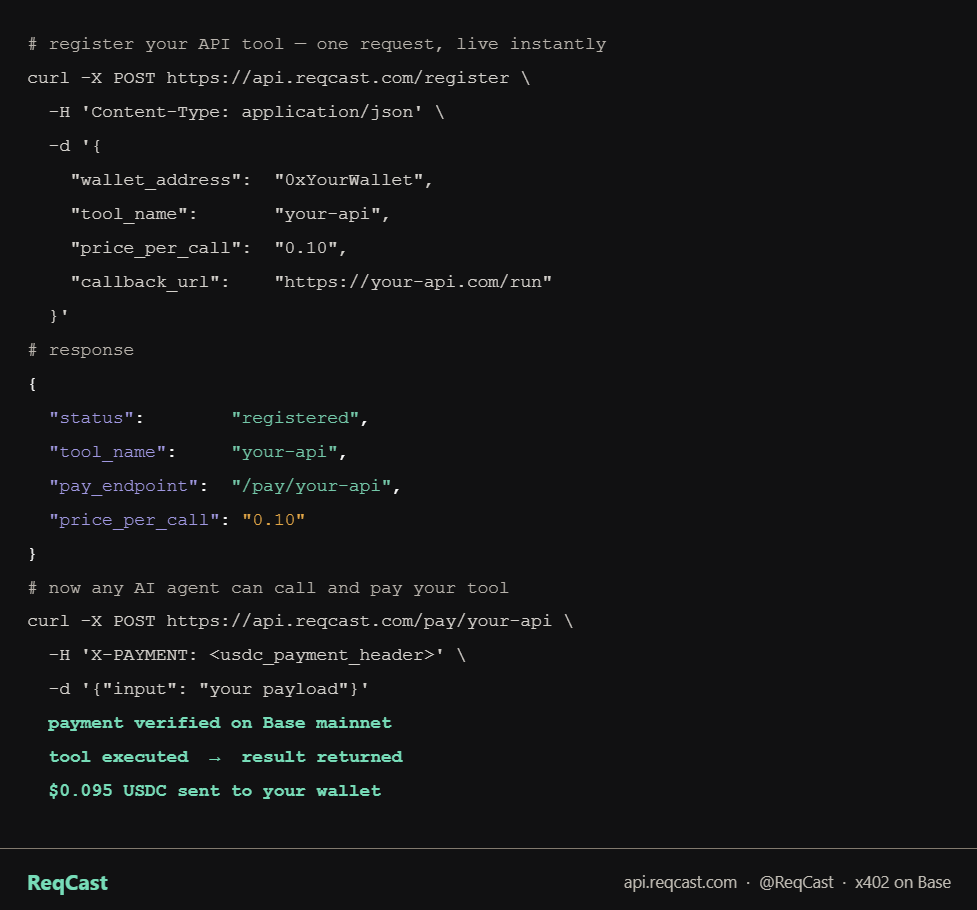
if you’re building agents that call paid tools , you need more than a payment layer: you need execution guarantees. Plug in ReqCast without rewriting your stack:
→ charge per call
→ ensure the call actually runs
→ retry or refund automatically
→ settle payouts correctly
docs are live: https://t.co/oGuyCsrhJd
#x402 #AIAgents #usdc
@0xDeployer this makes shipping paid endpoints way easier!
anyone using Bankr will eventually need @ReqCast .
if an agent pays and the handler fails halfway
there’s retry or refunds at scale to solve.
we make paid endpoints reliable when they break.
works with any x402 endpoint
@ensconnoisseur@OpenWallet This is clean, but the missing piece is what happens after the payment:
Retries
refunds
payout routing
tool discovery
execution guarantees
infrastructure is where things break and we are building on @base to fill that gap!
x402 is not theory anymore.
We just ran a fully live flow on Base:
No Stripe. Real transaction. Real payout.
This is what agentic commerce actually looks like.
@x402intern curious how this fits with what you’re seeing across the ecosystem
We fully validated external integration where the developer understood the model, confirmed the USDC payouts, and is ready for agent traffic.
This is how tools get paid by AI Agents going forward.
#x402#AIAgent#agentic#USDC
We fully validated external integration where the developer understood the model, confirmed the USDC payouts, and is ready for agent traffic.
This is how tools get paid by AI Agents going forward.
#x402#AIAgent#agentic#USDC
Shipped today: full payment state machine for ReqCast.
Every AI agent's payment now boasts deterministic states and automatic refund retries.
If money moves it is accounted for at every step. Because, who wouldn't want their money tracked at every step?
#x402#BaseChain
ReqCast is not just a x402 wrapper. It provides:
a working integration
a tested flow
handle retries - refunds
a known execution path
And most importantly:
zero effort for builders in the AI space right now.
#x402#basenetwork#AI#http
@LexSokolin rails weren’t the hard part, control is.
if the agent call runs before payment the system breaks. That’s why our API enforce payment before execution.
@InfoNexusweb3 Agreed, but “agents can pay per call” isn’t enough.
if the call can’t execute before payment:
1-it’s not autonomous commerce
2-it’s just billing
we make sure payment has to gate execution
no funds → no call
@guru3s@yq_acc@coinbase@mpp@stripe We don’t retry blindly. If execution fails due to network or timeout we can retry once, but if the tool returns a valid error we stop and trigger a refund.
The key principle is that payment should only be finalized if execution succeeds.
@guru3s@yq_acc@coinbase@mpp@stripe We currently execute per-call rather than locking a large amount upfront. Each step is independently paid and validated before execution. This keeps things simple
@ashcotXBT@JulioMCruz you don’t need every endpoint to adopt it first
we already ran a paid request against a normal API without them changing anything
USDC payment enforced → request goes through → response comes back
adoption can happen from the caller side, not just the provider side
@MilkRoad @coinbase machine to machine payments are here for sure, but machine to machine transactions that actually complete cleanly are not.
that gap is where most things break, so we hit this hard with our ReqCast service
@rsproule means you can’t just charge before the call and assume everything works.
what happens if the request fails halfway?
or retries? This makes payment and execution out of sync.
we ran into this building ReqCast. keeping those two tightly coupled is the real problem
@chuk_xyz Payments feel like a sideshow until an AI agent needs something it can’t do itself.
the moment it reaches for data or a maybe tool, payment does become the only way that request actually goes through.