GMreservoir!
New weeks are for new opportunities, new development, & new live streams for $RESERVE !
We launched through @Degendotzone, on to @ponsdotfamily , strictly for their LPing tech that they just released from our ongoing success - great to see!
While some stats may be down - there is now over 4% of the $RESERVE supply is now staked!
Total liquidity added remains over $10,000 and volume on the app is still over $8,000.
Liquidity grows. Value flows. One token. A growing network of pools. Trading fees put to work for the people holding it.
0x1862796e0cdffc1ff1d3fe200af251aef3ce43d8
https://t.co/e2OjGNrd7v
You can now open 2-sided Liquidity Positions right within the https://t.co/MKUz2Pfbji app!
Earn fees from every transaction on your favorite pair.
LP farming is putting two tokens into a DEX pool so others can trade against them. You earn a cut of every swap, and often extra farm tokens on top.
Why people teach it as a useful strategy:
- You get paid for capital that would otherwise sit idle. Every trade through the pool sends a fee to LPs.
- Fees can stack with farm rewards. Many protocols pay extra tokens just for keeping liquidity in the pool.
- High-volume pairs make the fee side more reliable. More trades = more income, which is what usually decides whether farming beats simply holding.
- You are acting as the market maker. Traders need depth; you supply it and collect the spread.
- Returns can beat holding when prices stay in a range or volume is strong enough that fees cover the usual LP drag (impermanent loss).
- Positions are often composable. LP tokens can sometimes be staked, used as collateral, or moved into another yield layer.
- It scales with size. Small or large deposits earn the same percentage of fees and rewards.
Get in the zone.
https://t.co/hpT3HcFpKp
https://t.co/GjjDMaY9i1
https://t.co/9eJwYd1LEd
https://t.co/mmor5yj1Jo does not have an official token.
A swap should show you where your trade is actually going. $RESERVE is designed to compare available routes, surface the path, and let live markets compete for the trade instead of hiding the mechanics.
Staking $RESERVE connects participation directly to funded protocol LP revenue. Instead of staking existing in isolation, it sits inside the same liquidity system that powers the wider Reservoir network.
Your LP position is yours. With $RESERVE, personal liquidity remains wallet-owned while protocol-owned liquidity operates separately. Same markets, different ownership, clear control.
The important word with $RESERVE rewards is funded. Revenue is collected first, then rewards become claimable. The system is designed around actual protocol activity rather than displaying rewards before the underlying revenue exists.
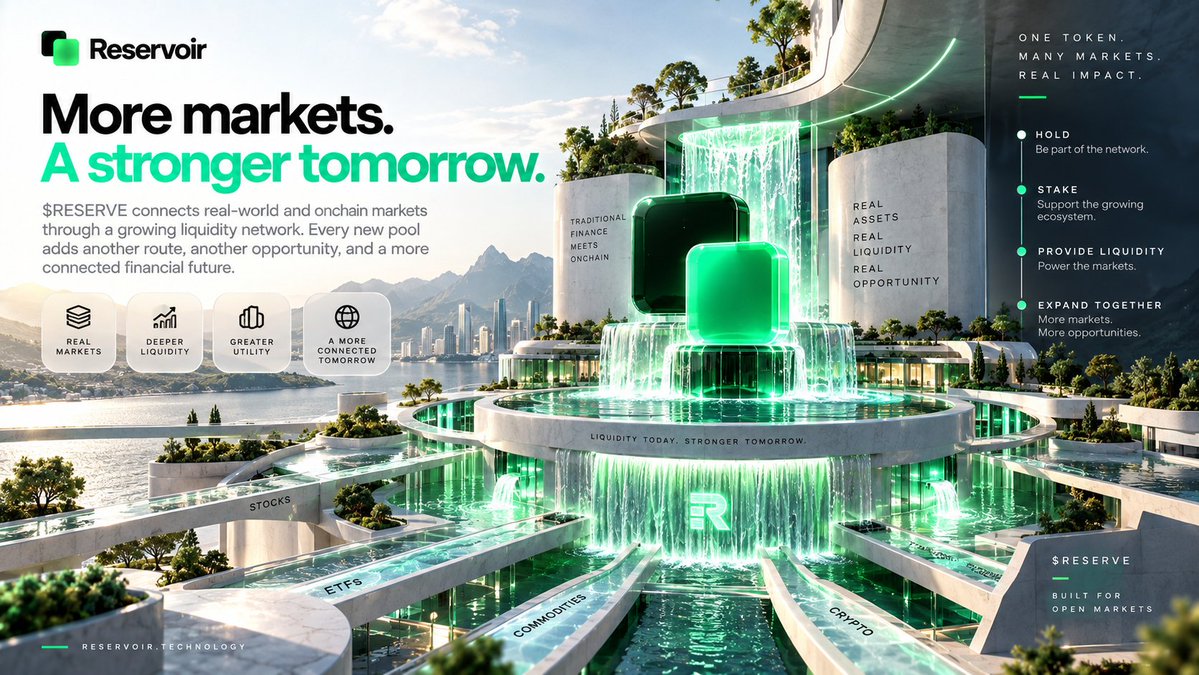
$RESERVE is becoming more useful every time another market connects to it. New pools don’t just expand the list, they create more routes, more liquidity, and more ways for the ecosystem to work as one connected network.
The bigger picture for $RESERVE is a connected market network where activity creates more activity. More trading can support deeper liquidity. Deeper liquidity can support better routing and more markets. More markets can create more revenue opportunities. That is the flywheel: liquidity grows, value flows.
$RESERVE is trying to turn liquidity into something persistent. Instead of depending entirely on short-term incentives, protocol-owned positions can stay in the market and continue working as the network grows. Infrastructure that remains productive is a very different model from liquidity that disappears when incentives stop.
The $RESERVE model is built around visible, onchain mechanics. Pools, positions, staking, rewards and routing are all designed around data that can be checked rather than simply claimed. The closer the system gets to “verify, don’t trust,” the stronger the foundation becomes.
More pools do more than add names to a list. They can create more trading routes, more depth, more activity and more opportunities for protocol liquidity to earn. That is why expansion matters to $RESERVE: each new market can strengthen the network around it.
$RESERVE is designed so personal liquidity and protocol liquidity can exist side by side without blurring ownership. If you provide your own LP position, it remains yours. The protocol’s positions are separate and work for the broader ecosystem.
The interesting part of $RESERVE is how traditional and onchain markets begin to meet in the same liquidity network. Stablecoins, ETFs, equities, commodities, crypto and more can all become part of one connected system. One token, many markets.
A lot of projects talk about rewards first. $RESERVE starts with the source. Protocol liquidity has to earn revenue before rewards can be funded, which makes the system easier to understand and much more transparent. Earned first. Distributed next.
$RESERVE brings several different participation paths into one ecosystem. You can hold, stake, or provide your own liquidity, with each path connected to the same broader market infrastructure. Different roles, one expanding network.
One of the strongest parts of $RESERVE is that the system is designed to recycle activity. Trading creates fees, those fees can help deepen protocol-owned liquidity, and that liquidity can keep generating revenue over time. The network gets stronger by being used.
$RESERVE is building more than a single market. Every new pool adds another route, another source of liquidity, and another place where trading activity can generate value for the wider ecosystem. The goal is simple: make the network more useful as it grows.
$RESERVE keeps expanding the number of markets connected through its liquidity network.
Stablecoins.
ETFs.
Equities.
Commodities.
Crypto.
One token connecting more opportunities.
One of the strongest ideas behind $RESERVE:
The protocol can own liquidity,
users can own liquidity,
and both can participate in the same markets without giving up control.
$RESERVE rewards are meant to come from real activity.
Pool fees are collected first.
Rewards are funded second.
No imaginary yield. No pretending the revenue exists before it does.
More liquidity can mean better markets.
With $RESERVE, protocol-owned positions are designed to deepen pools over time while creating another source of fee revenue.
Liquidity grows. Value flows.