Your money loses value every year on purpose.
Debt has to keep growing or the system seizes.
When debt gets too big, money gets cheaper so the bill can be paid.
That’s currency debasement.
Gold sits outside that machine.
The Great Financial Reset is what happens when the old debt system can’t stretch anymore.
I track the signals in plain English.
Japan's economy shrank for the first time in a year, and its stock market lost nearly ¥19 trillion (about $119 billion) in a single day.
Stocks fell 1.6% after the latest GDP report came in below forecasts.
Growth was 0.0% for the quarter, against an expected 0.1%.
On an annual basis, the economy contracted 0.1%, when economists had expected 0.3% growth.
Household spending fell 0.3%, as families cut back in the face of higher food and energy prices.
Trade with the rest of the world subtracted another 0.6% from growth, so exports cannot make up for weak demand at home.
Prices across the economy still rose 2.4%.
The weak economy sits on top of more than ¥1,300 trillion (about $8.2 trillion) in government debt.
Japan's 10yr government bond yield is now above 2.8%, which means the government will pay more each time it replaces maturing debt.
The Bank of Japan has no easy way out.
Raising rates could defend the yen and slow inflation, but it would add strain to an economy that is already contracting.
Holding rates low could keep the yen weak and push the cost of imported food and energy even higher.
The risk reaches beyond Japan, because Japanese investors own large amounts of foreign bonds, including U.S. Treasuries.
If higher yields at home draw that money back to Japan, borrowing costs in other countries could rise as well.
💵 If you find the fiat currency central banking system overtly complex, simply refer to the official Monopoly game rule book.
👇👇👇
The Bank never goes broke. If it runs out of physical money, the Banker issues more by writing amounts on ordinary paper (or using substitutes like notes).
Note: This applies only to the Bank, not to players. Players who can’t pay go bankrupt and are out.
Yes, that’s exactly how it works…
We don’t live in a Democracy. We live in a financial system.
Japan's inflation warning limits the case for cheap government borrowing.
For a reset of the fiat currency and debt system, Ueda's remarks show why protecting purchasing power and keeping debt affordable can require different decisions.
At Friday's IMF seminar, Bank of Japan Governor Kazuo Ueda said underlying inflation was expected near 2%, with a risk of rising further as energy costs reach consumer prices, according to Reuters.
He also described wage growth as consistent with that inflation rate, a useful qualification rather than evidence that prices are already rising out of control.
Ueda said emergency measures beyond ordinary interest-rate cuts could be needed after a future shock, but they have limitations and can interfere with smooth trading in government bonds.
The speech announced no interest-rate increase or change to Japan's policy of controlling government-bond interest rates.
The implication is that Japan cannot judge support for government borrowing only by whether it lowers interest costs, because the effects on inflation and the ability to buy and sell bonds matter too.
If inflation requires higher rates later, the government's interest bill can rise as existing debt is replaced, leaving less tax revenue for other spending unless taxes or borrowing increase.
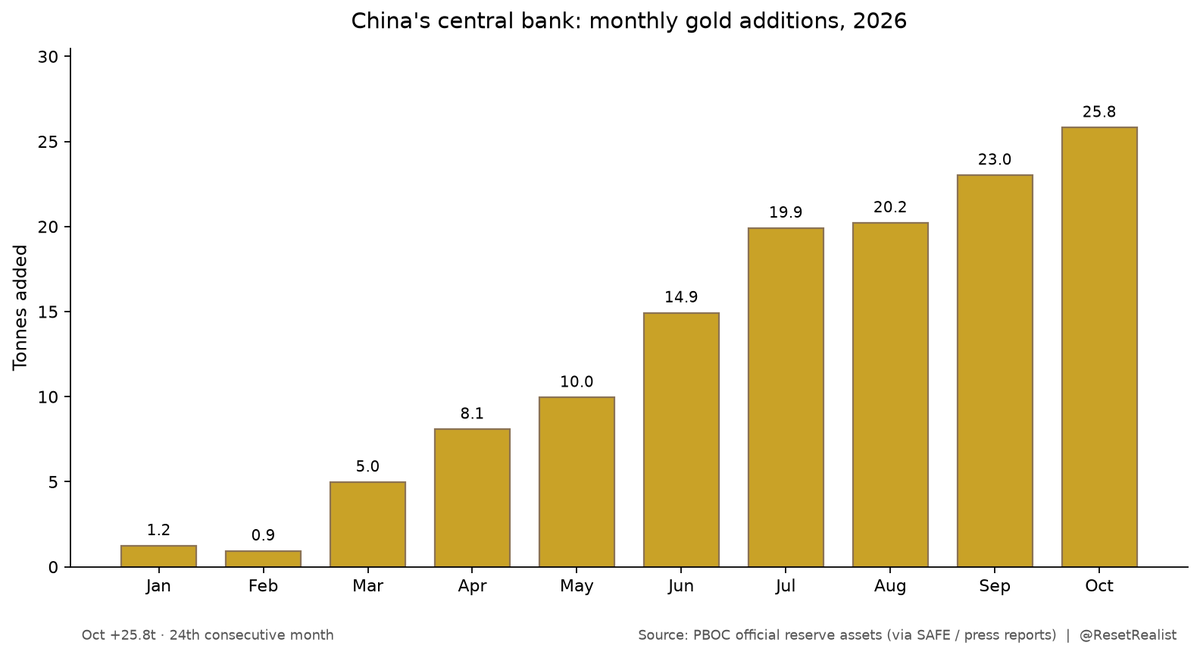
China's central bank kept buying gold through October's selloff.
The People's Bank of China added about 830,000 ounces in October, roughly 25.8 tonnes.
That lifted reported holdings to 78.30 million ounces, about 2,435 tonnes.
It was the 24th straight month of disclosed additions.
Gold fell almost 7% in October and finished the month below $4,000 an ounce, its worst October since 2008.
Beijing bought more ounces in that month than in any other month so far in 2026.
Official buyers who keep adding while the price falls are building a long-term reserve, not trading a short-term drop.
Gold has one feature that government bonds lack, because no government can create more of it by running a larger deficit.
China is not alone in that choice.
Poland's central bank just reached 700 tonnes and has said it may buy more.
The dollar is still at the center of the global reserve system, but some of its largest official holders, China included, are steadily moving part of their savings into an asset outside it.
When the biggest disclosed official buyer keeps adding for two full years, including through a sharp price drop, it shows how central banks now judge the long-term value of currency promises.
3 million Ueno customers lost access to their money in Paraguay, and the president has now been removed.
With pension money in the failed bank, the state's ability to protect savings is being tested alongside its political leadership.
Paraguay's Senate voted unanimously on Friday to remove Santiago Peña, and Pedro Alliana took office that day, according to Reuters reporting.
The central bank had taken control of Ueno on Monday after its measure of financial strength fell below half the legal minimum.
About $800 million in public funds was held at the bank, including roughly $380 million belonging to the state pension and health fund, according to Al Jazeera's reporting.
That pension and health money accounts for almost half the reported public funds, making the recovery of those assets important well beyond Ueno's private customers.
Congress passed a deposit-guarantee law, and payments for small accounts began Thursday, with the first payments covering accounts up to about $1,600.
Deposit insurance covers up to roughly $36,000 per customer and is estimated to protect about 97% of customers in full, although insurance coverage does not mean everyone can already use their money.
Moody's earlier assessment was that the damage could remain manageable if authorities handled the bank's failure in an orderly way, so the evidence does not establish a wider regional banking crisis.
Peña denies wrongdoing, and allegations involving influence and pension money have not been established in court.
The important question for a reset of the fiat currency and debt system is how losses are divided when a bank cannot meet its promises and the state steps in to protect depositors.
In Paraguay, replacing the president does not settle that question, because depositors still need access to savings and the pension fund still needs its money recovered.
Will your pension fund or retirement account end up owning risky AI debt?
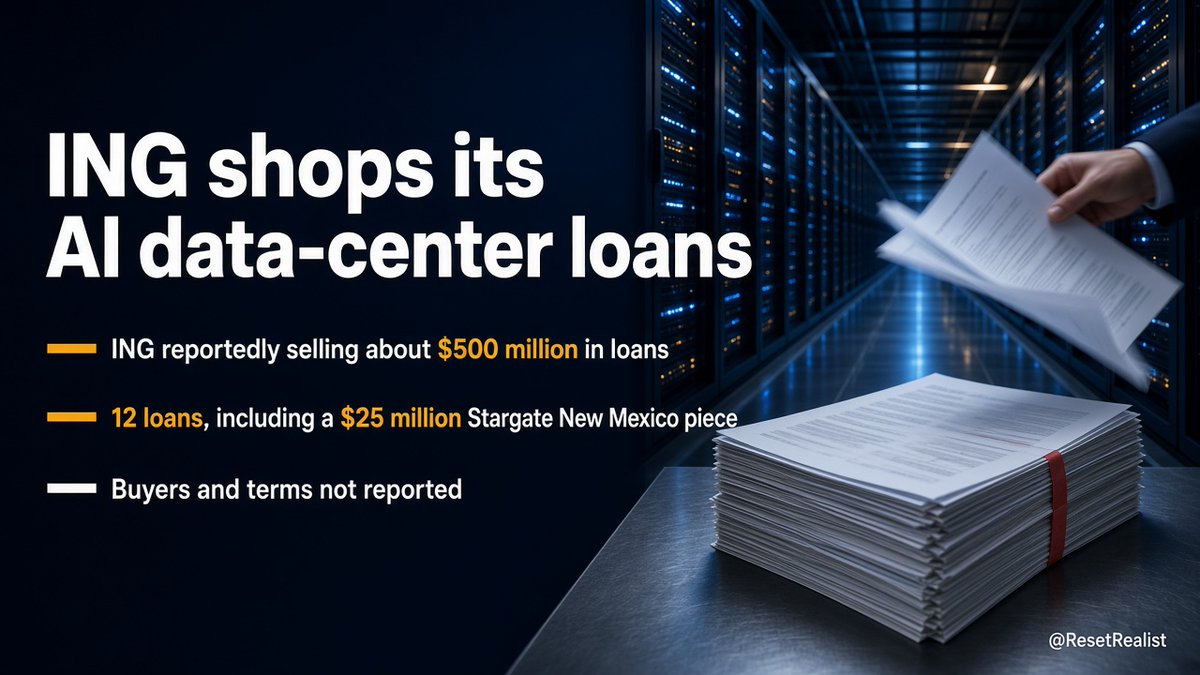
ING is reportedly looking for buyers for about $500 million of data-center loans, including a $25 million piece tied to the Stargate project in New Mexico, the AI venture involving OpenAI, SoftBank and Oracle.
The package covers twelve loans, including debt involving Vantage Data Centers and CyrusOne. ING declined to comment, and the buyers and terms have not been reported.
Banks often sell parts of the loans they make. Doing so frees room on their balance sheets to lend again and spreads the loans across private-credit funds, asset managers and insurers.
The data-center companies still owe the same debt. Only the lender changes.
Who ends up holding the loans matters. An insurer with long-term funding can hold a loan through a difficult stretch.
A fund that borrowed to buy it, or one that must pay out investors who want their money back, may be forced to sell if the loan loses value. Banks also lend to many of those same funds, so some of the risk can return to them indirectly.
The bids on ING's loans will show what return investors demand to finance the AI buildout now that its costs face closer scrutiny.
For ordinary savers, the bigger question is whether their pension funds, retirement accounts and insurers end up holding these loans, and whether the projects behind them earn enough to repay them.
Japan's central bank holds bonds worth ¥45 trillion ($288 billion) less than its accounts show
On March 31, 2026, the government bonds owned by the Bank of Japan would have sold for ¥45.44 trillion (about $288 billion) less than the values recorded in its accounts.
One year earlier, that gap was ¥28.62 trillion (about $182 billion). The bank released both figures in May.
A government bond is a loan to the government that pays a set amount of interest until it is repaid. For years the Bank of Japan bought huge amounts of them to keep borrowing cheap.
Now that rates in Japan are rising, new bonds pay more interest, so buyers will only pay less for the older, lower-paying ones. The more rates climb, the wider that gap grows.
The gap becomes an actual loss only if the bank sells a bond before its repayment date. The more direct pressure is on yearly income.
Commercial banks keep money on deposit at the Bank of Japan, and the central bank pays interest on those deposits. When it raises that rate, its costs go up right away, while income from its older bonds barely changes.
The bank still made a profit in the year ended March 2026 and paid ¥1.83 trillion (about $11.6 billion) to the government.
That payment is the number to watch. If profits shrink, the government loses income just as its own borrowing gets more expensive, and the difference has to come from more debt, higher taxes, or less spending.
This is the cost of the years Japan spent holding interest rates near zero, and it now falls on the central bank and the government budget at once. Higher rates can still help ordinary people.
Savings accounts may pay more, and a stronger yen would lower the price of imported food and fuel. Those benefits depend on the Bank of Japan keeping rates high enough to slow inflation, which is the same decision that widens the gap.
The U.S. added 165,000 jobs in October, more than three times the average monthly gain of 48,000 over the past year.
Unemployment held at 4.1%, and revisions added 84,000 jobs to August and September.
The strong report pushed interest rates higher on Friday.
Investors now expect the Federal Reserve to cut rates fewer times, so the two-year Treasury yield rose to about 4.52% and the ten-year to about 4.87%.
The dollar gained about 0.7%, because higher U.S. interest rates make dollar investments more attractive than those in other currencies.
Gold fell after the report but is still up nearly 5% for the week. Higher interest rates make income-paying assets more competitive with gold, which pays none, and a stronger dollar makes gold more expensive for buyers abroad.
The report was not strong everywhere. The number of people working part time because they cannot find full-time work rose by 339,000 to 4.8 million.
Wages rose 3.1% over the past year, and whether that keeps up with living costs decides how much better off workers really are.
A strong job market helps and hurts a heavily indebted country at the same time.
More paychecks bring in more tax revenue and leave more people able to repay their loans.
The same strength keeps interest rates high, so every Treasury bond that comes due is refinanced at a higher cost, and families pay more on new mortgages, car loans and refinanced debt.
🇧🇪The downward fiat debt spiral is spreading further across Western Europe.
Belgium now pays about 4.25% to borrow for ten years, up from 3.50% four months ago, while its government still cannot agree on a budget.
On Friday, King Philippe rejected Prime Minister Bart De Wever's resignation and asked the five-party coalition to return to talks immediately.
The parties have spent months at odds over €10 billion in spending cuts and tax increases, and each leader now says they are willing to compromise.
The numbers explain why the talks matter. Belgium's government debt stood at 107.9% of its annual economic output at the end of 2025, and that year's budget deficit was 5.2% of GDP.
Germany borrows for ten years at about 3.24%, so Belgium pays roughly one percentage point more. France pays about 4.80%, which shows Belgium is part of a wider European struggle over budgets and borrowing costs.
Higher rates do not hit the budget all at once. They reach it as older debt comes due and is refinanced, and as the government borrows to cover each new deficit.
Every year moves more of Belgium's debt onto today's higher rates, and the interest bill takes a larger share of the money that would otherwise pay for healthcare, pensions and public services.
Belgian rates have eased from their late-October peak, which gives the coalition some time to agree on a plan. A credible three-year budget would help keep refinancing costs in check.
Another round of deadlock would leave households facing the same tax and spending decisions with a larger interest bill attached.
U.S. stocks had their worst day in years on Thursday, two days after Democrats won control of both the House and the Senate.
The Nasdaq fell 5.5%, the S&P 500 lost 4.4%, and the Dow dropped 1,833 points. Chip and data-center companies led the decline, with Micron down 17%.
Much of the selling came from concern that the new Congress will bring tighter rules on artificial intelligence and on new data-center construction.
That concern reaches well beyond the stock market. Spending on AI infrastructure has been one of the largest sources of U.S. economic growth in recent years, and that growth has helped support a federal government that borrows heavily every year to cover its deficits. If the building slows, Washington will carry the same debts with a weaker economy behind them.
Poland's central bank now holds 700 tonnes of gold, reaching a target its governor set years ago. At current prices, that gold is worth roughly $91 billion.
Early in Governor Adam Glapiński's tenure, the bank held about 102 tonnes, so its holdings have grown nearly sevenfold. Gold now makes up about a third of Poland's reserves, which places the country among the ten largest official gold holders in the world.
Glapiński has also said he sees no reason for the bank to stop buying, even with the target reached.
Poland's decision shows how some central banks now think about their savings. Government bonds, including U.S. Treasuries, are only as good as the issuing government's ability to repay in money that holds its value. Gold depends on no government's promise, and no country can create more of it by running larger deficits.
Poland is not the only one making that choice. China's central bank has added gold to its reserves for 23 straight months.
When central banks keep buying gold after they hit their own targets, they are showing that they expect heavy government borrowing to continue, and that they want part of their reserves held outside that system.
Paraguay just showed what a digital balance really is.
Ueno Bank, the country's fastest-growing digital bank, was taken over by the central bank after its capital fell below half the legal minimum. About 3 million customers are frozen out.
The guarantee covers about $38,000 per person, paid on the fund's schedule, not the customer's.
Five months ago, Ueno reported healthy capital. The numbers looked fine right up until they didn't.
A balance on a screen is a claim on someone else's promise. Paraguay's savers are learning what that promise is worth in a single week.
🚨CHAOS IN PARAGUAY AFTER UENO BANK ACCOUNTS FROZEN‼️
⚠️3 MILLION PEOPLE- NEARLY 60% OF PARAGUAY’S ADULT POPULATION- LOCKED OUT OF ACCOUNTS THE AFTER MAJOR DIGITAL BANK FAILS‼️
A deal that keeps the tax cuts and adds the spending both sides want is not compromise. It is the deficit machine running on both engines.
If the debt ceiling is weakened or removed, the last speed bump on that machine gets cleared too.
The currency pays the fare either way.
The most likely legislation Congress can pass that Trump will sign will preserve all the tax cuts Trump brags about but include all the extra spending that Democrats want. It may also contain a complete repeal of the national debt ceiling and price controls on credit card interest rates. The result will be massive increases in already massive federal budget deficits.
If the economy also slips into recession due to a big slowdown in AI capex, budget deficits currently running at around $3 trillion annually could rise to nearly $5 trillion. That will send the national debt soaring to $50 trillion by the end of Trump's term. To accommodate those massive deficits, the Fed will open up the monetary spigots like never before, launching the mother of all QE programs. The U.S. dollar will tank, and consumer prices will go through the roof.
This will also put substantial upward pressure on long-term bond yields and mortgage rates, crushing the economy and housing market. To avoid a worse financial crisis than in 2008, the Fed will choose higher inflation instead and buy Treasuries and MBS in record amounts. Since the Fed won't buy corporate or municipal bonds, expect those yields to soar, wreaking havoc on state and local governments and the stock market.
Since credit card interest rates will likely be capped, expect most consumers to be completely cut off from credit. If price controls extend to consumer goods, expect shortages, long lines, black markets, widespread power outages, and civil unrest.
Since the war can't really end unless we surrender by caving in to Iran's demands, it will likely continue. Since the Strategic Petroleum Reserve will run dry if we don't stop the drain, oil prices will rise sharply, perhaps to $150–$200 per barrel. Even if Trump manages to end the war by promoting a defeat as a great victory, oil prices will rise anyway.
The 2028 election will be a blame game, with each party accusing the other of being responsible for the worst economy ever and the highest inflation in U.S. history. Voters have a track record of blaming presidents and their parties for the affordability crises, so not only will the Democrats win the White House, but they will also increase their majorities in both houses of Congress, likely reaching a filibuster-proof 60 seats in the Senate. Their policies will risk turning record-high inflation into hyperinflation.
The only thing you can do now is protect yourself, as there is nothing you can do to protect the country. In fact, by not going broke like the vast majority of Americans will, you will be better positioned to help rebuild what both Democrats and Republicans will have destroyed.
Load up on gold and silver now while you can still afford to buy them.
https://t.co/FGWVTrP1fx
Gold above $4,100 with yields and the dollar falling is not a mystery chart.
It is the market saying soft money and hard deficits travel together.
No-limit currencies get repriced by the one money that still has a limit.
🔥Gold extends its rebound above $4,100 as Dollar and yields retreat:
Gold prices rallied as much as +2.1% to $4,146 per ounce, extending Wednesday's +3% rally, its largest daily gain since August.
Simultaneously, Silver advanced +1.7% to $53.11 per ounce after jumping nearly +5% in the previous session.
This comes as US Treasury yields and the US Dollar Index extended their declines supporting demand for non-yielding gold and making it cheaper for international buyers.
Meanwhile, Brent crude briefly fell below $95 per barrel after Trump played down the prospect of strikes against Iran, easing concerns about inflation and further monetary tightening.
Despite the rebound, gold remains down more than -20% since the Iran war erupted in late February.
Is gold entering a new bull market? $GLD $SLV $GLDM
Is Russia planning a new gold-backed currency to derail U.S. dollar dominance?
Russia's gold-linked "world currency" is a trial balloon. The exits from the dollar are not.
Headlines running on X say Russia plans a gold currency. It is ahead of the facts. The direction behind it is real, and that is the story.
What was actually said
On Nov 3, Sergey Glazyev spoke at a security conference in Minsk, Belarus. He is State Secretary of the Russia–Belarus Union State. That is a political post, not the central bank.
He called the dollar system "archaic" and the Fed "a giant financial pyramid that we all subsidize."
His proposal: a world settlement currency in digital form, created by international treaty. It could be pegged to the currencies of the SCO countries (the Shanghai Cooperation Organisation) and/or a basket of commodities "that we produce and consume."
He said nothing prevents a first launch inside the Russia–Belarus union, at a tech hub in Minsk, and that "the relevant proposals are on the table."
What it is not
It is not "Russia plans." It is one official's proposal, pushed by Glazyev for years.
Russia's own technocrats are not on board. In October, Deputy Finance Minister Ivan Chebeskov told TASS that "the introduction of any new mechanisms is not under discussion."
It is not gold-backed as stated. The Minsk words were a peg to currencies and commodities. Gold enters through the gold-linked stablecoins he pointed to as early examples.
And it is not a concrete plan. No launch date, issuer, reserve custody, audit, or redemption terms have been published.
Why Moscow's technocrats can say no
Because the first exits already work.
Chebeskov says the ruble and yuan now make up nearly 100% of Russia–China settlements. Glazyev claims all trade inside the Russia–Belarus union and the Eurasian Economic Union has moved to national currencies.
The most talked-about vehicle, UNIT, is a privately promoted settlement token designed as 40% gold and 60% BRICS+ currencies. It has had trials. It has no official endorsement. India said in September there is "no proposal in the BRICS for BRICS currency as of now."
The real read
Since Russia's reserves were frozen in 2022, every central bank outside the Western bloc learned the same lesson. Dollar assets are someone else's liability, and they can be switched off. Gold held at home cannot.
The response has come in layers.
First, settlement moved into local currencies. Between Russia and China that is mostly done.
Second, central banks have been buying gold at a record pace. China's central bank alone has added gold for 23 straight months, to 2,410 tonnes.
Third, venues to price and clear physical gold outside London and New York: Shanghai, and now Hong Kong's tokenised 400-ounce bar.
Glazyev's idea would be a fourth layer: a neutral unit to settle the trade balances national currencies cannot settle cleanly. India's rupees piling up in Russia are the textbook case.
That fourth layer is the hardest. It needs trust, governance, and a reserve both sides can audit.
History has seen this offer before
In 1944, John Maynard Keynes proposed the "bancor," a treaty-based world unit. It lost to the dollar, and Bretton Woods anchored the dollar to gold instead.
What Glazyev describes is close to a bancor with a gold and commodity anchor, offered from the other side of the table.
The question that decides it is the one Milton Friedman would ask: who controls the supply? Every fiat unit eventually answers "whoever needs the money." That is how fiat regimes fail.
What to watch
A treaty text. A named issuer. Gold that is audited, vaulted, and redeemable. And whether the Bank of Russia or the People's Bank of China signs on.
Until then, this is a speech, not a currency.
But the dollar system's biggest users are not waiting on speeches. They are building exits one layer at a time, and each layer makes the next one easier.
The softest path for the dollar is also the most popular one.
After Democrats won both chambers, markets cut Treasury yields, weakened the dollar, and lifted gold back above $4,100 an ounce.
That is not a vote for fiscal repair. It is a bet on more spending and easier money at the same time.
Affordability is the new political word of the week. Bringing prices down fast is hard. Sending households more money is easy. History shows Congress usually picks the easy path.
A softer Fed fits the same story. Officials who talked tough on inflation this year were happy to cut when politics and growth looked weaker. Markets expect that reflex to return.
The bill is already on the books.
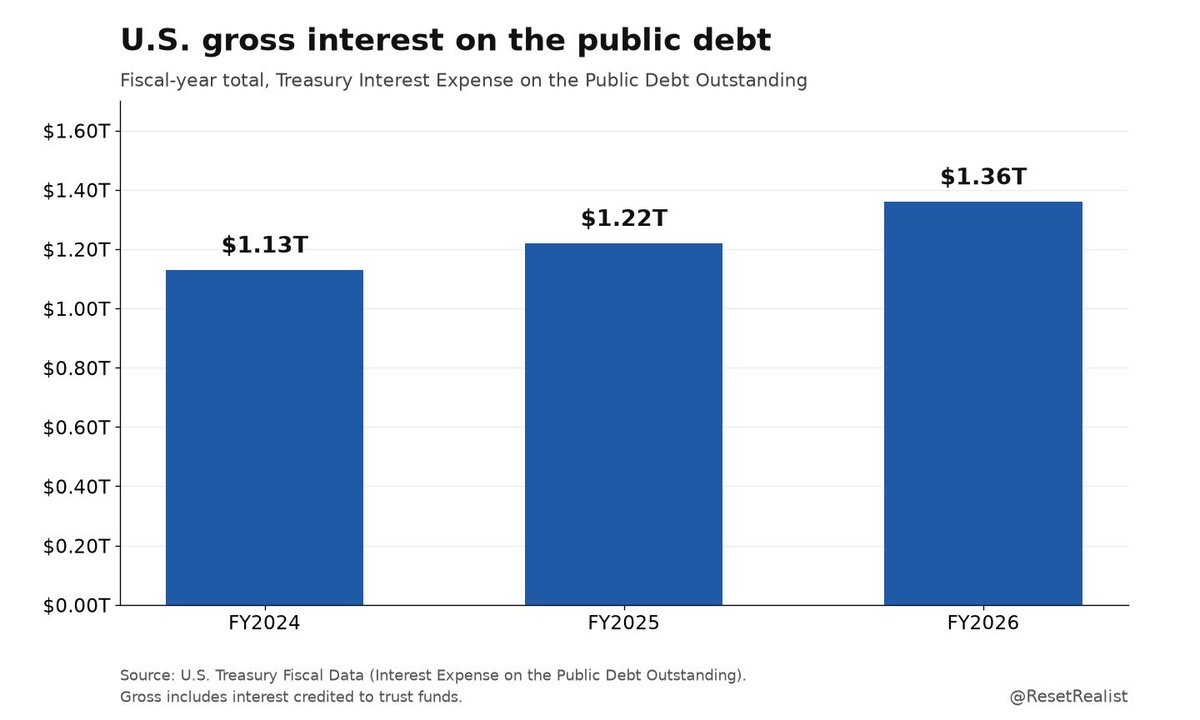
U.S. total debt is about $40.5 trillion as of November 3. In fiscal year 2026 alone, gross interest on that debt hit $1.36 trillion, up from $1.22 trillion the year before and $1.13 trillion the year before that.
Interest is no longer a side cost. It is one of the largest forces in the budget, and it grows while politics refuse to shrink the principal.
This is the fiat currency debt system in plain sight.
Governments run continuous deficits.
They borrow to cover them.
Central banks ease when the load gets heavy.
The currency buys less over time.
Gold, which no government can print, reprices the damage.
Both parties keep the deficits. The midterms change who writes the next spending deal. They do not change the math.
When voters demand cheaper living costs and Congress answers with more borrowing, the currency absorbs the difference. That is not a conspiracy. It is arithmetic.
A system that pays yesterday's interest by selling tomorrow's debt, then asks the central bank to keep rates friendly, is already on the reset path. The dollar is still the world's main reserve. That status slows the process. It does not cancel it.
Gold's jump above $4,100 while yields and the dollar fell together is the market's short version of the same lesson.
The reset is not a future speech. It is the path markets are pricing when soft money and hard deficits travel as one trade.
Affordability through bigger checks is not a price cut. It is another round of demand funded by debt.
When Congress borrows to make high prices feel manageable, the next round of prices usually follows.
That is how the fiat debt loop keeps turning: spend, borrow, inflate, repeat.
“Affordability” seems to be the mandate for the new Democrat majority. So they need to either find a “magic wand” to bring prices down quickly, or they need to….give money to people (so the high prices are made “affordable”) yet again. Only causing more inflation.
A softer Fed with bigger deficits is not a free lunch for households.
It is the classic fiat path: paper over the debt load, then watch the currency buy less.
Gold already moved first. The dollar and yields moved with it.
The midterms change a lot of things, including the Fed. Many of the FOMC members who've been hawkish this year were very happy to cut under Powell in 2025, even though inflation was worse than now. These folks will now rediscover their inner dovishness...
https://t.co/NnsR19tEXo
Gold is real money. Everything else is credit. China is building the system that settles in the real thing.
That is the read on Hong Kong's new tokenised gold project, and the token itself is the least interesting part of it.
This week, Hong Kong's Secretary for Financial Services and the Treasury, Christopher Hui, said an interbank tokenised gold project "is going to start soon." Each token stands for one standard 400-ounce bar, priced on HAU, Hong Kong's own gold price, and paid with tokenised bank deposits. A first bank-to-bank trade has reportedly already settled within minutes.
Look at the sequence instead. In under four months, Hong Kong has:
- opened a government-owned gold clearing system (July 7)
- launched HAU, a gold price set in Asian hours
- linked gold delivery with the Shanghai Gold Exchange
- and now, bank-to-bank settlement of bar-backed tokens
Each step on its own is small. Together they are the plumbing to price and move physical gold outside London and New York, the two markets that run on the dollar.
And the builder is the biggest player in gold. China has been the world's largest producer since 2007 and largest consumer since 2013. It imported 901 tonnes in 2025 and more than 1,000 tonnes in the first eight months of 2026. Its central bank has bought for 23 straight months and now officially holds 2,410 tonnes.
That is not a country hedging. That is a country preparing.
The West mostly trades gold as paper: claims on metal, priced and cleared in dollars. China is laying rails that move the metal itself. When trust in paper money is high, that difference looks academic. When debt keeps climbing and currencies keep losing value, it becomes the whole story.
This is why it matters for the reset. The fiat currency debt system depends on the world settling trade and storing savings in dollars. Every new lane that bypasses that system makes it a little less necessary.
Keep it in proportion. This is bank-only, has no full launch date, and is not a gold-backed yuan. It does not replace the dollar tomorrow.
But it is a working alternative lane, and it gets wider every quarter.
Next marker: China's October central bank gold figure, due around Nov 7.
Sources: Hong Kong Government, HKMA, LBMA, World Gold Council, China customs data via CNBC.
A worker who started a 9 to 5 job in 1971 has spent 50 years earning dollars that the system was built to keep shrinking.
That is how the fiat currency debt system works. And it is why the dollar is heading toward a reset.
In August 1971, the US ended the dollar's link to gold. Before that, foreign governments could swap dollars for gold at $35 an ounce. After that, the dollar was backed by nothing but trust in the government that prints it.
Without gold as a limit, the money supply could grow as fast as the debt needed it to.
It did.
M2 is the broad money supply: cash, checking and savings accounts, and similar money people can spend quickly.
In January 1971, M2 was about $633 billion. By September 2026, it was about $23.4 trillion.
That is roughly 37 times more dollars.
More dollars chasing the same goods means each dollar buys less.
By the government's own price index, CPI, a dollar from January 1971 now buys about 12 cents of goods. The dollar has lost about 88% of its purchasing power.
Gold shows an even wider gap. In 1971 an ounce cost $35. Today it costs about $4,060. Measured in gold, the dollar has lost about 99% of its value.
The COVID era showed how fast this can move.
From February 2020 to March 2022, M2 grew about 41%, from $15.5 trillion to $21.8 trillion.
About one in every three dollars in M2 today was created after February 2020.
For a worker, that is the hard part. Wages are paid in dollars. Savings sit in dollars. When new dollars are created faster than the economy grows, the value of past work quietly leaks away.
This is the doom loop of fiat debt. The government runs continuous deficits. It borrows to cover them. The money supply expands to carry the debt. Each dollar weakens, so the next round needs even more.
A system that only works by creating more of its own money cannot run forever. At some point, the debt and the currency get reset.
The lesson is simple. Fifty years of labor deserves to be stored in something that cannot be printed.
Sources: Federal Reserve (FRED: M2SL, CPIAUCSL), BLS, gold spot.