Proud to announce our publication in the Journal of Surgical Oncology. We report our institutional learning curve in 187 consecutive esophagectomies, demonstrating the impact of technical standardization of gastric conduit formation on conduit-related outcomes.
Grateful to my co-authors and the entire surgical team whose dedication made this work possible.
🔗 https://t.co/PLGYBQnulz
#SurgicalOncology #EsophagealCancer #Esophagectomy #UpperGI #JSO
For decades, KRAS was the poster child of the "undruggable" oncogene.
This study showing a doubling of survival with KRAS inhibition feels like a watershed moment in oncology.
Beyond a new drug, it represents the triumph of persistence, structural biology, and translational science over a seemingly impossible target.
If these results hold across broader settings, we may be witnessing the beginning of a Nobel-worthy chapter in cancer therapeutics. #Oncology #KRAS #CancerResearch
https://t.co/ubSgHWlVLj
https://t.co/roXv3yn1iW
A comprehensive, step-by-step video guide on Pancreatoduodenectomy. We cover:
✅ Dissection planes
✅ Vascular preservation
✅ Reconstruction technique
Perfect for trainees looking to master the steps.
Our data on 187 Esophagectomies done at MPMMCC, high volume Indian center.
Tripathi, M., Balachandran, R.R.,et al. Predictors of PCR after NAT in Esophageal Ca: a Parsimonious Model and Nomogram from a High-Volume Indian Center. Indian J Surg (2026). https://t.co/05IHLWAJqw
85 years of care, compassion, and commitment.
Since 1941, @TataMemorial has remained dedicated to accessible cancer care, advancing research, and training the next generation of oncology professionals.
Honouring the legacy. Renewing the commitment.
#85YearsOfCare#FoundationDay
https://t.co/THMA6AnjGh
https://t.co/BcRXjShbTN
Not all post-Whipple hemorrhage is Whipple-related: inferior rectal artery aneurysm rupture masquerading as delayed bleeding after pancreatoduodenectomy
@Mayank_Oncology
We’ve just uploaded a comprehensive, step-by-step video guide on Pancreatoduodenectomy. We cover:
✅ Dissection planes
✅ Vascular preservation
✅ Reconstruction technique
Perfect for trainees looking to master the steps.
@IHPBA@IhpbaIndia@EAHPBA@AHPBA@SanjayGovil8@Shrikhande_SV
https://t.co/tmKTT5OA98
Not sure… 🙋🏻♀️ I have concerns
LEOPARD2 was stopped due to high mortality - experience and learning were cited as explanation
Here, with experience & training: lower morbidity but but over x2 mortality rates… to me points towards potential issues with rescue; beyond absolute complication rate, their severity and repercussions would see different
And with no evidence of superiority - why keep using for MIS Whipple? What are we pursuing?
Holidays are upon us and yes, I’m a Grinch 😈
Doesn’t take anything from the massive feat of running these studies! We need these data and few can pull this together.
*now standing off my soap box*
Unusual arterial anatomy encountered during Whipple’s: J1, IPDA, and rRHA arising from a single common trunk.
A reminder that casual dissection can lead to inadvertent rRHA ligation, misidentifying it as the IPDA.
@IHPBA@EAHPBA@AHPBA
For trainees to understand this beautiful picture:
remember RRHA comes from SMA (hidden at the inferior edge of pancreas behind the veins in the picture) then passes posteriolateral to portal vein and lateral to CBD, opposites to the usual medial position.
This is type III variation and important to know to avoid intraoperative injury.
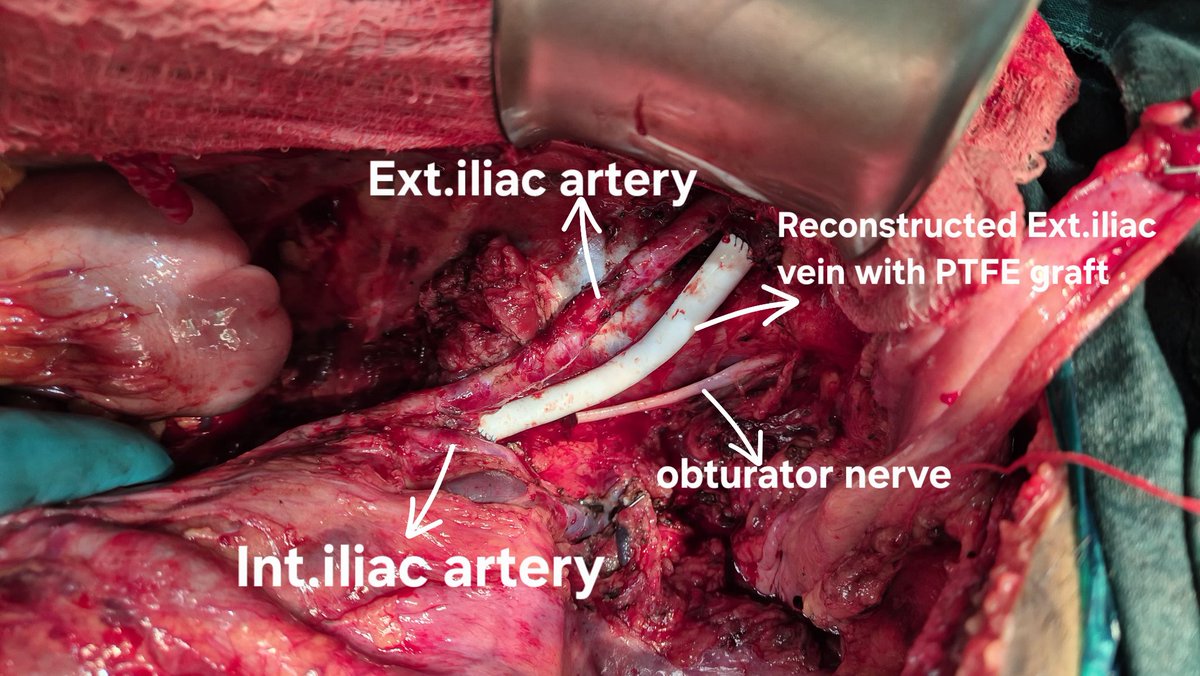
Compartmental resection for retroperitoneal sarcoma with en bloc excision of the involved external iliac vein and PTFE graft reconstruction with
sigmoidectomy and distal ureterectomy with Boari flap.
@EAHPBA@IHPBA@AHPBA@SanjayGovil8@alegronchi
📚
A Novel Dual Replaced Hepatic Arterial System Arising from the Superior Mesenteric Artery: A Newly Described Vascular Trap in Pancreatoduodenectomy
https://t.co/NAqT69JPb9
@SN and #SNAuthor.