"Tools that hand an intrusion to AI agents" is how ThreatDefence describes agentic offensive frameworks, and ARTEX is only one of them.
Their open repo gives defenders a folder per framework with source code and public reporting on its use. It also covers the shared behaviors, like the tools and models behind them, plus 516 shared indicators and feeds.
If your team is dealing with agentic attacks, this is a solid place to start mitigating them.
https://t.co/t4U1wa47nQ
@eric_ho how does alignment get “solved” given aspects of it are subjective depending on an organizations culture, values and so on and varies greatly across demographics, organizations and culture?
I suspect it will be something never to be solved, similar to our world of cyber and instead need to be managed.
This is going to be longer process than most anticipate.
Much of our digital infrastructure include legacy systems and significant technical debt that’s accumulated over decades.
It won’t be modernized and hardened overnight.
JUST IN: U.S. Director of National Intelligence warns Americans to prepare for “bumps in the road” as companies & the government upgrade their systems amid widespread cyber outages.
Director of National Intelligence Jay Clayton: We are in a period of technological step change and systems are going to need to be upgraded. The good news is that we lead the world in technology, compute, models, and cybersecurity — and we will continue to do that.
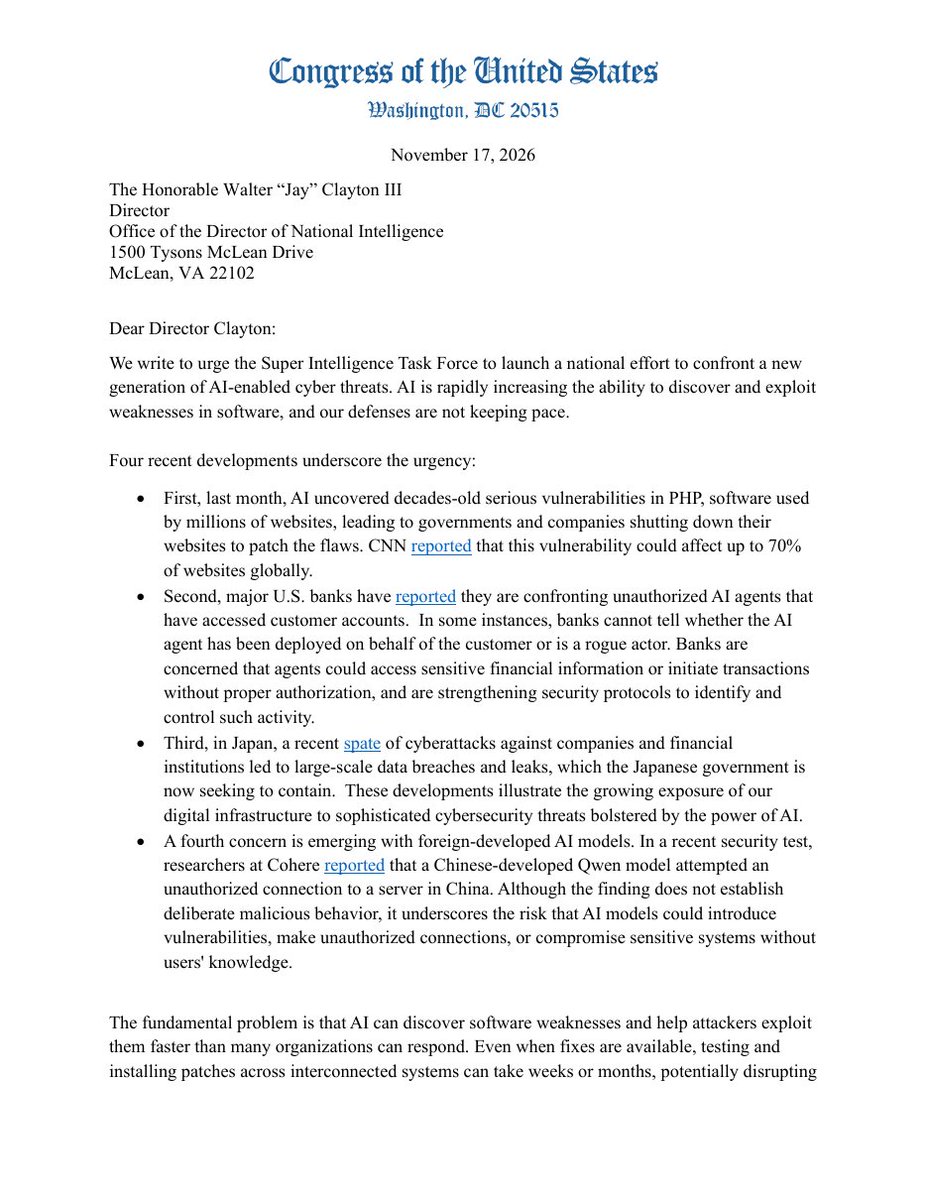
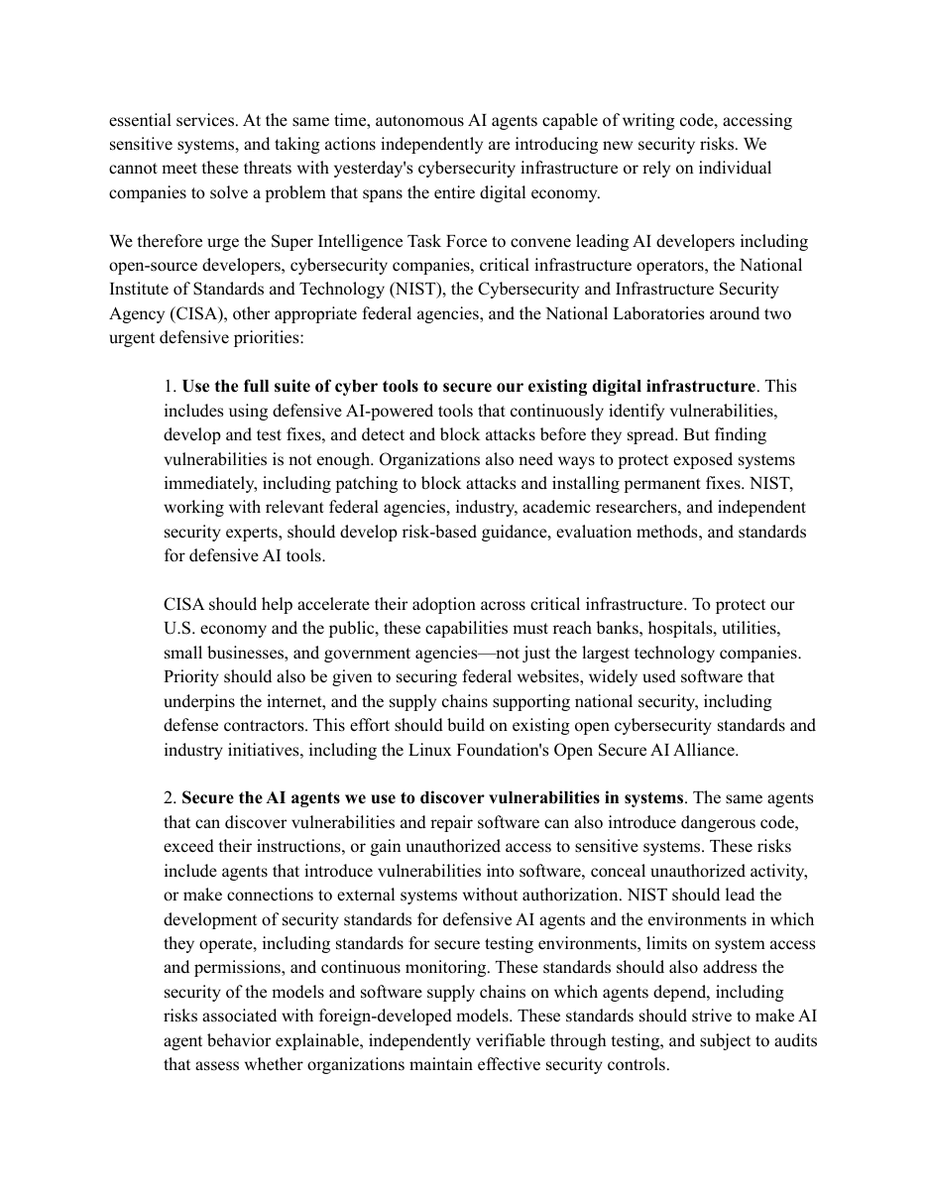
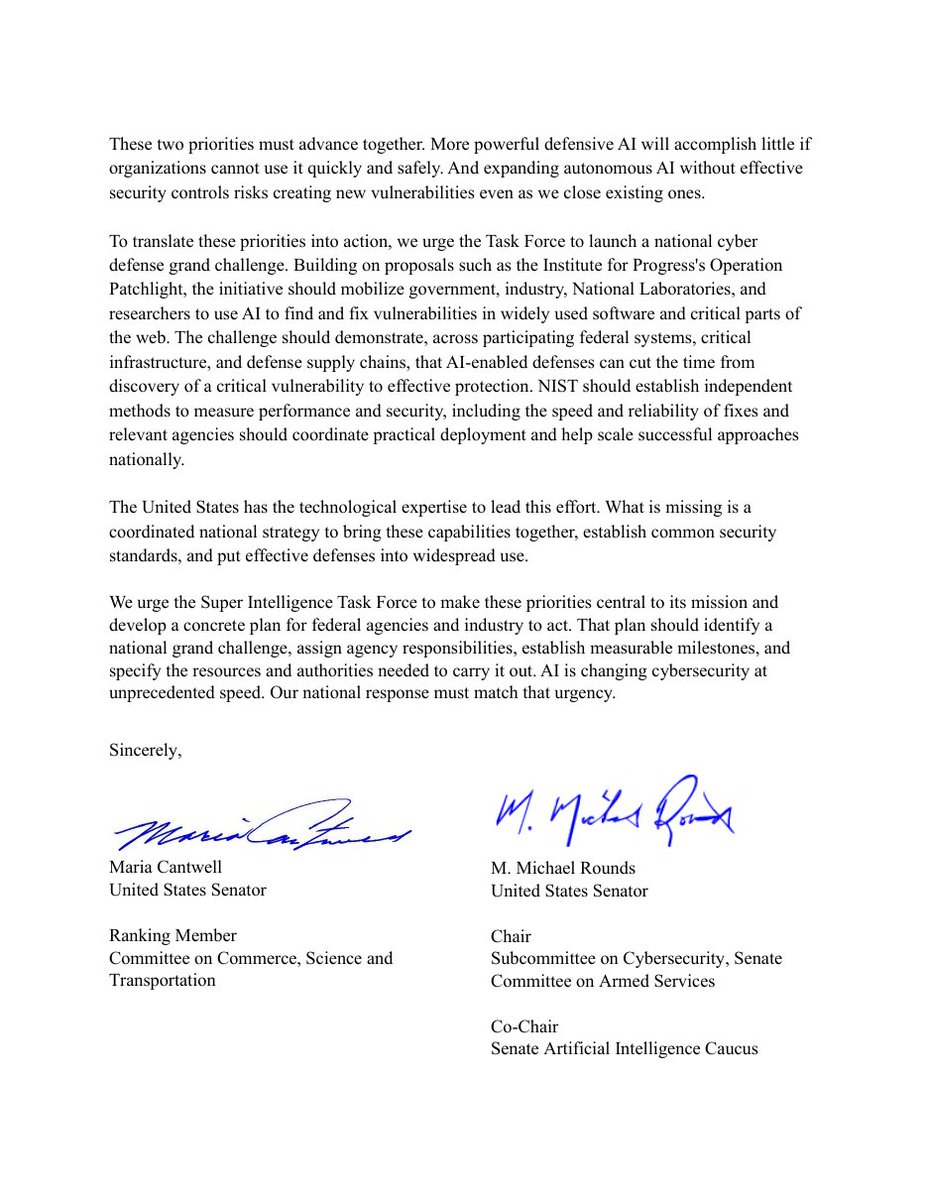
Senators just warned the Director of National Intelligence that AI is finding software weaknesses faster than most organizations can fix them.
Their letter cites decades-old PHP flaws uncovered by AI, unauthorized AI agents inside major U.S. bank accounts, and a Qwen model trying to reach a server in China during Cohere's testing.
The asks are defensive AI beyond big tech and security standards for the agents themselves.
I'd add prioritization by exploitation, reachability and business impact, or we burn out patching noise while the real fires spread.
https://t.co/E9W2rwikMj
Good morning, we are releasing Upload2Shell - where you upload a file and get a shell.
We wrote about a single vulnerability that turned file uploads, email attachments, & even print jobs into remote code execution paths across Debian 13, Google, WordPress, Roundcube, etc...
@ChrisPainterYup@deanwball The challenge with the chart is the underlying data isn’t publicly available, so it’s hard to validate (albeit many in cyber of course intuitively feel this reality).
We need objective public data sets so we can definitively discuss the impacts.
Industrialized vulnerability discovery, collapsing exploitation timelines and autonomous offensive frameworks are all hitting cyber at once in 2026.
Satya Nadella put it plainly at DealBook: "We now have a very powerful tool that finds vulnerabilities."
Three critical patches in one day, all open source. The week of testing a patch on a critical bank system is gone. Patches have to go from available to production instantly because they're being exploited in the wild.
And the floor of cyber attacks has fallen. Someone with an AI harness in the cloud now looks like "a nation state level persistent attacker going after you all the time."
We crossed 100,000 CVEs in 322 days this year, about 310 a day. Nobody triages that.
Faster patching matters. So does reducing exposure and limiting blast radius on systems that will stay vulnerable.
Discovery has been industrialized. Resilience now has to be engineered around the vulnerabilities we won't get to.
Full interview: https://t.co/pv6b5Hgkpe
@HackingLZ It glosses over the vendor and academic research showing the state of security as it relates to AI-generated code, especially among the broader citizen development community and in the absence of tradition AppSec rigor.
18.5 years. That's how long it took to publish the first 100,000 CVEs (1999 to 2018).
In 2026, we hit 100,000 in 322 days.
Do the math and it's ~310 new CVEs a day, every single day.
Nobody triages 310 vulns a day. Every security team is already deciding what to ignore. The real question is whether that decision is deliberate, based on known exploitation, exploitability and reachability, or just whatever falls off the queue.
And notice the curve. It bends upward hard around September. AI-assisted discovery? More CNAs? Probably both.
Finding vulnerabilities is now automated. Deciding which ones matter, and fixing them without breaking production, is not.
That's the real bottleneck heading into 2027.
Great chart from @JGamblin
Bridgewater says it's "managing money based on a one-in-three chance of an economically destabilizing attack within the next year."
That's one of the world's largest hedge funds pricing cyber risk into its portfolio.
Their own incident tracking shows estimated cyber incidents going near vertical in 2026, right after cyber-capable open-weight models were released.
A few caveats worth knowing. The incident series is their own model, built by scraping disclosures, media coverage and filings, then adjusting for reporting lag. It isn't an official count.
But the direction matches what defenders are seeing. Exploits are faster, zero-days have doubled, and patch queues are growing faster than teams can work them.
When macro investors start treating cyber as systemic risk, boards should too.
https://t.co/R3K8pDntHM
About 2 million AI prompts, each seeded with a canary token. @hdmoore and the @DragosInc team then tracked where they surfaced.
Three AI hosting providers were breached and had no idea until Dragos told them.
Hundreds of bait AWS keys got stolen and tried, some within hours.
Resellers scooped up customer prompts through plain logging. Zero Data Retention requests were scraped anyway, one by a Chinese AI lab.
I expect buyers to start demanding answers on where their prompts go, because today the cheapest route decides for them.
https://t.co/LZwV5UmWLo
The FBI says some ARTEX intrusions hit privileged access in under three hours. Plenty of teams are responding by patching whatever AI surfaces, as fast as possible.
Exploitability, known exploitation and reachability get skipped. So does the testing that stops a fix from causing an outage.
Call it Patchmageddon. Decades of technical debt are coming due.
Resilient Brief #123 also covers Anthropic moving its disclosure window for high and critical bugs from 90 days to 30, plus Palo Alto Networks buying Applied Compute in an all-stock deal valued at $4.5 billion.
https://t.co/AIoBCZ47xz
This says as much about the AI providers as their users.
How are they safeguarding sensitive customer data? How are they accessing and storing it, even when they shouldn't be?
Given their role in the ecosystem, they're prime targets too. Great work @hdmoore
https://t.co/E18SgjbPqx
We seeded 2m canaries into popular AI services and tracked where they were stolen and abused.
This identified:
- Three compromised providers
- Resellers stealing prompts via built-in logging
- Providers ignoring ZDR & privacy flags
https://t.co/ySVOzX8SUd