$MCD had a pretty interesting move today, so I went back and looked at what happened historically when it saw a similar setup.
It traded down more than 5% intraday, although it ended up closing -4.81%, so technically today did not trigger the exact signal I tested.
The test was simple: MCD closes down 5%+ in a day while RSI(14) is at 30 or below.
There have only been a handful of cases since 2000, and after removing the clustered March 2020 signals, the sample falls to just 5 independent-ish events, so obviously this is a very small sample.
Still, the 1-month numbers are not bad at all:
+6.0% average return
+5.9% median return
80% positive
Not enough data to build a trade around on its own, but definitely an interesting short-term mean reversion setup to keep in mind here.
$MCD had a pretty interesting move today, so I went back and looked at what happened historically when it saw a similar setup.
It traded down more than 5% intraday, although it ended up closing -4.81%, so technically today did not trigger the exact signal I tested.
The test was simple: MCD closes down 5%+ in a day while RSI(14) is at 30 or below.
There have only been a handful of cases since 2000, and after removing the clustered March 2020 signals, the sample falls to just 5 independent-ish events, so obviously this is a very small sample.
Still, the 1-month numbers are not bad at all:
+6.0% average return
+5.9% median return
80% positive
Not enough data to build a trade around on its own, but definitely an interesting short-term mean reversion setup to keep in mind here.
Update: Reuters is now reporting that Trian is no longer preparing a take-private bid for Wendy’s and has no plans to make one at this time. Trian declined to comment, and the sources said it remains open-minded about its future intentions.
This materially changes the near-term catalyst behind the trade. The valuation work may still explain what a buyer could afford, but the event thesis has failed for now. I have added an update to the article and will follow up after reassessing the position.
1/8
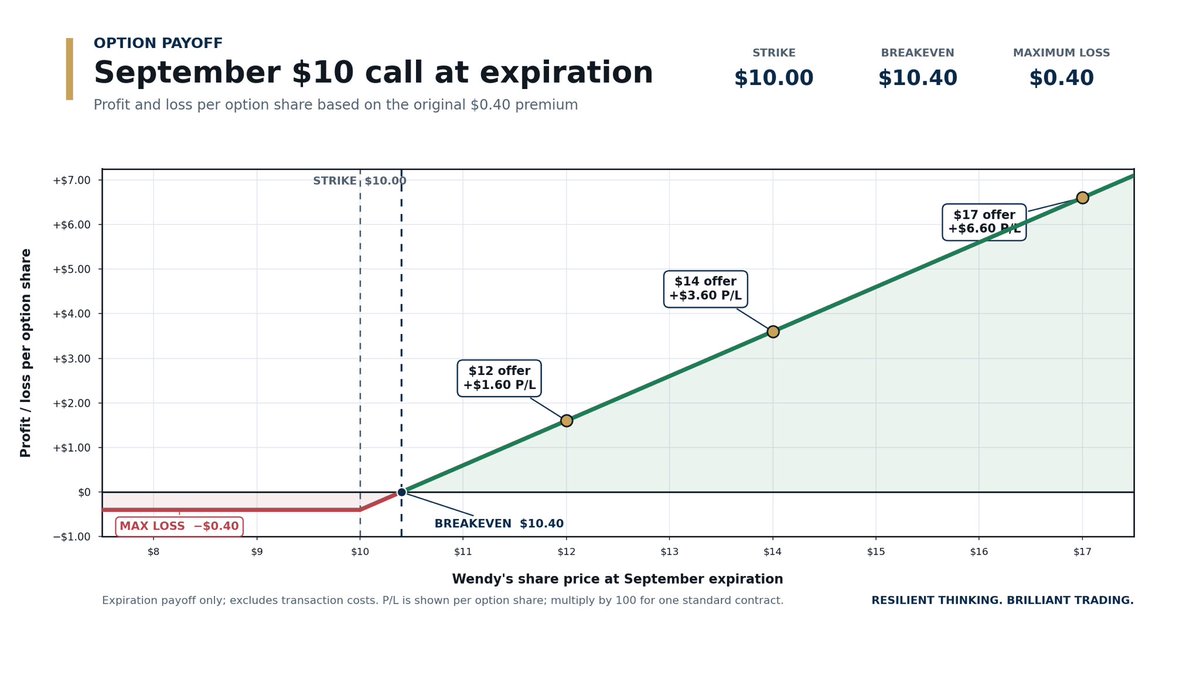
I bought the September $10 calls in $WEN before doing any valuation work.
The chart looked interesting, short interest was extremely high and the takeover report gave it a real catalyst.
I also had $12 in my head, but I could not properly explain why it made sense.
Definitely a contrarian view given how terribly this stock has performed, but I agree with you here.
The extremely negative sentiment combined with improving technicals could actually be the perfect fuel for a strong move higher before there's any obvious improvement in the fundamental story and people start paying attention again.
One piece of context missing from this comparison is where $WEN was trading relative to its 200-week MA.
The November 2024 golden cross formed as price rallied into the 200-week MA and rejected. Today, $WEN would need roughly 75% upside just to retest it. Not saying that this is a good target.
It does not automatically make the current golden cross bullish either, but the two setups are taking place in very different long-term contexts.
8/8
This is a long one, but I wanted it to be something traders can refer back to as the situation develops.
It covers the debt structure, buyer/seller ranges, option pricing and what would prove my reasoning wrong.
Full article:
https://t.co/X8ZarepGdn
Disclosure: I hold $WEN Sep and Nov $10 calls. This is personal analysis, not financial advice.
7/8
Timing was the main problem with the options.
A bid can happen and the September calls still expire worthless if it arrives too late. More than half my simulated outcomes had no intrinsic value, even though the expected value was positive.
One thing I noticed is that historically APP seasonality has actually been pretty decent on average in Aug/Sept.
The chart overall still looks bearish to me, but the daily RSI is quite oversold, so I can see the logic behind the $280 puts. That strike gives you roughly another 10% of room from here.
Only hesitation for me is IV looks pretty depressed right now, so you're not getting paid that well to sell the downside. I'd probably prefer the same trade after another sharp red day or volatility spike.
Thoughts on $MELI
One way I think about $MELI, and this is definitely NOT a way to value a company, is to occasionally forget the spreadsheet and just think about the size of the opportunity. $MELI is worth $90b today, but it is playing in commerce, payments, credit, advertising and logistics that are collectively worth perhaps trillions, in a region that is still relatively early in its so called “digital transition”.
The interesting question isn’t whether $90b looks cheap today. It’s whether we are dramatically underestimating how large $MELI itself can eventually become. Great companies have a funny way of making numbers that once looked enormous seem almost laughably small a decade later. I suspect $MELI may be one of those companies.
Their model can absorb enormous growth, the reinvestment runway is still incredibly long, and management has spent 25 years proving they know how to allocate capitals and COMPETE. Put those together and today’s enormous numbers may look surprisingly small in hindsight. I also think the current worries around credit will look overdone, and that $MELI’s credit business will ultimately become many times larger than it is today.
Everything has a price. No business, no matter how extraordinary, is worth an infinite amount. $MELI isn’t extraordinarily cheap, but at roughly 31x next year’s earnings for a business expected to grow earnings around 40%, I think the valuation is surprisingly reasonable. Especially when you remember those earnings are being produced while $MELI is deliberately sacrificing margins to invest aggressively in logistics, fintech, credit and the next decade of growth. Add with its a rapidly growing credit book the current earnings power is distorted, and today’s P/E probably tells you less about $MELI’s true earning power than it appears. So perhaps a consideration can be made that the “real PE” is actually less than 31x?
🌹
@VJNCapital This is basically what caught my attention too. I probably wouldn’t call it silly cheap just yet, only because that 58% FCF growth is backward looking.
But at 23x, APP really doesn’t need to keep growing anywhere near that fast. Even 20-30% FCF growth could be enough.
5/5
In the full post, I go through real examples from $MELI, $ARGX and $INTU and how I classified the decisions behind each trade.
The biggest thing I've learned is not to judge myself based on the colour of the P&L.
Some losses will be good. Some will be bad. Sometimes I'll even get rewarded for doing the wrong thing.
The job is to keep separating decision quality from outcome and correcting what is actually within my control.
The objective isn't to eliminate losing trades. It's to eliminate the losses you didn’t need to take.
Full post:
Not All Trading Losses Are Equal
https://t.co/jZIK6eu0nV
1/5
I started writing my latest Resilliant post while $MELI was trading around $1,768.
My stop was at $1,766.
By the time I finished writing it, I had been stopped out.
What was interesting to me was that I genuinely felt nothing. No anger, no disappointment and no feeling that the market owed me the money back.
I had already moved on mentally to the next trade.
4/5
I actually think a bad win can be more dangerous than a bad loss.
A bad loss punishes you for breaking your rules.
A bad win rewards you for it.
Do that enough times and you can slowly become more comfortable with behaviour that was never part of your edge in the first place.
Eventually, you get the trade where luck doesn't bail you out.