🌹Quran Tafsir Lecture Series: 🌹
Journey of Prophet Moses and Khidr (pbut):
The Hidden Real Story within the Story -- PART 1
https://t.co/O20LateXF5 via @YouTube#Quran#Moses#Khidr#Khader#Exodus#Mercy
@SoulfulNajbun Which scholars are you referring to for these trials? Here is https://t.co/dnWparPHzu. There are 91 tafsirs here--virtually all major tafsirs in the history of Islam. Please point to which one talks about this surah in terms of these four trials??
This idea that Sarah Al-Kahf revolves around these four trials is a most misguided claim that emerged in the end of times.
There is not a single Hadith, nor a report from Salaf, nor any commentary to this effect in any traditional tafsir. If there is show me!
People who spread this baseless idea should realize who they are attributing the trial of knowledge to -- To Prophet Musa (pbuh)? and the trial of power -- to Hz Dhul Qarnayn? One must shudder at even suggesting this. It is a complete distortion of what these stories are meant to convey.
I am a Professor and have studied this Surah for decades and there is not an iota of evidence supporting these claims. Yes I am aware who the people are who proposed this misguided tafsir and they are people of no authority on the Qur'an.
May Allah protect us all from speaking about the Qur'an without knowledge! Ameen.
Most people think “reciting the Qur’an correctly” is mainly about makhārij, aḥkām, and tajwīd.
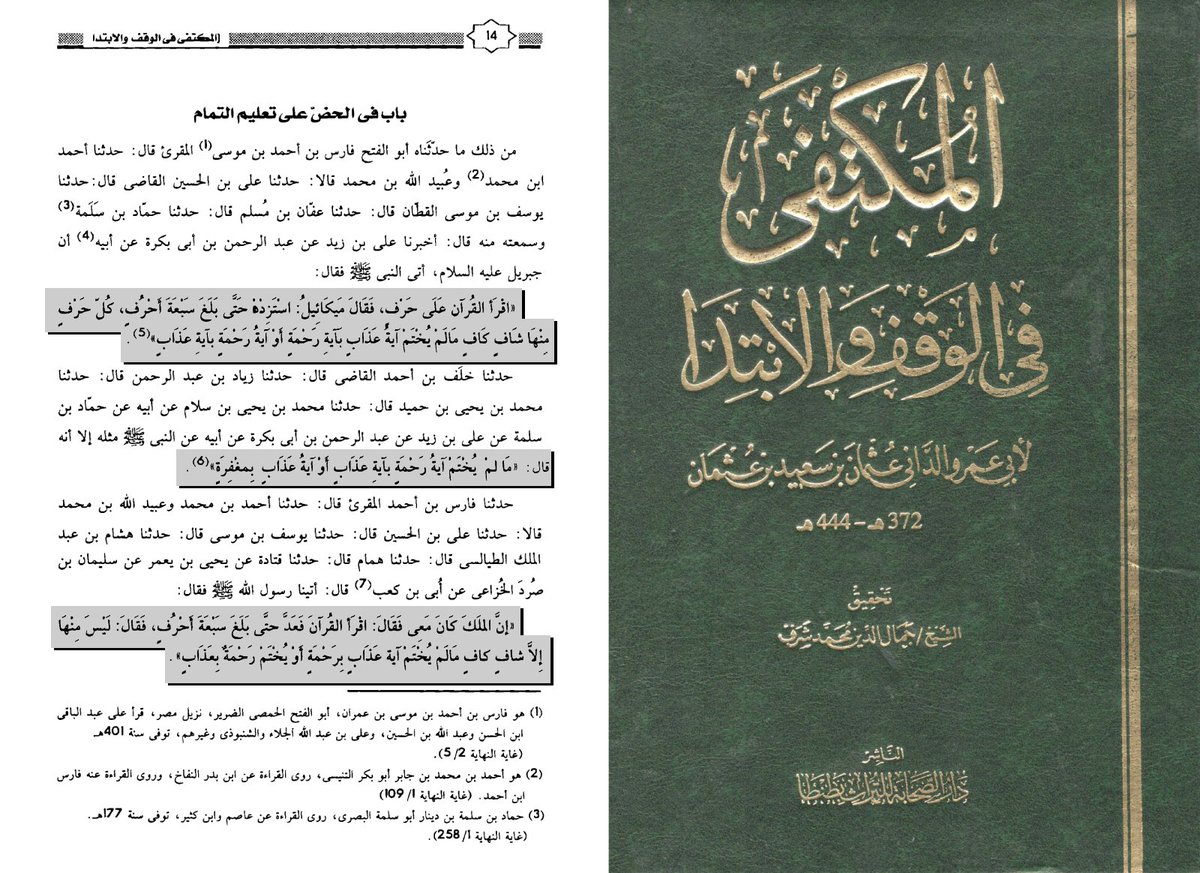
The Andalusian imām of qirāʾāt Abū ʿAmr al-Dānī (d. 444 AH) opens al-Muktafā fī al-Waqf wa’l-Ibtidāʾ with something deeper:
Where you stop — and where you start again — can preserve meaning… or quietly distort it.
This is the science of al-Waqf wa’l-Ibtidāʾ: A pause is not just a breath. A pause is a judgment about what the verse is saying. He does not begin with grammar.
He begins with transmission. Through the reciter Abū al-Fatḥ Fāris b. Aḥmad → ʿAffān b. Muslim → Ḥammād b. Salamah → ʿAlī b. Zayd → ʿAbd al-Raḥmān b. Abī Bakrah → Abū Bakrah رضي الله عنه, he narrates:
Jibrīl came to the Prophet ﷺ and said:
“Recite the Qur’an on one harf.”
Then Mīkāʾīl said:
“Ask for more.”
And this continued until it reached seven aḥruf.
Then Jibrīl said:
“Each one of them is sufficient and complete — so long as you do not end an āyah of punishment with an āyah of mercy, nor an āyah of mercy with an āyah of punishment.”
Meaning: even the separation of verses itself was taught.
The same meaning is narrated again through another route from Ubayy b. Kaʿb رضي الله عنه.
FRAUD ALERT
There is an increase in AI generated content online using my face, voice and name addressing political and sectarian issues that I do not discuss. Beware this is NOT me. I cannot guarantee any content that is not on my verified social media accounts and I cannot be held accountable for such fraud. Please be alert, attentive and report all such content as impersonation!
Tucker Carlson has revealed that during the brief Iran-Israel war earlier this year, Israeli soldiers were barging into U.S. military meetings at the Pentagon, issuing demands, and telling American officers what to do.
He says Pentagon officials stood by in silence and is questioning why no one dared to act.
Islam in the Bible: Jesus (pbuh) reveals that in his second coming, he won't be drinking wine:
Matthew, Chapter 26 (p. 56) Last Supper:
"I tell you I will drink no more wine until I drink it afresh with you in my Father’s kingdom.”
Why would he say this if he will stay on earth for 40 years in his second coming, and in his law, wine was permitted?
Curious, isn't it? Could it be because (as Muslims believe) in his second coming he will be following Prophet Muhammad's law, which bans alcohol? Food for thought...
#Bible #Jesus #Wine #lastsupper #Islam #Muhammad