To the uninitiated, deductible balances can look like denials. To a well-run practice, they are predictable cash-flow events.
A deductible is part of the patient’s benefit design—not a payer failure. The operational response is to verify benefits, estimate responsibility before the visit, communicate clearly, and collect appropriately up front.
When you classify deductibles correctly, you stop wasting time on unnecessary appeals, reduce patient A/R, and give your team a more accurate view of true denial performance.
#TheClaimDenialPlaybook #RevenueCycleManagement #PatientResponsibility #PatientAR #MedicalBilling
One small remittance detail can completely change how you interpret a deductible balance:
The deductible applies to the allowed amount, not the original charge.
If your charge is $250 but the payer’s allowed amount is $150, the patient’s deductible responsibility is calculated from that $150 allowed amount—not from the full $250 charge. The difference is typically a contractual adjustment, not additional patient responsibility.
Train your team to read charges, allowed amounts, adjustments, and PR amounts together. That is how you post accurately, bill patients correctly, and avoid unnecessary confusion or write-offs.
#TheClaimDenialPlaybook #RevenueCycleManagement #MedicalBilling #PatientResponsibility #RCM
The fastest way to improve the patient financial experience is to estimate and collect deductible responsibility before service.
Patients are far less frustrated when they understand their expected cost in advance than when an unexpected balance arrives weeks later. Upfront estimates also reduce patient A/R, lower collection costs, and create more predictable cash flow for the practice.
Start with accurate eligibility and benefit verification. Estimate from the allowed amount—not the billed charge. Then give staff a clear, respectful script for discussing expected responsibility before the visit.
#TheClaimDenialPlaybook #PatientResponsibility #RevenueCycleManagement #PatientExperience #MedicalBilling
Expect PR-1 deductible responsibility to rise as high-deductible health plans become more common.
That is not a denial trend—it is a patient-financial workflow reality. If your practice waits until after adjudication to address those balances, patient A/R grows, cash flow slows, and staff spend more time on follow-up.
Plan ahead: verify benefits, identify remaining deductible, estimate the allowed amount, communicate expected responsibility, and collect appropriately before service. Strong patient-access processes turn predictable deductibles into predictable cash flow.
#TheClaimDenialPlaybook #RevenueCycleManagement #PatientResponsibility #PatientAR #MedicalBilling
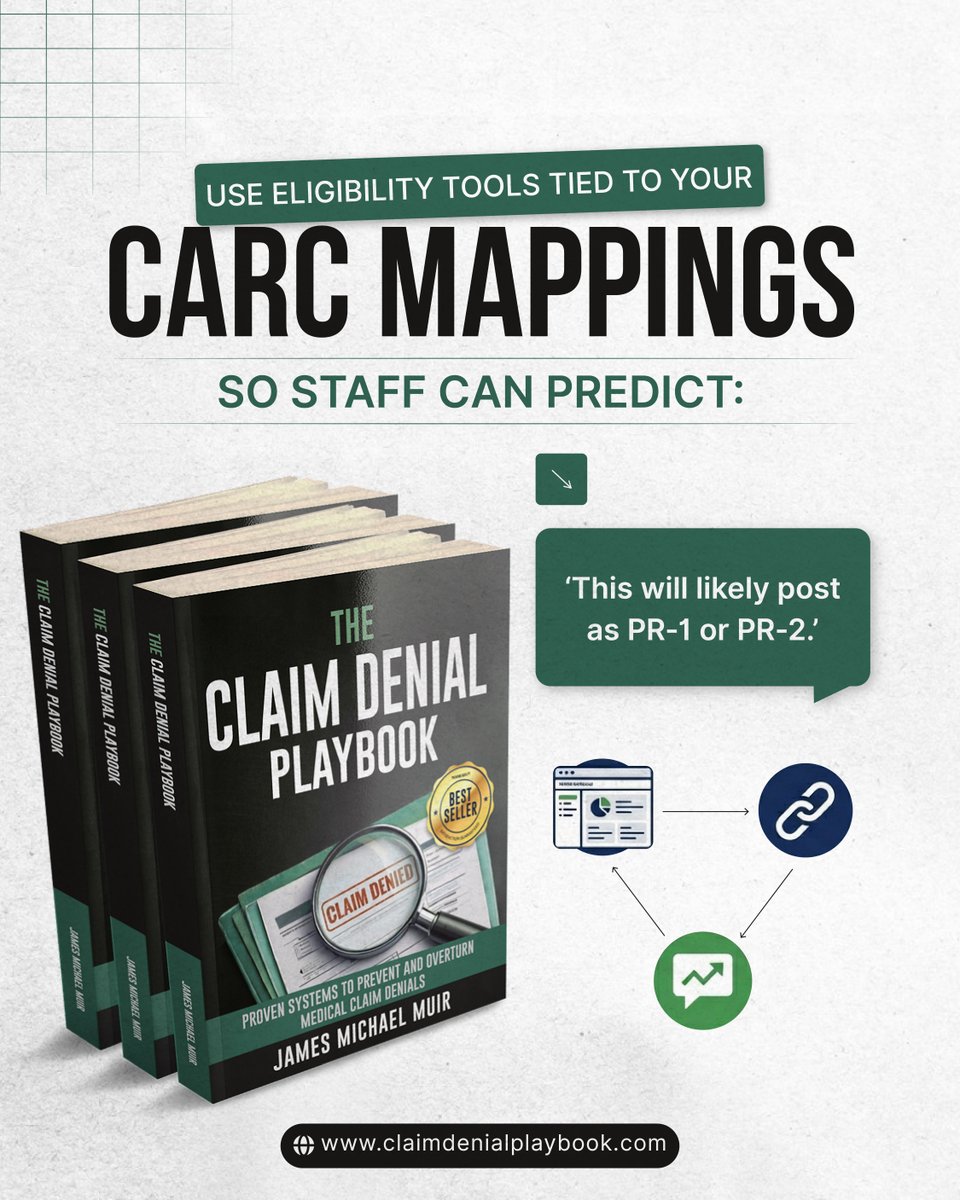
Your eligibility workflow should do more than confirm that coverage is active. It should help staff predict the likely patient responsibility.
When eligibility tools are tied to your CARC mapping and benefit data, staff can see whether a visit is likely to post as a PR-1 deductible or PR-2 coinsurance amount before the claim is submitted.
That gives your team time to estimate accurately, explain the expected balance, and collect appropriately at or before the visit—rather than creating surprise bills and avoidable patient A/R later.
#TheClaimDenialPlaybook #RevenueCycleManagement #EligibilityVerification #PatientResponsibility #MedicalBilling
Standardize how your team talks about deductibles.
When every staff member uses a different explanation, patients hear uncertainty—and uncertainty creates complaints, delayed payments, and avoidable confusion.
Give your team a simple, consistent talk track:
“Based on your plan benefits, this service is expected to apply toward your deductible. Your estimated responsibility today is... Your insurance will process the final claim, and we will adjust the balance if needed.”
Clear language builds confidence. Confident staff create better patient experiences and stronger upfront collections.
#TheClaimDenialPlaybook #PatientResponsibility #PatientCommunication #RevenueCycleManagement #MedicalBilling
Many “denial problems” are actually deductible-workflow problems in disguise.
If benefits are not verified, responsibility is not estimated, and staff are not equipped to collect before service, deductible balances show up later as patient A/R—and get mislabeled as claim denials.
The fix is upstream: confirm eligibility, determine remaining deductible, estimate based on the allowed amount, use a consistent patient conversation, and collect appropriately before the visit.
Better deductible workflows improve the patient experience, reduce collection costs, and keep your team focused on true denials that need prevention or appeal.
#TheClaimDenialPlaybook #PatientResponsibility #RevenueCycleManagement #PatientAR #DenialPrevention
A patient statement should answer the question before the phone rings: “Why do I owe this?”
Instead of a vague balance, clearly label deductible responsibility with plain language such as: “Applied to your annual deductible.”
That one line helps patients understand that the balance came from their health-plan benefits—not from a billing error or an arbitrary charge by the practice. Clear statements reduce confusion, lower call volume, and improve the likelihood of timely payment.
Better patient communication is a revenue cycle strategy.
#TheClaimDenialPlaybook #PatientCommunication #PatientResponsibility #RevenueCycleManagement #MedicalBilling
Leadership needs two clear numbers—not one blended blur.
Track your true payer denial rate separately from patient cost share such as deductibles, copays, and coinsurance. These categories have different causes, different owners, and different solutions.
True denials point to opportunities in eligibility, authorization, coding, documentation, claim quality, and payer policy. Patient cost share points to benefit verification, estimation, upfront collection, and patient communication.
When the metrics are clean, leaders can see where revenue is truly at risk and make better operational decisions.
#TheClaimDenialPlaybook #RevenueCycleManagement #RCMAnalytics #DenialPrevention #PatientResponsibility
Handled correctly, deductible CARCs should never touch your denial worklist.
They belong in a defined patient-responsibility pathway: verify the adjustment, confirm that it aligns with the allowed amount and the patient’s benefit, transfer the balance correctly, communicate it clearly, and follow your established collection process.
This keeps denial specialists focused on recoverable payer issues while patient-access and patient-A/R teams manage deductible balances through the right workflow.
The result: cleaner metrics, faster follow-up, less rework, and a better patient financial experience.
#TheClaimDenialPlaybook #RevenueCycleManagement #PatientResponsibility #PatientAR #MedicalBilling
Payer rules are the hidden operating system of your revenue cycle.
Coverage policies, authorization requirements, medical-necessity criteria, coding edits, documentation standards, filing limits, and network rules determine whether a claim pays—or becomes expensive rework.
Ignore those rules and your team will keep discovering them after the claim is denied. Learn them, translate them into front-end workflows and claim edits, and use denial patterns to identify where the process needs to improve.
That is how you move from reacting to payer behavior to building a revenue cycle that works with it.
#TheClaimDenialPlaybook #RevenueCycleManagement #DenialPrevention #MedicalBilling #HealthcareOperations
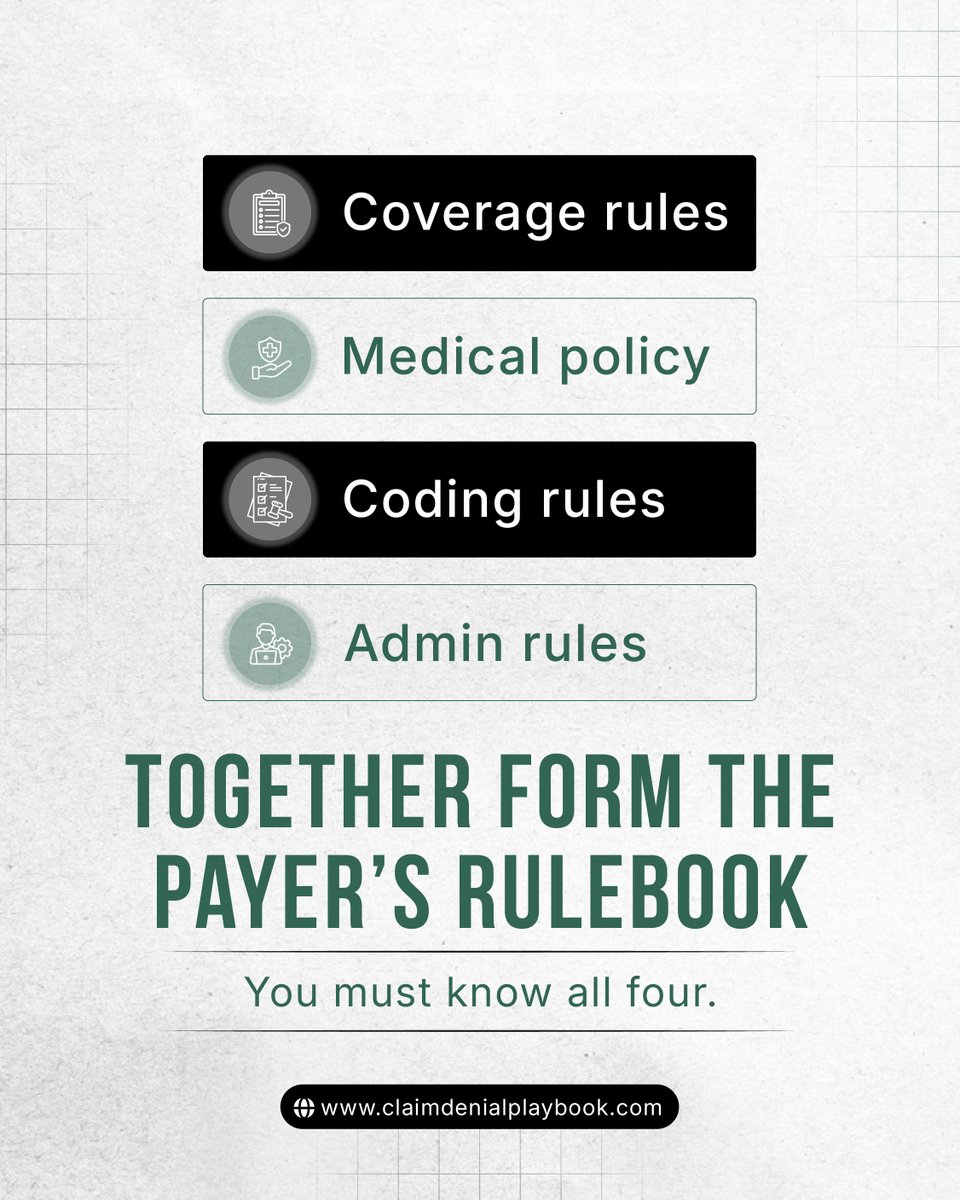
Every payer rulebook has four layers—and your revenue cycle must account for all of them.
Coverage rules: Is the patient eligible, and is the service a covered benefit?
Medical policy: Does the diagnosis, documentation, and clinical scenario meet the payer’s criteria?
Coding rules: Are the CPT, ICD-10, HCPCS, modifiers, and code combinations correct?
Administrative rules: Were authorization, referral, network, enrollment, format, and timely-filing requirements met?
A clean claim requires alignment across all four. Miss just one layer, and the claim can be delayed, denied, or written off.
#TheClaimDenialPlaybook #RevenueCycleManagement #DenialPrevention #MedicalBilling #HealthcareOperations
Even perfect coding can be denied when payer-specific rules are ignored.
The CPT and diagnosis may be correct, but the payer may still require a particular modifier, place of service, prior authorization, referral, or claim-submission convention. “Correct coding” is only one part of a clean claim.
Build payer-specific requirements into your workflow before submission. Use checklists, front-end edits, authorization tracking, and targeted staff training to prevent the avoidable denials that occur when the clinical coding is right—but the payer’s administrative rules are missed.
#TheClaimDenialPlaybook #RevenueCycleManagement #DenialPrevention #MedicalBilling #PriorAuthorization
Payer contracts do more than set reimbursement rates. They quietly define the rules that shape your write-offs, patient-balance practices, appeal rights, filing deadlines, and audit exposure.
If your billing, posting, and denial teams do not understand the contract terms, they may write off balances too early, bill patients incorrectly, miss appeal opportunities, or accept underpayments without question.
Treat contract knowledge as an operational requirement—not a legal document that lives in a folder. Translate the terms into clear workflows, adjustment rules, and staff training.
#TheClaimDenialPlaybook #RevenueCycleManagement #PayerContracts #MedicalBilling #RevenueIntegrity
The cheapest denial is the one your claim never creates.
Maintain payer-specific edit libraries that catch requirements before submission: authorization numbers, required modifiers, place-of-service rules, diagnosis-to-procedure relationships, coverage limits, and payer-specific formatting.
Every pre-submission edit prevents downstream rework—fewer calls, fewer corrections, fewer appeals, and faster cash flow.
Do not let your team learn payer rules one denial at a time. Turn recurring denial patterns into targeted edits, keep them current, and make clean claims the default.
#TheClaimDenialPlaybook #DenialPrevention #RevenueCycleManagement #CleanClaims #MedicalBilling
Payers often have a stated reason for a denial—and an operational reality behind it.
The stated reason may be “missing authorization,” “medical necessity,” “invalid modifier,” or “coverage exclusion.” The real reason may be a process gap: an eligibility step was missed, an authorization workflow broke down, a payer policy changed, or a claim edit was never built.
Strong denial management requires understanding both. Read the remittance code, investigate the actual workflow failure, and use that insight to decide whether to correct, appeal, escalate, or prevent the next occurrence.
Do not stop at the denial code. Find the root cause.
#TheClaimDenialPlaybook #DenialPrevention #RevenueCycleManagement #MedicalBilling #HealthcareOperations
A denial is not always the final answer.
Many denials can be overturned when the practice responds with the right evidence, the right appeal strategy, and the discipline to meet payer deadlines. Yet too many claims are written off simply because the team lacks a clear workflow for deciding what to appeal and how to pursue it.
Build a process that identifies high-value, recoverable denials; gathers the required documentation; assigns ownership; tracks deadlines; and follows escalation paths when the initial appeal fails.
Do not let payer friction decide which revenue you recover.
#TheClaimDenialPlaybook #ClaimAppeals #RevenueCycleManagement #DenialManagement #MedicalBilling
Complex processes, opaque rationales, and automated denials are not random accidents. They are part of the cost-containment environment providers must learn to navigate.
The answer is not to give up or work every denial the same way. It is to prioritize: identify high-value claims, separate correctable issues from appealable disputes, gather the strongest evidence, meet deadlines, and escalate strategically when needed.
A disciplined denial strategy turns confusion into a repeatable recovery process—and gives your organization a clearer view of what needs to be prevented upstream.
#TheClaimDenialPlaybook #DenialManagement #ClaimAppeals #RevenueCycleManagement #MedicalBilling
Denials are one of the payer’s primary tools for enforcing benefit design and controlling costs. Your job is to make sure they are applied correctly—not simply accepted because they appear on an EOB.
That means reading the reason code, checking the claim and documentation, validating the payer policy and contract terms, and distinguishing a legitimate benefit limitation from a preventable error or an incorrect adjudication.
A strong denial-management program protects revenue by challenging denials that do not hold up—and preventing the operational issues that create valid ones.
#TheClaimDenialPlaybook #DenialManagement #RevenueCycleManagement #ClaimAppeals #MedicalBilling
A strong appeal strategy starts with a hard truth: a denial does not become correct simply because it was issued.
Treat every appealable denial as a case to be built. Confirm the facts, identify the payer’s stated reason, compare it with the applicable policy and contract, gather the clinical and administrative evidence, and submit a clear argument before the deadline.
The goal is not to appeal everything. It is to consistently challenge the denials that are wrong, unsupported, or preventable—and to use the results to strengthen your processes.
#TheClaimDenialPlaybook #ClaimAppeals #DenialManagement #RevenueCycleManagement #MedicalBilling